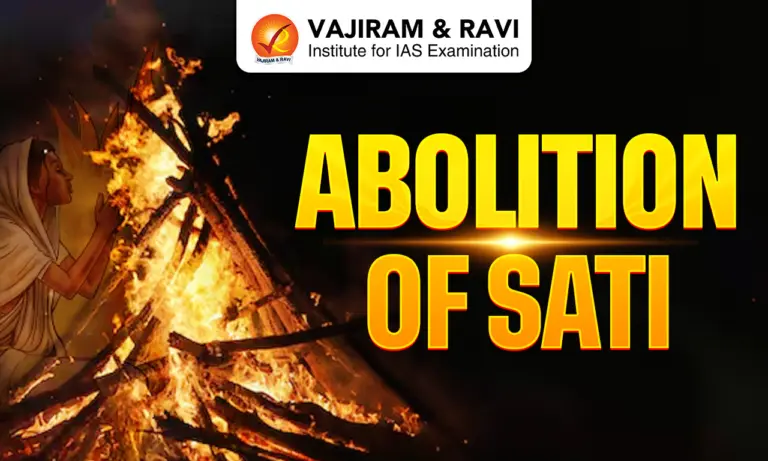
The Abolition of Sati is one of the most important social reforms in Indian history. It ended a cruel and inhuman practice where widows were forced or expected to burn themselves on the funeral pyre of their husbands. This reform not only saved countless women’s lives but also marked the beginning of a new era of social justice, women empowerment, and legal reforms in India.
What is Sati?
Sati was a traditional practice in which a widow sacrificed her life by sitting on her husband’s funeral pyre. Although some believed it was an act of devotion, in reality, many women were forced or pressured into it by family and society.
The term “Sati” is linked to Sati, who is believed to have sacrificed herself for her husband Shiva. Over time, this mythological story was wrongly used to justify the practice in society.
Causes Behind the Practice of Sati
The continuation of Sati in Indian society was not due to religion alone but a combination of social, economic, and cultural reasons.
- Patriarchal society where women had very little independence
- Lack of education and awareness among women
- Misinterpretation of religious texts and traditions
- Social pressure to maintain family honor
- Economic dependency of widows on their families
- Harsh and restrictive life imposed on widows
- Fear of widow remarriage and social stigma





Role of Raja Ram Mohan Roy in Abolishing Sati
Raja Ram Mohan Roy was the most important Indian reformer who led the movement against Sati in the early 19th century. Deeply affected by real incidents of widows being forced into Sati, he used logic, religion, and activism to oppose it. His efforts played a decisive role in influencing public opinion and the British government to finally ban the practice in 1829.
- Personal Experience Motivated Him: Raja Ram Mohan Roy was deeply disturbed after witnessing cases of Sati, including incidents involving people close to him. This inspired him to dedicate his life to abolishing the practice.
- Used Religious Texts as Evidence: He studied Hindu scriptures like the Vedas and Upanishads and proved that Sati was not a compulsory religious duty, countering orthodox beliefs.
- Published Articles and Pamphlets: In 1818, he published writings such as “A Conference Between an Advocate and an Opponent of the Practice of Burning Widows Alive” to expose the truth about Sati.
- Founded Reform Movements: He established organizations like the Brahmo Sabha (1828), which later became the Brahmo Samaj, to promote social reforms and oppose harmful practices like Sati.
- Organized Public Debates: He actively participated in debates with orthodox scholars to challenge their views and spread awareness among the masses.
- Petitions to the British Government: He submitted several petitions urging the British authorities to ban Sati and provided evidence of its inhuman nature.
- Advocated Women’s Rights: He supported widow rights, women’s education, and equality, which strengthened his argument against Sati.
- Influenced Policy Makers: His strong arguments and reform efforts greatly influenced Lord William Bentinck in passing the Bengal Sati Regulation Act in 1829.
- Faced Strong Opposition: Despite resistance from conservative groups, he continued his efforts with courage and determination.
- Legacy in Social Reform: His role in abolishing Sati made him a pioneer of modern Indian social reform and a key figure in promoting human rights and equality.
Role of Lord William Bentinck
Lord William Bentinck played a decisive role in abolishing Sati by taking strong legal action in 1829. As the Governor-General of India, he recognized the practice as inhuman and took bold steps despite opposition from conservative sections of society.
Governor-General during Abolition (1828–1835): He served as Governor-General when the issue of Sati became a major concern, especially in Bengal.
Studied the Practice in Detail: He collected official data and reports which showed that hundreds of Sati cases were occurring every year, particularly in Bengal Presidency.
Consulted Reformers and Officials: He held discussions with Indian reformers like Raja Ram Mohan Roy, as well as British officials and scholars before taking action.
Recognized Sati as a Social Evil: After careful analysis, he concluded that Sati was not a religious necessity but a harmful social practice.
Passed Bengal Sati Regulation Act, 1829: On December 4, 1829, he officially passed the regulation banning Sati in the Bengal Presidency.
Declared Sati a Criminal Offense: The law made participation, support, or encouragement of Sati punishable under criminal law (treated as culpable homicide).
Faced Strong Opposition: Orthodox groups protested against the ban and even challenged it legally, claiming interference in religious matters.
Upheld the Ban Firmly: Despite resistance, he stood firm and ensured the law was implemented strictly.
Extended the Law to Other Regions: The ban was later extended to Madras and Bombay Presidencies, making it applicable across British India.
Abolition of Sati Act, 1829
The Abolition of Sati Act, 1829, also known as the Bengal Sati Regulation, was a landmark law that officially banned the practice of Sati in India. It was enacted by Lord William Bentinck with strong support from reformers like Raja Ram Mohan Roy.
- Declared Sati Illegal: The regulation declared the practice of Sati as illegal and prohibited it in all forms.
- Punishable Offense: Anyone who supported, encouraged, or participated in Sati was considered guilty of a criminal offense.
- Treated as Culpable Homicide: The Act classified Sati-related acts as culpable homicide, meaning offenders could face severe punishment under law.
- Initial Area of Application: It was first लागू (applied) in the Bengal Presidency, where Sati cases were more frequent.
- Extension to Other Regions: Later, the law was extended to Madras and Bombay Presidencies, making it applicable across British India.
- Based on Reform Movements: The Act was influenced by strong social reform movements led by Raja Ram Mohan Roy.
- Opposition and Legal Challenge: Orthodox groups opposed the Act and challenged it in courts, but the ban was upheld.
- Administrative Enforcement: British officials were instructed to prevent Sati and take strict action against violators.
- Historical Significance: The Act is considered one of the earliest and most important social reform laws in India, promoting human rights and women’s dignity.
Impact of the Abolition of Sati
The abolition of Sati in 1829 brought a major transformation in Indian society by ending a cruel and inhuman practice. It not only saved the lives of countless widows but also marked the beginning of social reform and women empowerment in India.
- Protection of Women’s Lives: The most immediate impact was that thousands of widows were saved from being forced into Sati, ensuring their right to live with dignity.
- Improvement in Status of Women: The abolition helped in improving the social position of women, as they were no longer seen as expendable after their husband’s death.
- Beginning of Women Empowerment: It encouraged reforms related to women’s education, widow remarriage, and property rights, laying the foundation for gender equality.
- Reduction in Social Pressure on Widows: Widows were freed from the fear and societal pressure of committing Sati, allowing them to live independently.
- Encouragement to Other Social Reforms: The success of this reform inspired movements against other social evils like child marriage and restrictions on widow remarriage.
- Strengthening of Legal System: It established the role of law in bringing social change and protecting vulnerable sections of society.
- Long-term Social Transformation: Over time, the abolition contributed to a more humane and progressive society based on equality, justice, and human rights.

 Last updated on April, 2026
→ UPSC Final Result 2025 is now out.
→ UPSC has released UPSC Toppers List 2025 with the Civil Services final result on its official website.
→ Anuj Agnihotri secured AIR 1 in the UPSC Civil Services Examination 2025.
→ UPSC Marksheet 2025 is now out.
→ UPSC Notification 2026 & UPSC IFoS Notification 2026 is now out on the official website at upsconline.nic.in.
→ UPSC Calendar 2026 has been released.
→ Check out the latest UPSC Syllabus 2026 here.
→ UPSC Prelims 2026 will be conducted on 24th May, 2026 & UPSC Mains 2026 will be conducted on 21st August 2026.
→ The UPSC Selection Process is of 3 stages-Prelims, Mains and Interview.
→ Prepare effectively with Vajiram & Ravi’s UPSC Prelims Test Series 2026 featuring full-length mock tests, detailed solutions, and performance analysis.
→ Enroll in Vajiram & Ravi’s UPSC Mains Test Series 2026 for structured answer writing practice, expert evaluation, and exam-oriented feedback.
→ Join Vajiram & Ravi’s Best UPSC Mentorship Program for personalized guidance, strategy planning, and one-to-one support from experienced mentors.
→ Shakti Dubey secures AIR 1 in UPSC CSE Exam 2024.
→ Also check Best UPSC Coaching in India
Abolition of Sati FAQs
Q1. What was Sati?+
Q2. Who abolished Sati in India?+
Q3. What law banned Sati?+
Q4. What was the role of social reformers in abolishing Sati?+
Q5. What was the role of social reformers in abolishing Sati?+
Tags: abolition of sati history modern indian history