About African dream herb
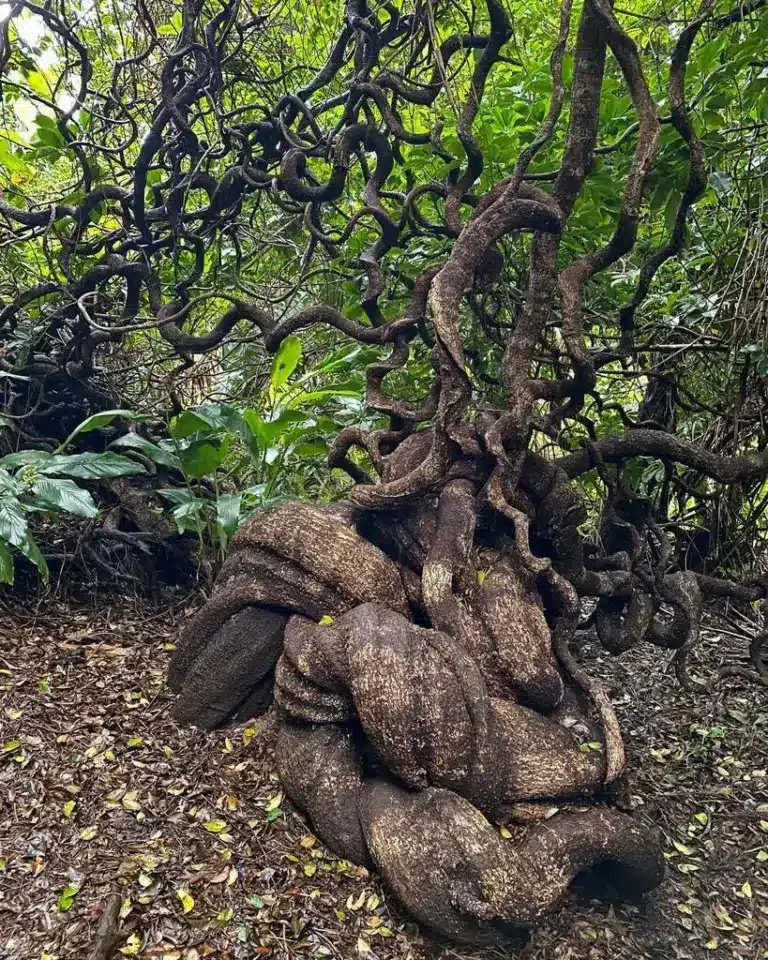
- A perennial climbing vine that is used by African traditional healers to induce vivid dreams that enables them to communicate efficiently with their ancestors.
- Common names: Giant sea bean, African dream herb, snuff box and Entada rheedii
- Distribution and habitat: It is indigenous to Africa, Asia, Australia and Madagascar. It grows in tropical lowlands, along the coastline and river banks, in woodland, thickets and riverine rain forests.
- Uses
- A paste made from the leaves, bark and roots is used to clean wounds, treat burns and heal jaundice in children.
- Tea made from the whole plant is used to improve blood circulation to the brain and heal the after-effects of a stroke.
- The bark is used to treat diarrhoea, dysentery and parasitic infections.
- This creeper yields a dark brown and spherical seed, almost the size of a human patella or kneecap, used to play ‘Hambi Kepathu’. Associated with the origin of the Karbi community.
What is Hambi Kepathu?
- It is also known as Simrit in some parts of Karbi Anglong, is played on three rectangular courts by two teams comprising three members each.
- Each member of a team has to place a ‘hambi’, or the glazed creeper seed, vertically on the midpoint of the boundary line of his court for a player of the rival team to hit with his ‘hambi’.
- Hambi Kepathu, whose name is derived from the first syllables of the names of a Karbi sister-brother duo, is a male-only game like other traditional Karbi games such as ‘Pholong’ (spinning top), ‘Thengtom Langvek’ (torch swimming), and ‘Kengdongdang’ (bamboo stilt race).
Q1) What is Jaundice?
It is a condition produced when excess amounts of bilirubin circulating in the bloodstream dissolve in the subcutaneous fat (the layer of fat just beneath the skin), causing a yellowish appearance of the skin and the whites of the eyes.
Source: In Assam, creeper conservation rides revived Karbi traditional game





 Last updated on March, 2026
→ UPSC Final Result 2025 is now out.
→ UPSC has released UPSC Toppers List 2025 with the Civil Services final result on its official website.
→ Anuj Agnihotri secured AIR 1 in the UPSC Civil Services Examination 2025.
→ UPSC Marksheet 2025 is now out.
→ UPSC Notification 2026 & UPSC IFoS Notification 2026 is now out on the official website at upsconline.nic.in.
→ UPSC Calendar 2026 has been released.
→ Check out the latest UPSC Syllabus 2026 here.
→ UPSC Prelims 2026 will be conducted on 24th May, 2026 & UPSC Mains 2026 will be conducted on 21st August 2026.
→ The UPSC Selection Process is of 3 stages-Prelims, Mains and Interview.
→ Prepare effectively with Vajiram & Ravi’s UPSC Prelims Test Series 2026 featuring full-length mock tests, detailed solutions, and performance analysis.
→ Enroll in Vajiram & Ravi’s UPSC Mains Test Series 2026 for structured answer writing practice, expert evaluation, and exam-oriented feedback.
→ Join Vajiram & Ravi’s Best UPSC Mentorship Program for personalized guidance, strategy planning, and one-to-one support from experienced mentors.
→ Shakti Dubey secures AIR 1 in UPSC CSE Exam 2024.
→ Also check Best UPSC Coaching in India