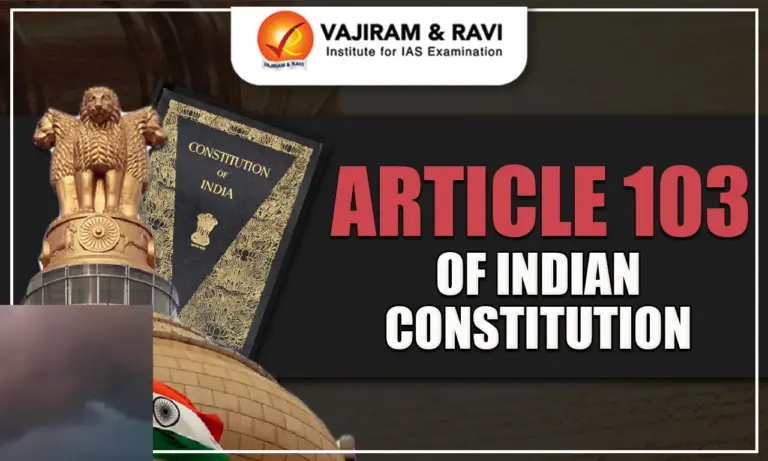
Article 103 of the Constitution of India talks about the questions such as the disqualification of members. The Constitution of India provides the outline of governance of India as well as the structure, power and responsibilities of government bodies. In this article, we are going to cover all about Article 103 of the Indian Constitution.
Article 103 of the Indian Constitution Interpretation
Article 103 of the Constitution states -“1) If any question arises as to whether a member of either House of Parliament has become subject to any of the disqualifications mentioned in clause (1) of Article 102, the question shall be referred for the decision of the President and his decision shall be final. 2) Before giving any decision on any such question, the President shall obtain the opinion of the Election Commission and shall act according to such opinion.”
Article 103 of the Constitution of India talks about the disqualification of a member of Parliament and its reference to the President of India. The article makes it compulsory for the President to ask the opinion of the Election Commission of India and work accordingly before announcing the decision. The decision given by the President is always final. The Election Commission is consulted in order to make the decision impartial and ensures a system of checks and balances.
Article 103 of Indian Constitution Importance
Article 103 deals with the decision on disqualification of Members of Parliament. The article is important due to the following reasons:
- Independent Decision-Making: It gives the President of India the power to decide on disqualification cases only after receiving the opinion of the Election Commission.
- Checks Political Misuse: By involving the Election Commission, Article 103 protects the MPs from politically motivated disqualifications, upholding democratic values.
- Upholds Constitutional Morality: It makes sure that decisions related to disqualification (under Article 102) are managed judiciously and constitutionally, not arbitrarily.
- Protects Legislative Sanctity: By setting up a clear and consultative process, it provides the credibility and stability of legislative institutions.






 Last updated on March, 2026
→ UPSC Final Result 2025 is now out.
→ UPSC has released UPSC Toppers List 2025 with the Civil Services final result on its official website.
→ Anuj Agnihotri secured AIR 1 in the UPSC Civil Services Examination 2025.
→ UPSC Marksheet 2025 is now out.
→ UPSC Notification 2026 & UPSC IFoS Notification 2026 is now out on the official website at upsconline.nic.in.
→ UPSC Calendar 2026 has been released.
→ Check out the latest UPSC Syllabus 2026 here.
→ UPSC Prelims 2026 will be conducted on 24th May, 2026 & UPSC Mains 2026 will be conducted on 21st August 2026.
→ The UPSC Selection Process is of 3 stages-Prelims, Mains and Interview.
→ Prepare effectively with Vajiram & Ravi’s UPSC Prelims Test Series 2026 featuring full-length mock tests, detailed solutions, and performance analysis.
→ Enroll in Vajiram & Ravi’s UPSC Mains Test Series 2026 for structured answer writing practice, expert evaluation, and exam-oriented feedback.
→ Join Vajiram & Ravi’s Best UPSC Mentorship Program for personalized guidance, strategy planning, and one-to-one support from experienced mentors.
→ Shakti Dubey secures AIR 1 in UPSC CSE Exam 2024.
→ Also check Best UPSC Coaching in India
Article 103 of Indian Constitution FAQs
Q1. What is the Article 103 of the Constitution?+
Q2. What is the 103rd Amendment of the Indian Constitution?+
Q3. What is Article 104 of the Constitution of India?+
Q4. What is the importance of Article 103?+
Q5. When can a member of parliament be disqualified?+
Tags: article 103 article 103 of indian constitution indian constitution