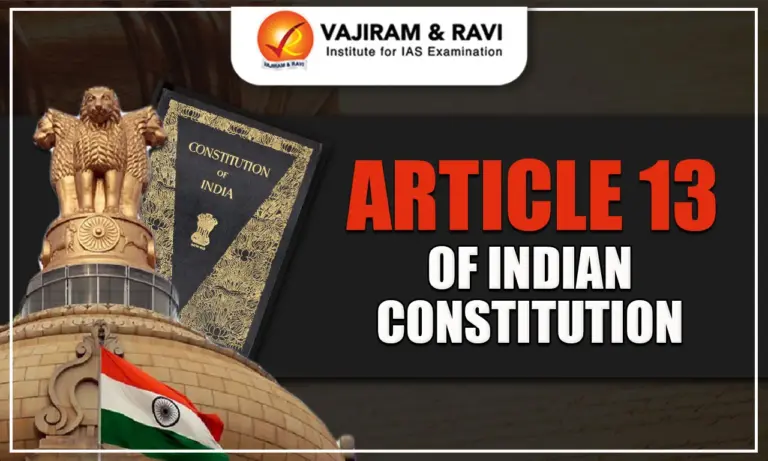
Article 13 comes under Part III of the Constitution of India. The article is a foundational pillar that helps protect the fundamental rights of citizens of India. It says that any existing or future laws that violate these rights should be considered void to the extent of the violation. This article helps establish the supremacy of the Constitution and also makes sure that no authority including the executive and executive can surpass the fundamental rights of individuals. In this article, we are going to cover Article 13 of the Constitution of India, its interpretation and its significance.
Article 13 of the Constitution of India
The Constitution of India has stated the following about Article 13:
Laws inconsistent with or in derogation of the fundamental rights
- All laws in force in the territory of India immediately before the commencement of this Constitution, in so far as they are inconsistent with the provisions of this Part, shall, to the extent of such inconsistency, be void.
- The State shall not make any law which takes away or abridges the rights conferred by this Part, and any law made in contravention of this clause shall, to the extent of the contravention, be void.
- In this article:
- (a) “Law” includes any Ordinance, order, bye-law, rule, regulation, notification, custom, or usage having in the territory of India the force of law;
- (b) “Laws in force” includes laws passed or made by a Legislature or other competent authority in the territory of India before the commencement of this Constitution and not previously repealed, notwithstanding that any such law or any part thereof may not be then in operation either at all or in particular areas.
- Nothing in this article shall apply to any amendment of this Constitution made under Article 368.
Article 13 of Constitution of India Interpretation
Article 13 of Indian Constitution can be interpreted in the following manner
- Article 13(1) says that any laws that are existing even before the Constitution was constituted, and are now in conflict with fundamental rights will now become invalid in case of any conflict.
- Article 13(2) of the Indian Constitution says that the state is not allowed to make laws that violate the fundamental rights of citizens of India. Such laws will be considered to be void in case of violation.
- Article 13(3) of the Indian Constitution particularly defines “Law” in the form of legal instruments and customs.
- Article 13(4) of the Indian Constitution states that the constitutional amendments under Article 368 does not come under the provisions mentioned under Article 13.
Article 13 of the Indian Constitution Important Cases
Article 13 has always been in shaping India’s constitutional framework by ensuring that laws violating fundamental rights are struck down. Key Supreme Court judgments interpreting Article 13 include:
- Kesavananda Bharati v. State of Kerala (1973): Establishing the Basic Structure Doctrine, limiting Parliament’s power to amend core constitutional principles, including fundamental rights.
- I.C. Golaknath v. State of Punjab (1967): Ruled that Parliament cannot amend fundamental rights, treating amendments as “law” under Article 13.
- Minerva Mills Ltd. v. Union of India (1980): Reaffirmed the Basic Structure Doctrine and held limited amending power as a basic feature.
- L. Chandra Kumar v. Union of India (1997): Declared judicial review as a basic feature; tribunals cannot exclude High Court or Supreme Court jurisdiction.





Article 13 of the Indian Constitution Significance
Article 13 of the Constitution of India is important in the following manners:
- Make sure that the fundamental rights of citizens are protected by declaring any law that violates it void.
- Gives the power to the courts to review and nullify any unconstitutional laws.
- Article 13(1) of the constitution can remove any pre-constitutional law that violates the fundamental rights.
- Article 13(2) of the Constitution of India makes sure that the state does not make any laws that violate the constitution in the future.
- Article 13(4) of the Const
- Article 13 ensures all laws, whether past or present, must respect fundamental rights, and when read with Article 12 (defining “State”), it empowers citizens to hold the State accountable.

 Last updated on March, 2026
→ UPSC Final Result 2025 is now out.
→ UPSC has released UPSC Toppers List 2025 with the Civil Services final result on its official website.
→ Anuj Agnihotri secured AIR 1 in the UPSC Civil Services Examination 2025.
→ UPSC Marksheet 2025 is now out.
→ UPSC Notification 2026 & UPSC IFoS Notification 2026 is now out on the official website at upsconline.nic.in.
→ UPSC Calendar 2026 has been released.
→ Check out the latest UPSC Syllabus 2026 here.
→ UPSC Prelims 2026 will be conducted on 24th May, 2026 & UPSC Mains 2026 will be conducted on 21st August 2026.
→ The UPSC Selection Process is of 3 stages-Prelims, Mains and Interview.
→ Prepare effectively with Vajiram & Ravi’s UPSC Prelims Test Series 2026 featuring full-length mock tests, detailed solutions, and performance analysis.
→ Enroll in Vajiram & Ravi’s UPSC Mains Test Series 2026 for structured answer writing practice, expert evaluation, and exam-oriented feedback.
→ Join Vajiram & Ravi’s Best UPSC Mentorship Program for personalized guidance, strategy planning, and one-to-one support from experienced mentors.
→ Shakti Dubey secures AIR 1 in UPSC CSE Exam 2024.
→ Also check Best UPSC Coaching in India
Article 13 of Indian Constitution FAQs
Q1. What did Article 13 say?+
Q2. Is the word minority not defined in the Constitution of India?+
Q3. What is the main object of Article 13?+
Q4. What is the Article 13 summary?+
Q5. What is the Article 13 agreement?+
Tags: article 13 of indian constitution