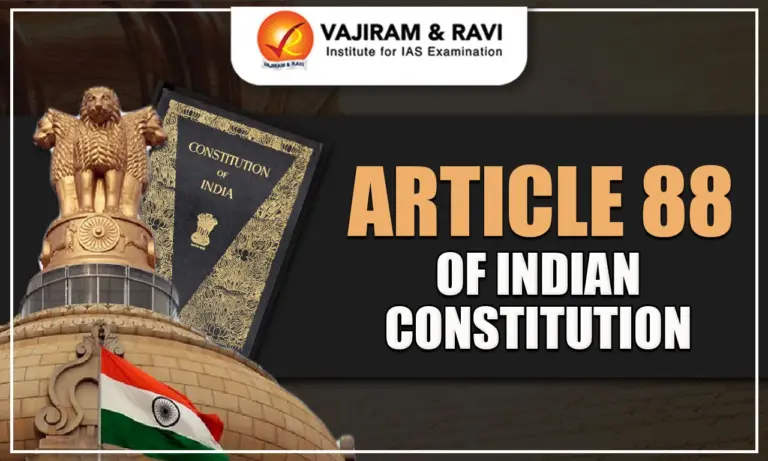
Article 88 of the Constitution of India talks about the rights of Ministers and Attorney-General in their respective houses. The Constitution of India provides the framework and the operations of the Government of India. In this article, we are going to cover all about Article 88 of the Constitution of India.
Article 88 of Constitution of India Interpretation
Article 88 of the Constitution states – “Every Minister and the Attorney-General of India shall have the right to speak in, and otherwise to take part in the proceedings of either House, any joint sitting of the Houses, and any committee of Parliament of which he may be named a member, but shall not by virtue of this article be entitled to vote.”
Article 88 of the Constitution of India talks about all the Ministers and the Attorney General of India and their right to speak and engage in discussion in-
- House of Parliament
- Joint Sittings
- Parliamentary Committees
These rights to speak and discuss in the parliament does not include voting in any of the proceedings. A Minister who is also a member of one house can attend the proceedings of the other house.
Article 88 of the Indian Constitution Significance
Article 88 of the Indian Constitution has the following importance:
- Provides Executive accountability to legislature: Allows participation of ministers and attorney generals in parliamentary debates, government policies and provides clarification on matters.
- Legal as well as Policy Clarity: The Attorney General has the right to speak and offer legal insights in houses, providing constitutionality and legality of proposals.
- Cabinet Responsibility: Ministers who are members of either House can engage with both Lok Sabha and Rajya Sabha proceedings, strengthening the principle of collective responsibility.
- Functioning Committee: The Attorney General is allowed to contribute in the scrutiny of bills, budgets and policies.






 Last updated on March, 2026
→ UPSC Final Result 2025 is now out.
→ UPSC has released UPSC Toppers List 2025 with the Civil Services final result on its official website.
→ Anuj Agnihotri secured AIR 1 in the UPSC Civil Services Examination 2025.
→ UPSC Marksheet 2025 is now out.
→ UPSC Notification 2026 & UPSC IFoS Notification 2026 is now out on the official website at upsconline.nic.in.
→ UPSC Calendar 2026 has been released.
→ Check out the latest UPSC Syllabus 2026 here.
→ UPSC Prelims 2026 will be conducted on 24th May, 2026 & UPSC Mains 2026 will be conducted on 21st August 2026.
→ The UPSC Selection Process is of 3 stages-Prelims, Mains and Interview.
→ Prepare effectively with Vajiram & Ravi’s UPSC Prelims Test Series 2026 featuring full-length mock tests, detailed solutions, and performance analysis.
→ Enroll in Vajiram & Ravi’s UPSC Mains Test Series 2026 for structured answer writing practice, expert evaluation, and exam-oriented feedback.
→ Join Vajiram & Ravi’s Best UPSC Mentorship Program for personalized guidance, strategy planning, and one-to-one support from experienced mentors.
→ Shakti Dubey secures AIR 1 in UPSC CSE Exam 2024.
→ Also check Best UPSC Coaching in India
Article 88 of Indian Constitution FAQs
Q1. What is Article 88 of the Indian Constitution?+
Q2. Article 88 is part of which Indian Schedule?+
Q3. What is the 88th Amendment of the Indian Constitution?+
Q4. What is Article 89 of the Indian Constitution?+
Q5. What is the importance of Article 88 of Indian Constitution?+
Tags: article 88 of indian constitution