Atmospheric Circulation and Air Pressure form the backbone of Earth’s climate system. Powered by solar energy, they govern how heat and moisture move across the planet. High- and low-pressure systems, influenced by Earth’s rotation and the Coriolis effect, give rise to global wind belts, ocean currents, and shifting weather patterns. Together, these processes not only shape regional climates but also sustain ecosystems by maintaining the planet’s energy balance.
Atmospheric Circulation and Air Pressure
Atmospheric Circulation and Air Pressure are core drivers of Earth’s climate system, controlling how air moves across the planet. These processes begin with uneven solar heating, which creates temperature contrasts between the equator and the poles. Warm air rising near the equator forms low-pressure zones, while cooler, denser air sinking at the poles generates high-pressure zones.
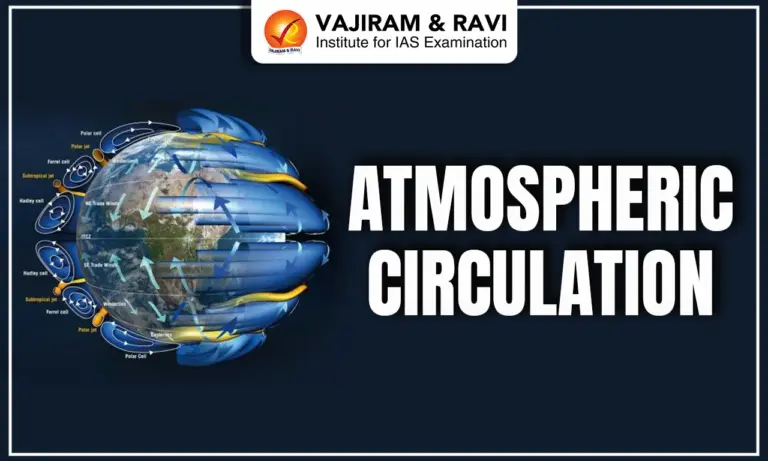
This pressure gradient fuels global wind patterns that shape weather systems and influence ocean currents. In each hemisphere, circulation is organized into three key cells Hadley, Ferrel, and Polar that work together to redistribute heat and maintain climate balance. The Coriolis effect, caused by Earth’s rotation, bends these winds, giving rise to trade winds, westerlies, and polar easterlies.
Fluctuations in Air Pressure also underpin day-to-day weather. High-pressure systems usually bring clear, stable conditions, while low-pressure areas often trigger storms, rainfall, and atmospheric instability.
In essence, Atmospheric Circulation and Air Pressure link the atmosphere, oceans, and ecosystems in a dynamic cycle that sustains Earth’s climate.
Atmospheric Circulation Types
Atmospheric Circulation refers to the large-scale movement of air across the Earth, driven by unequal heating of the planet’s surface by the Sun. This circulation redistributes heat and moisture between the equator and the poles, maintaining the global energy balance. It operates at three levels: global, regional, and local, each playing a key role in shaping weather and climate patterns.
| Atmospheric Circulation Types | |||
|
Level |
Type |
Description |
Key Impact |
|
Global |
Hadley Cell |
Warm air rises at the equator, moves poleward aloft, sinks at ~30° latitude. |
Creates trade winds, deserts in subtropics. |
|
Ferrel Cell |
Transitional zone (30°–60° latitude); surface winds move poleward, upper winds equatorward. |
Produces westerlies, storm systems in mid-latitudes. |
|
|
Polar Cell |
Cold air sinks at poles, moves equatorward, meets westerlies at ~60°. |
Forms polar easterlies, stormy polar fronts. |
|
|
Regional |
Monsoons |
Seasonal reversal of winds due to land-sea heating contrasts. |
Heavy summer rainfall in South Asia, Africa. |
|
Jet Streams |
Narrow, fast-moving winds at tropopause level. |
Influence weather systems, monsoon onset. |
|
|
Local |
Land & Sea Breezes |
Daily reversal of winds between land and sea. |
Regulate coastal weather, moderate temperatures. |
|
Mountain & Valley Breezes |
Daytime upslope winds (valley breeze) and nighttime downslope winds (mountain breeze). |
Affect microclimates in hilly regions. |
|





Air Pressure Types
Air Pressure is the weight of the atmosphere exerted on the Earth’s surface. Variations in air pressure create different weather systems and drive Atmospheric Circulation. Pressure differences arise due to temperature variations, movement of air masses, and the Earth’s rotation. These systems influence local weather patterns as well as global climate.
| Air Pressure Types | ||
|
Type |
Description |
Weather Impact |
|
High Pressure (Anticyclone) |
Descending air compresses and warms, inhibiting cloud formation. |
Clear skies, dry, and stable conditions. |
|
Low Pressure (Cyclone) |
Rising air expands and cools, leading to condensation and cloud formation. |
Cloudy skies, precipitation, and storms. |
|
Dynamic Pressure |
Caused by movement of air masses due to Earth’s rotation and wind systems. |
Influences trade winds, westerlies, and jet streams. |
|
Thermal Pressure |
Created by temperature differences altering air density (warm air rises, cold air sinks). |
Responsible for equatorial low and polar high zones. |
Atmospheric Circulation Significance
Atmospheric Circulation and Air Pressure are central to the functioning of Earth’s climate system. Their role goes beyond day-to-day weather and extends to regulating global climate stability.
- Heat Distribution: They redistribute solar energy from the equator toward the poles, preventing extreme temperature differences and maintaining balance across latitudes.
- Weather Formation: Pressure variations drive the movement of air masses, leading to rainfall, storms, cyclones, and periods of fair weather.
- Ocean Currents: Winds influence major ocean currents, aiding in the transport of heat and nutrients vital for marine life.
- Ecosystem Support: By shaping rainfall and temperature patterns, they sustain agriculture, forests, and biodiversity.
- Global Wind Belts: Systems like trade winds and westerlies are products of circulation, guiding navigation and human activities.
- Climate Regulation: Long-term circulation patterns determine climate zones, ensuring ecological balance on the planet.
Atmospheric Circulation Causes
The movement of air across the globe is driven by a set of interconnected natural factors. Major causes include:
- Uneven Solar Heating: The Earth’s spherical shape leads to unequal heating, maximum at the equator and minimum at the poles creating strong temperature gradients.
- Pressure Differences: Rising warm air forms low-pressure zones, while sinking cool air creates high-pressure zones. These differences initiate air circulation.
- Earth’s Rotation (Coriolis Effect): The rotation of the Earth deflects moving air masses, giving rise to global wind systems such as trade winds, westerlies, and polar easterlies.
- Differential Heating of Land and Water: Land responds faster to heating and cooling than oceans, producing local circulations like land-sea breezes and monsoons.
- Altitude Variations: Air Pressure decreases with height, influencing vertical movements of air and the development of pressure systems.
- Seasonal Changes: The axial tilt of the Earth alters solar heating patterns across seasons, shifting circulation systems and pressure belts.
Factors Affecting Atmospheric Circulation
Several interlinked factors control Atmospheric Circulation and Air Pressure, shaping global climate and regional weather. The major ones are:
- Solar Radiation: Unequal heating between equator and poles creates temperature gradients that set large-scale convection currents in motion.
- Earth’s Rotation (Coriolis Effect): The spinning of Earth deflects moving air, giving rise to trade winds, westerlies, and polar easterlies.
- Pressure Gradients: Air always flows from high-pressure to low-pressure zones, establishing wind systems across scales.
- Altitude: As elevation increases, air pressure decreases, influencing vertical circulation and cloud formation.
- Land-Sea Contrast: Land heats and cools faster than oceans, producing local and regional systems like monsoons, land-sea breezes, and cyclones.
- Topography: Mountains block, channel, or uplift winds, creating rain shadows and distinct microclimates.
- Earth’s Tilt: Seasonal variation in solar energy due to axial tilt shifts global circulation belts like the ITCZ north and south.
- Ocean Currents: Heat exchange between oceans and atmosphere redistributes energy, affecting pressure zones and circulation patterns.
| Also Check Other Posts | |
| Soils of India | Western Disturbances |
| Geomorphology | Coastal States of India |

 Last updated on March, 2026
→ UPSC Final Result 2025 is now out.
→ UPSC has released UPSC Toppers List 2025 with the Civil Services final result on its official website.
→ Anuj Agnihotri secured AIR 1 in the UPSC Civil Services Examination 2025.
→ UPSC Marksheet 2025 is now out.
→ UPSC Notification 2026 & UPSC IFoS Notification 2026 is now out on the official website at upsconline.nic.in.
→ UPSC Calendar 2026 has been released.
→ Check out the latest UPSC Syllabus 2026 here.
→ UPSC Prelims 2026 will be conducted on 24th May, 2026 & UPSC Mains 2026 will be conducted on 21st August 2026.
→ The UPSC Selection Process is of 3 stages-Prelims, Mains and Interview.
→ Prepare effectively with Vajiram & Ravi’s UPSC Prelims Test Series 2026 featuring full-length mock tests, detailed solutions, and performance analysis.
→ Enroll in Vajiram & Ravi’s UPSC Mains Test Series 2026 for structured answer writing practice, expert evaluation, and exam-oriented feedback.
→ Join Vajiram & Ravi’s Best UPSC Mentorship Program for personalized guidance, strategy planning, and one-to-one support from experienced mentors.
→ Shakti Dubey secures AIR 1 in UPSC CSE Exam 2024.
→ Also check Best UPSC Coaching in India
Atmospheric Circulation FAQs
Q1. What is the atmospheric circulation?+
Q2. What is atmospheric circulation (UPSC)?+
Q3. What are the two main causes of atmospheric circulation?+
Q4. What is atmospheric circulation in GCSE?+
Q5. What are the three types of atmospheric circulation called?+
Tags: atmospheric circulation