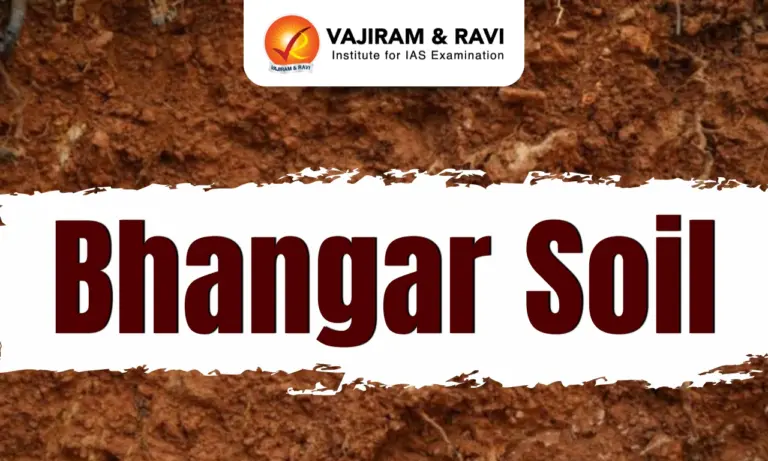
Bhangar Soil is an older alluvial soil found in the higher parts of the Indo-Gangetic Plains, generally around 30 meters above the flood level of rivers. It develops over long periods as rivers shift their courses and deposit sediments. This soil contains calcareous materials and lime nodules. Compared with newer alluvial soils, Bhangar is relatively less fertile but still widely used for cultivation in many parts of North India.
Also Read: Soils of India
Bhangar Soil Features
Bhangar Soil shows distinctive characteristics related to its formation, structure, fertility and agricultural use across the elevated floodplain regions of the northern plains. The key features of the soil are highlighted below:
- Formation: Bhangar Soil forms from older alluvial deposits left by rivers after they change their course over long geological periods in the Indo-Gangetic plains.
- Elevation: This soil occurs on slightly elevated terraces, generally around 30 meters above river flood levels, which prevents annual flooding and fresh sediment deposition.
- Composition: Bhangar mainly consists of clayey and sandy loam materials mixed with calcareous deposits and impure calcium carbonate nodules called kankars.
- Texture: The soil has a comparatively coarse texture with larger particles and rough structure, unlike the finer texture found in newly deposited alluvial soils.
- Distribution: It is widely found in the doab regions of North India, especially across the Gangetic plains located between major river systems.
- Fertility Level: Bhangar Soil is moderately fertile but less productive than newer floodplain soils because it does not receive annual nutrient rich silt deposits.
- Mineral Content: The presence of lime nodules and mineral deposits gives the soil a distinct chemical composition but sometimes reduces natural fertility compared to fresh alluvium.
- Flood Influence: Unlike low lying floodplain soils, Bhangar areas rarely experience river flooding, which prevents yearly soil renewal and influences long term soil productivity.
- Crops: It supports a variety of crops that do not require excessive moisture like- Wheat, Maize, Pulses, etc.






 Last updated on March, 2026
→ UPSC Final Result 2025 is now out.
→ UPSC has released UPSC Toppers List 2025 with the Civil Services final result on its official website.
→ Anuj Agnihotri secured AIR 1 in the UPSC Civil Services Examination 2025.
→ UPSC Marksheet 2025 is now out.
→ UPSC Notification 2026 & UPSC IFoS Notification 2026 is now out on the official website at upsconline.nic.in.
→ UPSC Calendar 2026 has been released.
→ Check out the latest UPSC Syllabus 2026 here.
→ UPSC Prelims 2026 will be conducted on 24th May, 2026 & UPSC Mains 2026 will be conducted on 21st August 2026.
→ The UPSC Selection Process is of 3 stages-Prelims, Mains and Interview.
→ Prepare effectively with Vajiram & Ravi’s UPSC Prelims Test Series 2026 featuring full-length mock tests, detailed solutions, and performance analysis.
→ Enroll in Vajiram & Ravi’s UPSC Mains Test Series 2026 for structured answer writing practice, expert evaluation, and exam-oriented feedback.
→ Join Vajiram & Ravi’s Best UPSC Mentorship Program for personalized guidance, strategy planning, and one-to-one support from experienced mentors.
→ Shakti Dubey secures AIR 1 in UPSC CSE Exam 2024.
→ Also check Best UPSC Coaching in India
Bhangar Soil FAQs
Q1. What is Bhangar Soil? +
Q2. Where is Bhangar Soil mainly found? +
Q3. Why is Bhangar Soil less fertile than Khadar soil? +
Q4. What are kankars in Bhangar Soil? +
Q5. Which crops are grown in Bhangar Soil? +
Tags: bhangar soil geography