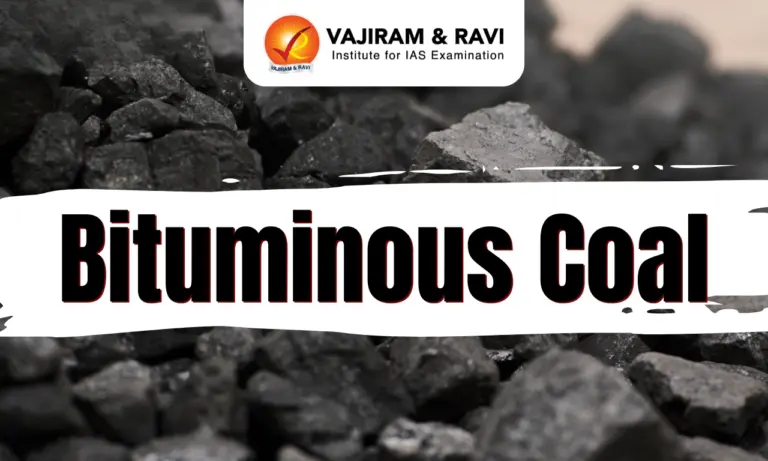
Bituminous Coal is a widely available fossil fuel commonly called Black Coal due to its dark colour and high carbon content. It contains a tar like substance called bitumen. It is formed through geological coalification processes at temperatures above 85° C. It is globally abundant and widely used for electricity generation, steel manufacturing and industrial fuel due to its high calorific value and strong carbon concentration.
Bituminous Coal Features
Bituminous Coal is a dense fossil fuel with high carbon concentration and significant energy potential. The major features of the coal has been listed below:
- Carbon Content: Bituminous Coal generally contains about 40-80% carbon, while detailed chemical composition averages nearly 84.4% carbon, 5.4% hydrogen, 6.7% oxygen, 1.7% nitrogen and 1.8% sulfur by weight.
- Physical Property: This coal type appears dark brown to deep black and is dense yet friable. Coal seams usually show alternating bright and dull bands formed during organic deposition.
- Bitumen: The name “bituminous” originates from bitumen, a sticky tar like substance present in the coal that softens and swells when heated.
- Combustion Behaviour: During burning, it usually produces a smoky flame and softens before forming coke like porous residue due to the bitumen content.
- Geological Formation: It forms when sub-Bituminous Coal is buried deeper underground and exposed to temperatures above 85°C during coalification.
- Industrial Uses: Bituminous Coal is widely used in thermal power plants, steel production through coke manufacture and production of activated carbon.
Also Read: Coal Mines In India
Bituminous Coal in India
Bituminous Coal plays a central role in India’s energy system, industrial development and electricity production infrastructure.
Distribution
Bituminous Coal deposits in India are concentrated mainly in eastern and central regions within major Gondwana coalfields.
- States: Significant reserves occur in Jharkhand, Odisha, Chhattisgarh, West Bengal and Madhya Pradesh, mainly across Damodar Valley (Jharia, Raniganj), Mahanadi Valley (Talcher), Son Valley, etc.
- Largest Reserves: Jharkhand holds the highest coal reserves in India, followed by Odisha, Chhattisgarh, West Bengal and Madhya Pradesh.
Production
- Total coal production in India reached about 730.354 million tonnes in 2018-19, showing nearly 7.9% annual growth.
- Coal accounts for roughly 55% of India’s total energy requirements, making it the most important fossil fuel in the country.
Challenges
- India imports nearly 213 million tonnes of coal annually, mainly high quality coking coal required for steel manufacturing.
- Coal mining expansion frequently encounters land acquisition disputes and rehabilitation challenges.
- Strict environmental regulations increase operating and maintenance coal mines.
- Growing electricity demand after power sector reforms in 2003 created supply shortages in domestic coal production.
Government Initiatives
- Coal Mines Nationalisation Act 1973: This legislation brought most coal mines under government control and established centralised sector management.
- Commercial Mining Reform: Private and foreign companies were allowed to participate in commercial coal mining to increase competition and efficiency.
- Coal Mines Special Provisions Act 2015: This law introduced transparent auction based allocation of coal blocks after earlier allocations were cancelled.
- UTTAM Monitoring App: The Ministry of Coal launched the UTTAM mobile application in 2018 for third party assessment and transparency in coal quality monitoring.






 Last updated on March, 2026
→ UPSC Final Result 2025 is now out.
→ UPSC has released UPSC Toppers List 2025 with the Civil Services final result on its official website.
→ Anuj Agnihotri secured AIR 1 in the UPSC Civil Services Examination 2025.
→ UPSC Marksheet 2025 is now out.
→ UPSC Notification 2026 & UPSC IFoS Notification 2026 is now out on the official website at upsconline.nic.in.
→ UPSC Calendar 2026 has been released.
→ Check out the latest UPSC Syllabus 2026 here.
→ UPSC Prelims 2026 will be conducted on 24th May, 2026 & UPSC Mains 2026 will be conducted on 21st August 2026.
→ The UPSC Selection Process is of 3 stages-Prelims, Mains and Interview.
→ Prepare effectively with Vajiram & Ravi’s UPSC Prelims Test Series 2026 featuring full-length mock tests, detailed solutions, and performance analysis.
→ Enroll in Vajiram & Ravi’s UPSC Mains Test Series 2026 for structured answer writing practice, expert evaluation, and exam-oriented feedback.
→ Join Vajiram & Ravi’s Best UPSC Mentorship Program for personalized guidance, strategy planning, and one-to-one support from experienced mentors.
→ Shakti Dubey secures AIR 1 in UPSC CSE Exam 2024.
→ Also check Best UPSC Coaching in India
Bituminous Coal FAQs
Q1. What is Bituminous Coal? +
Q2. How is Bituminous Coal formed? +
Q3. What are the main uses of Bituminous Coal? +
Q4. Where are major Bituminous Coal deposits found in India? +
Q5. Why is Bituminous Coal mining considered risky? +
Tags: bituminous coal geography