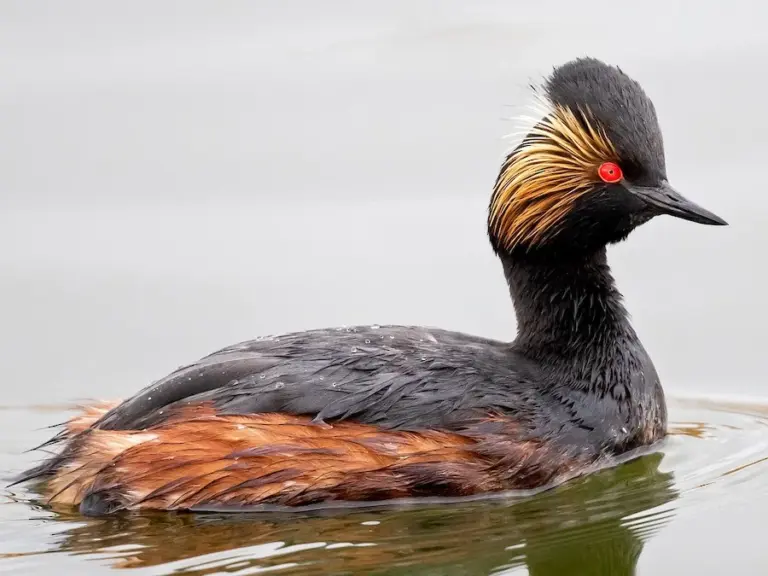
About Black-necked Grebe
- The black-necked grebe, or eared grebe, is a member of the grebe family of water birds.
- Scientific Name: Podiceps nigricollis
- Distribution: It has a widespread breeding area, with migratory populations covering an extensive range of Eurasia and North America, while a resident population is also found in subtropical Africa.
- Features:
- It usually measures between 28 and 34 centimetres in length and weighs 265 to 450 grams.
- It has a wingspan range of 20.5-21.6 in (52-55 cm).
- Its breeding plumage features a distinctive ochre-coloured plumage that extends behind its eye and over its ear coverts.
- The rest of the upper parts, including the head, neck, and breast, are coloured black to blackish brown.
- When in its non-breeding plumage, this bird has greyish-black upper parts.
- The legs are a dark greenish grey. The sexes are similar.
- It uses multiple foraging techniques. Insects, which make up the majority of this bird’s diet, are caught either on the surface of the water or when they are in flight.
- Although it generally avoids flight, the black-necked grebe travels as far as 6,000 kilometres (3,700 mi) during migration.
- Conservation Status:
- IUCN: Least Concern
Key Facts about Hokersar Wetland
- Known as the ‘Queen Wetland of Kashmir’, Hokersar (also known as Hokera) is a designated Ramsar site is located in Srinagar, Jammu and Kashmir.
- It is spread over an area of 13.75 sq. km (1375 ha) in the northwest Himalayan Biogeographic province of Kashmir, in the backyard the snow draped Pir Panjal range with an altitude of 1584 m.
- It is a natural perennial wetland contiguous to the Jhelum basin.
- It gets water from the Doodhganga River (Tributary of Jhelum)
- It is the only site with remaining reed beds of Jammu and Kashmir.
- It is the abode of 68 waterfowl species like Large Egret, Great Crested Grebe, Little Cormorant, Common Shelduck, Tufted Duck and endangered White-eyed Pochard, coming from Siberia, China, Central Asia, and Northern Europe.
Q1) Which is a Ramsar site?
A Ramsar site is a wetland site designated to be of international importance under the Ramsar Convention.Ramsar convention defines wetlands as “areas of marsh, fen, peat land or water, whether natural or artificial, permanent or temporary, with water that is static or flowing, fresh, brackish or salt, including areas of marine water the depth of which at low tide does not exceed six meters.”
Source: Black-necked Grebe sighted at Hokersar wetland for the first time






 Last updated on March, 2026
→ UPSC Final Result 2025 is now out.
→ UPSC has released UPSC Toppers List 2025 with the Civil Services final result on its official website.
→ Anuj Agnihotri secured AIR 1 in the UPSC Civil Services Examination 2025.
→ UPSC Marksheet 2025 is now out.
→ UPSC Notification 2026 & UPSC IFoS Notification 2026 is now out on the official website at upsconline.nic.in.
→ UPSC Calendar 2026 has been released.
→ Check out the latest UPSC Syllabus 2026 here.
→ UPSC Prelims 2026 will be conducted on 24th May, 2026 & UPSC Mains 2026 will be conducted on 21st August 2026.
→ The UPSC Selection Process is of 3 stages-Prelims, Mains and Interview.
→ Prepare effectively with Vajiram & Ravi’s UPSC Prelims Test Series 2026 featuring full-length mock tests, detailed solutions, and performance analysis.
→ Enroll in Vajiram & Ravi’s UPSC Mains Test Series 2026 for structured answer writing practice, expert evaluation, and exam-oriented feedback.
→ Join Vajiram & Ravi’s Best UPSC Mentorship Program for personalized guidance, strategy planning, and one-to-one support from experienced mentors.
→ Shakti Dubey secures AIR 1 in UPSC CSE Exam 2024.
→ Also check Best UPSC Coaching in India