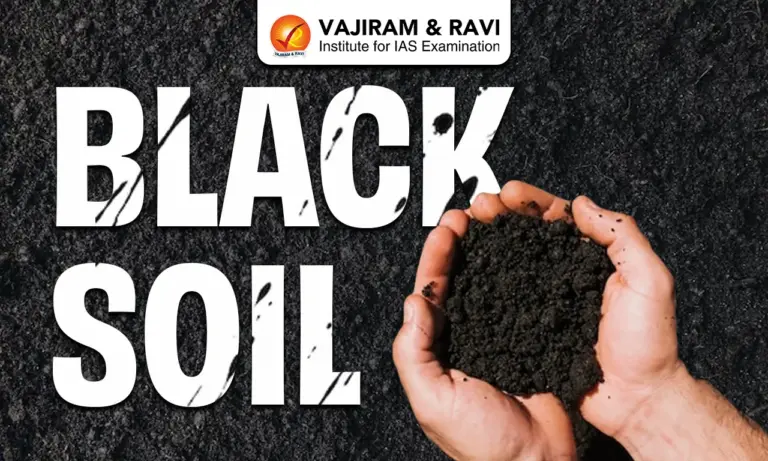
Black soil, also known as Regur soil or Black cotton soil, is one of the most important soil types of India. It is especially suitable for cotton cultivation and is mainly found in the Deccan Plateau region.
Black Soil Origin and Formation
- Black Soil is primarily formed by the weathering of basaltic rocks of the Deccan Trap region which were formed by volcanic eruption during the Cretaceous period.
Black Soil Geographical Distribution
- Black soil is the third most common soil in India. It covers nearly 16–18% of India’s total geographical area.
- Black soil is mainly found over the Deccan Plateau.
- Major states include Maharashtra, Madhya Pradesh, Gujarat, Telangana, Andhra Pradesh, Karnataka, and Tamil Nadu. It is also found in parts of Chhattisgarh and along the Narmada and Tapi river valleys.





Black Soil Characteristics
- Colour: Black Soil is dark black in colour due to the presence of organic matter and iron and aluminium.
- Texture: Black Soil is fine grained and clayey in nature.
- High Water Holding Capacity: Black Soil has a very high water holding capacity, making it suitable for rain-fed agriculture in semi- arid regions. Moisture remains available to crops even during dry spells.
- Self-Ploughing: Due to high clay content, black soil shrinks and develops deep, wide cracks during hot, dry seasons. These cracks allow for significant aeration and natural mixing of soil particles, effectively “ploughing” itself without human intervention.
- Rich in lime (calcium carbonate), iron, magnesium, and alumina.
- Poor in nitrogen, phosphorus, and organic matter.
- Crops: Black soil is famous for cotton farming, but it is also suitable for soybean, groundnut, sunflower, jowar, maize, pulses, sugarcane, pulses, and some fruits. It supports both Kharif and Rabi crops due to moisture retention capacity.
UPSC CSE Previous Year Question (2021)
Q: The black cotton soil of India has been formed due to the weathering of
- Brown forest soil
- Fissure volcanic rock
- Granite and schist
- Shale and limestone
Ans: 2

 Last updated on April, 2026
→ UPSC Final Result 2025 is now out.
→ UPSC has released UPSC Toppers List 2025 with the Civil Services final result on its official website.
→ Anuj Agnihotri secured AIR 1 in the UPSC Civil Services Examination 2025.
→ UPSC Marksheet 2025 is now out.
→ UPSC Notification 2026 & UPSC IFoS Notification 2026 is now out on the official website at upsconline.nic.in.
→ UPSC Calendar 2026 has been released.
→ Check out the latest UPSC Syllabus 2026 here.
→ UPSC Prelims 2026 will be conducted on 24th May, 2026 & UPSC Mains 2026 will be conducted on 21st August 2026.
→ The UPSC Selection Process is of 3 stages-Prelims, Mains and Interview.
→ Prepare effectively with Vajiram & Ravi’s UPSC Prelims Test Series 2026 featuring full-length mock tests, detailed solutions, and performance analysis.
→ Enroll in Vajiram & Ravi’s UPSC Mains Test Series 2026 for structured answer writing practice, expert evaluation, and exam-oriented feedback.
→ Join Vajiram & Ravi’s Best UPSC Mentorship Program for personalized guidance, strategy planning, and one-to-one support from experienced mentors.
→ Shakti Dubey secures AIR 1 in UPSC CSE Exam 2024.
→ Also check Best UPSC Coaching in India
Black Soil FAQs
Q1. What is another name of black soil?+
Q2. From which rock type is black soil formed?+
Q3. In which region of India is black soil mainly found?+
Q4. Which is the most important crop grown in black soil?+
Q5. Which nutrients are abundant and which are deficient in black soil?+
Tags: black soil geography geography notes