C. Rajagopalachari Latest News
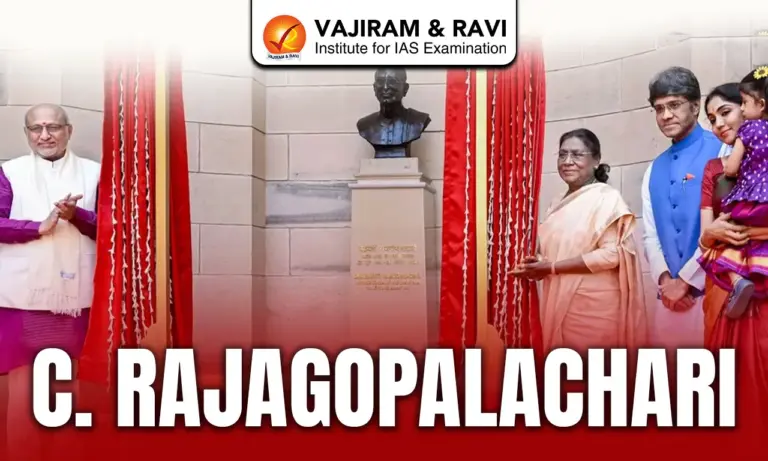
- President Droupadi Murmu unveiled a statue of C. Rajagopalachari (Rajaji) in the central courtyard of Rashtrapati Bhavan, replacing the bust of British architect Edwin Lutyens.
- The decision, announced by PM Modi, highlighted Rajaji’s legacy of public service, self-restraint, and independent thinking.
- The move symbolically honours Rajaji’s enduring political and moral influence, recognising him not merely as a statesman but as a leader who viewed power as a responsibility rather than a privilege.
C. Rajagopalachari’s Early Role in the Freedom Movement
- C. Rajagopalachari (Rajaji), born in December 1878 in Thorapalli, Tamil Nadu, grew up in a Tamil-speaking Brahmin family.
- Entry into National Politics – Rajaji attended the 1906 Calcutta and 1907 Surat sessions of the Indian National Congress, marking his early engagement with the national movement.
- Rise in Local Leadership – In 1911, he was elected to the Salem Municipal Council. By 1916, he had joined Annie Besant’s Home Rule League and established its Salem unit. In 1917, he became Chairman of the Salem Municipal Council, reflecting his growing political prominence.
- Move to Madras and Meeting with Gandhi – In 1919, Rajaji shifted to Madras to expand his public role. There, he met Mahatma Gandhi during his visit, a turning point that would deepen Rajaji’s involvement in the Independence movement.





C. Rajagopalachari: Freedom Struggle and the Rajaji Formula
- Rowlatt and Non-Cooperation Movements (1919–20) – Rajaji was an early supporter of the Rowlatt Satyagraha in 1919. He later led the Non-Cooperation Movement in Tamil Nadu, giving up his successful legal practice and advocating boycott of elections, institutions, and official titles.
- Salt Satyagraha in the South (1930) – In April 1930, he led the historic march from Trichy to Vedaranyam as part of the Salt Satyagraha. He was arrested multiple times for defying colonial authorities and distributing satyagraha material.
- Differences During the Quit India Movement (1942) – While a close associate of Mahatma Gandhi, Rajaji differed with him during the Quit India Movement. He doubted that Britain would leave merely in response to slogans and instead advocated a negotiated settlement with the Muslim League.
The Rajaji (CR) Formula
- Rajaji proposed a Congress–Muslim League agreement, later known as the Rajaji Formula, which Gandhi agreed to consider.
- Key Provisions
- The Muslim League would cooperate in forming a provisional government.
- Congress would accept a post-independence plebiscite in Muslim-majority districts of the North-West and East to decide on Pakistan.
- In case of partition, mutual agreements would safeguard defence, commerce, and communications.
- In 1944, Rajaji conveyed Gandhi’s acceptance of the proposal to Muhammad Ali Jinnah.
- However, Jinnah rejected it, arguing that the proposed Pakistan was smaller than demanded and conditional upon a plebiscite and treaty arrangements.
Rajagopalachari on Hindi Policy and Temple Entry Reform
- As Premier of Madras in 1938, Rajaji introduced compulsory Hindi for Classes 6–8, describing it as “chutney on a leaf — to be tasted or left alone.”
- Students would not fail for poor performance. However, the move triggered widespread protests.
- During the anti-Hindi agitations of 1965, Rajaji strongly opposed making Hindi the sole official language.
- He criticised its imposition by majority force, arguing English functioned more effectively as a neutral link language. His objection was to coercion, not to Hindi itself.
Champion of Temple Entry and Social Reform
- Rajaji supported M. C. Rajah’s Bill to remove social disabilities against Dalits, making discrimination in jobs, education, and public access punishable.
- He also backed measures enabling temples to be opened to Dalits by majority approval.
- Though supportive, Rajaji limited the Temple Entry measure initially to the Malabar district, likely to avoid provoking orthodox backlash amid the Hindi controversy.
The Meenakshi Temple Breakthrough (1939)
- When trustees of the Meenakshi Temple in Madurai showed willingness to admit Dalits but feared legal consequences, Rajaji promised protective legislation.
- On July 8, 1939, Dalits entered the temple with official approval.
- Facing legal challenges and demands for ritual purification, Rajaji introduced the Temple Entry Authorisation and Indemnity Bill (1939), protecting officials who permitted temple access.
- Soon, several temples in Tanjore and other regions opened their doors to Dalits.
Reformist Outlook
- Responding to scriptural objections at Srirangam, Rajaji remarked that sacred texts were like an “infinite ocean” from which one could draw either wisdom or prejudice.
- His stance reflected a reformist vision balancing tradition with social justice while navigating political sensitivities.
Rajaji and the Swatantra Party: A Liberal Alternative to Congress
- After serving as Home Minister under Jawaharlal Nehru (1950–51), Rajaji grew increasingly critical of Congress policies by the mid-1950s.
- He feared that the party’s dominance and statist, centralising approach could weaken democratic balance.
- Rajaji argued that democracy required a strong Opposition to act as a corrective “brake” on excessive state control.
- He believed only a conservative—or, as he preferred, constitutional—party could provide a true democratic counterweight to Congress.
Formation of the Swatantra Party (1959)
- In August 1959, Rajaji founded the Swatantra Party (Freedom Party).
- It evolved from earlier platforms like the Forum for Free Enterprise (1956) and the All India Agriculturalists’ Federation (1958).
- The Swatantra Party championed free enterprise but rejected unregulated 19th-century laissez-faire capitalism.
- Rajaji opposed “coercive Soviet-type planning,” advocating regulation and guidance instead of extensive state ownership.
- Despite promoting liberal economic principles, the party faced criticism. Nehru and others portrayed it as representing feudal and elite interests, dismissing it as a party of “Lords, castles and Zamindars.”
Rajaji’s Enduring Significance
- Replacing a colonial-era statue with that of C. Rajagopalachari at Rashtrapati Bhavan aligns with the emphasis on cultural nationalism and reinterpreting colonial legacies.
A Bridge from Colonial to Republican India
- He became Premier under the Government of India Act, 1935.
- He succeeded Lord Mountbatten as Governor-General in 1948 — the only Indian to hold the post.
- He served as Chief Minister of Madras (1952–1954).
- His career reflected India’s transition from colonial rule to sovereign republic.
Intellectual and Cultural Contributions
- Rajaji is also remembered for his accessible retellings of the Ramayana and Mahabharata, which remain widely read.
- Rajaji’s conservative outlook, particularly his critique of Nehruvian socialism, resonates with contemporary political currents, including the BJP’s economic and ideological positioning.
- Respected by both Mahatma Gandhi and Jawaharlal Nehru, Rajaji was awarded the Bharat Ratna in 1954 and accorded a state funeral in 1972.
- His life exemplified “principled flexibility” in politics — balancing conviction with pragmatic adaptation.
Source: IE

 Last updated on April, 2026
→ UPSC Final Result 2025 is now out.
→ UPSC has released UPSC Toppers List 2025 with the Civil Services final result on its official website.
→ Anuj Agnihotri secured AIR 1 in the UPSC Civil Services Examination 2025.
→ UPSC Marksheet 2025 is now out.
→ UPSC Notification 2026 & UPSC IFoS Notification 2026 is now out on the official website at upsconline.nic.in.
→ UPSC Calendar 2026 has been released.
→ Check out the latest UPSC Syllabus 2026 here.
→ UPSC Prelims 2026 will be conducted on 24th May, 2026 & UPSC Mains 2026 will be conducted on 21st August 2026.
→ The UPSC Selection Process is of 3 stages-Prelims, Mains and Interview.
→ Prepare effectively with Vajiram & Ravi’s UPSC Prelims Test Series 2026 featuring full-length mock tests, detailed solutions, and performance analysis.
→ Enroll in Vajiram & Ravi’s UPSC Mains Test Series 2026 for structured answer writing practice, expert evaluation, and exam-oriented feedback.
→ Join Vajiram & Ravi’s Best UPSC Mentorship Program for personalized guidance, strategy planning, and one-to-one support from experienced mentors.
→ Shakti Dubey secures AIR 1 in UPSC CSE Exam 2024.
→ Also check Best UPSC Coaching in India
C. Rajagopalachari FAQs
Q1. Why is C. Rajagopalachari legacy significant today?+
Q2. What was C. Rajagopalachari’s role in temple entry reform?+
Q3. How did C. Rajagopalachari view the Hindi policy?+
Q4. What was the Rajaji Formula?+
Q5. Why did Rajagopalachari found the Swatantra Party?+
Tags: C. Rajagopalachari mains articles upsc current affairs upsc mains current affair