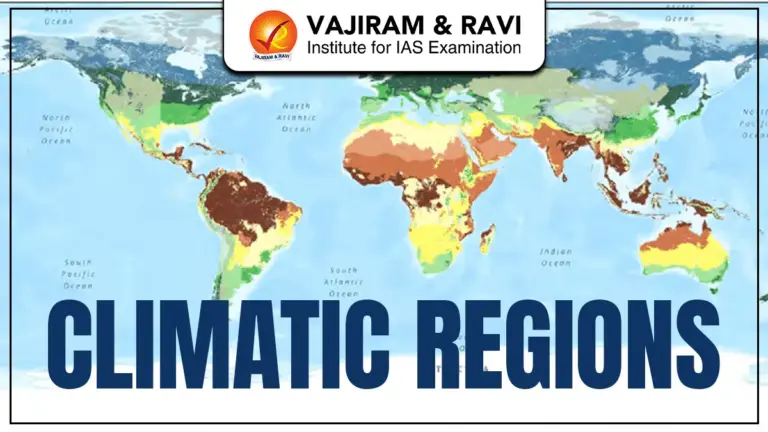
Climate refers to the long term average of weather conditions over a period of at least 30 years, covering temperature, rainfall, wind, humidity and pressure patterns. Climatic regions emerge because solar energy is unevenly distributed across Earth due to latitude, Earth’s curvature, axial tilt, atmospheric circulation, ocean currents and surface characteristics. These strongly influence vegetation, agriculture, settlement patterns, biodiversity and economic activities of the regions.
Climatic Regions
Climatic regions are large areas of the Earth that experience similar long term atmospheric conditions, including temperature range, rainfall pattern, seasonality, and wind systems. Regions near the equator receive direct solar radiation and remain warm throughout the year, while polar regions receive oblique sunlight and remain cold. Elevation, distance from oceans, prevailing winds, vegetation cover, and ocean currents further modify regional climates, creating diverse climatic belts across continents and oceans. Climatic regions also explain why deserts, rainforests, grasslands, and tundra exist in specific belts.
Read about: Climate of India
Climatic Regions Classification
There are three globally accepted methods of classification of Climatic Regions given below:
- Koppen Climatic Classification: Developed by Wladimir Koppen, this system links climate with natural vegetation using mean monthly temperature and precipitation data, dividing the world into five major climatic groups labeled A, B, C, D and E. The classification uses temperature thresholds, seasonal rainfall patterns, and vegetation limits, making it empirical and widely applicable for mapping climatic regions across continents.
- Thornthwaite Climatic Classification: Proposed by C.W. Thornthwaite, it classifies climatic regions based on precipitation effectiveness and evapotranspiration, emphasizing water availability for plant growth. He introduced a moisture index comparing precipitation with potential evapotranspiration, helping identify wet, humid, sub-humid, semi-arid and arid climatic regions.
- Global Climatic Classification: This approach groups climatic regions into equatorial, tropical, temperate, polar and desert climates based on latitude, solar energy receipt, and global atmospheric circulation.





Climatic Regions of the World
Various Climatic Regions of the World with their location, characteristics and economic activities has been discussed here:
- Hot Wet Equatorial Climatic Region: Found between 5° – 10° latitudes, this region has uniform temperatures of 24 – 27°C and heavy rainfall exceeding 150 – 300 cm, supporting dense evergreen rainforests like the Amazon selvas.
- Tropical Monsoon Climatic Region: Located between 5° – 30° latitudes, it experiences high temperatures and seasonal rainfall from monsoon winds, supporting deciduous forests and intensive agriculture in South and Southeast Asia.
- Savanna (Sudan) Climatic Region: A transitional belt between equatorial forests and deserts, it has distinct wet and dry seasons, annual rainfall of 100 – 150 cm, and tall grasses with scattered deciduous trees.
- Hot Desert Climatic Region: Found between 15° – 30° latitudes, deserts like Sahara and Thar experience extreme temperatures, very low rainfall, high diurnal range, and xerophytic vegetation adapted to drought.
- Mediterranean Climatic Region: Located between 30° – 45° latitudes on western continental margins, it has hot dry summers and mild wet winters, supporting orchard farming, vineyards, and evergreen shrubs.
- Temperate Continental (Steppe) Climatic Region: Found in continental interiors, this region experiences temperature extremes, low rainfall, treeless grasslands, and extensive mechanized wheat cultivation.
- Warm Temperate Eastern Margin Climatic Region: Present on eastern continental margins, it has warm humid summers, cool winters, moderate rainfall, and supports crops like maize, cotton, tobacco, and rice.
- Cool Temperate Western Margin Climatic Region: Influenced by westerlies and ocean currents, it has mild temperatures, rainfall throughout the year, deciduous forests, and mixed farming systems.
- Cool Temperate Continental (Siberian) Climatic Region: Found between 50° – 70°N, it experiences long severe winters, short summers, coniferous taiga forests, and supports lumbering and fur trapping.
- Cool Temperate Eastern Margin (Laurentian) Climatic Region: A mix of maritime and continental influences, it has cold snowy winters, warm wet summers, dense forests, and major fishing and timber industries.
- Arctic or Polar Climatic Region: Located beyond Arctic and Antarctic Circles, it has extremely low temperatures, permafrost, tundra vegetation, and limited human activities due to harsh conditions.
Read about: Tropical Climate
Climatic Regions of India
The Climatic Regions of India based on the Koppen Classification Method has been discussed below:
- Tropical Monsoon with Short Dry Winter (Amw): Found along the western coast south of Mumbai, this region receives over 300 cm rainfall and supports dense tropical forests and plantation agriculture.
- Tropical Monsoon with Dry Summer (As): Present along the Coromandel Coast, this region receives winter rainfall of 75 – 100 cm from retreating monsoons, influencing rice cultivation.
- Tropical Savanna Climate (Aw): Covering most of peninsular India, it has seasonal rainfall around 75 cm and supports dry deciduous forests and mixed cropping.
- Semi-Arid Steppe Climate (BShw): Found in rain-shadow regions and parts of Rajasthan, Haryana, and Gujarat, it receives 12 – 25 cm rainfall and supports pastoralism.
- Hot Desert Climate (BWhw): Dominant in western Rajasthan, it receives less than 12 cm rainfall annually and has sparse xerophytic vegetation.
- Monsoon Climate with Dry Winters (Cwg): Covering the Ganga Plains and Assam, this region receives 100 – 200 cm rainfall and is India’s major agricultural belt.
- Cold Humid Climate (Dfc): Found in northeastern Himalayan regions, it experiences heavy rainfall around 200 cm and supports dense mountain forests.
- Tundra Climate (Et): Present in high altitude Himalayan regions, it has average temperatures between 0 – 10°C and limited vegetation.
Polar Climate (E): Found in higher Himalayan areas of Jammu and Kashmir and Himachal Pradesh, precipitation occurs as snow with extremely low temperatures.

 Last updated on March, 2026
→ UPSC Final Result 2025 is now out.
→ UPSC has released UPSC Toppers List 2025 with the Civil Services final result on its official website.
→ Anuj Agnihotri secured AIR 1 in the UPSC Civil Services Examination 2025.
→ UPSC Marksheet 2025 is now out.
→ UPSC Notification 2026 & UPSC IFoS Notification 2026 is now out on the official website at upsconline.nic.in.
→ UPSC Calendar 2026 has been released.
→ Check out the latest UPSC Syllabus 2026 here.
→ UPSC Prelims 2026 will be conducted on 24th May, 2026 & UPSC Mains 2026 will be conducted on 21st August 2026.
→ The UPSC Selection Process is of 3 stages-Prelims, Mains and Interview.
→ Prepare effectively with Vajiram & Ravi’s UPSC Prelims Test Series 2026 featuring full-length mock tests, detailed solutions, and performance analysis.
→ Enroll in Vajiram & Ravi’s UPSC Mains Test Series 2026 for structured answer writing practice, expert evaluation, and exam-oriented feedback.
→ Join Vajiram & Ravi’s Best UPSC Mentorship Program for personalized guidance, strategy planning, and one-to-one support from experienced mentors.
→ Shakti Dubey secures AIR 1 in UPSC CSE Exam 2024.
→ Also check Best UPSC Coaching in India
Climatic Regions FAQs
Q1. What are Climatic Regions?+
Q2. Which factor mainly determines Climatic Regions of the world?+
Q3. Why do Equatorial Regions receive rainfall throughout the year?+
Q4. Which Climatic Region supports grassland vegetation instead of forests?+
Q5. Why is the Mediterranean Climate ideal for orchard farming?+
Tags: climatic regions