Constitution (130th Amendment) Bill, 2025 Latest News
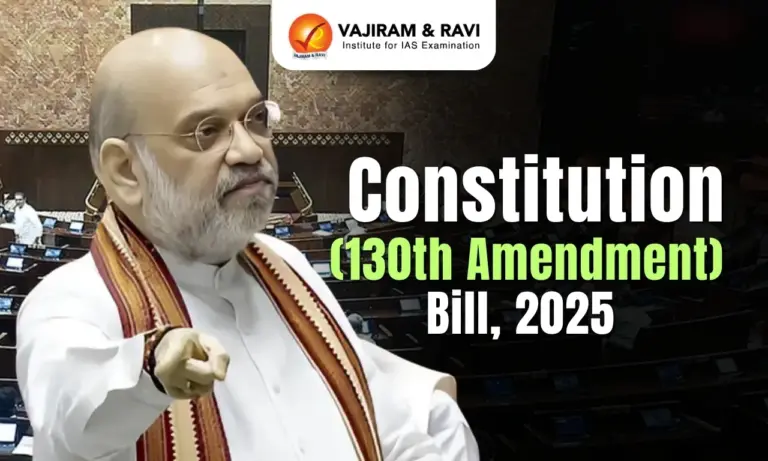
- Union Home Minister Amit Shah is expected to introduce the Constitution (130th Amendment) Bill, 2025 in the Lok Sabha.
- The bill aims to address the gap in the Constitution regarding removal of Ministers (PM, CMs, Union/State Ministers) facing serious criminal allegations and detained for 30 consecutive days.
- The move comes against the backdrop of the controversy that surrounded the arrest in 2023 of V Senthil Balaji, a minister in Tamil Nadu’s DMK government.
Key Provisions of the Constitution (130th Amendment) Bill, 2025
- Constitutional amendments:
- The Bill will amend Articles 75, 164 and 239AA.
- Article 75 of the Constitution primarily deals with the appointment and responsibilities of the Council of Ministers, including the Prime Minister.
- Article 164 of the Constitution outlines the provisions related to the CoMs in a state.
- Article 239AA of the Constitution outlines special provisions for the NCT of Delhi.
- Removal clause: If a Minister (PM/CM/Minister) is arrested and detained for 30 consecutive days on charges punishable with five years or more imprisonment, then:
- President (on advice of PM/directly) removes Union Ministers/PM.
- Governor (on CM’s advice) removes State Ministers.
- Governor (directly) removes Chief Minister of State.
- UT-specific amendments cover CMs/Ministers in UTs and J&K.
- Reappointment: Ministers can be reappointed upon release.





Justification and Rationale Behind the Constitution (130th Amendment) Bill, 2025
- Good governance and constitutional morality: Ministers facing criminal charges undermine public trust and principles of responsible government.
- Character beyond suspicion: Elected representatives must rise above political interests to uphold the welfare of people.
- Constitutional gap: No explicit removal provision existed earlier; courts interpreted “pleasure of Governor/President” but bound by aid and advice doctrine.
Political and Legal Background
- Case reference:
- Arrest of V. Senthil Balaji (DMK Minister, 2023) sparked controversy.
- Governor R.N. Ravi dismissed him → CM M.K. Stalin reinstated after bail → later reshuffle removed Balaji after SC’s concerns.
- Judicial doctrine: Governors’ powers under Article 164 are not absolute, subject to aid and advice of the Council of Ministers.
Related Legislative Measures
- Constitution (130th Amendment) Bill, 2025 – For union and states.
- Government of Union Territories (Amendment) Bill, 2025 – Amends the Government of Union Territories Act, 1963 and covers UTs like Puducherry and Delhi.
- J&K Reorganisation (Amendment) Bill, 2025 – Amends section 54 in the 2019 reorganisation act (the act turned J&K from a state to a UT).
- All bills are likely to be referred to a Joint Committee of Parliament.
Procedural Issues in Parliament
- Rule 19A and 19B of Lok Sabha Rules: Require prior notice and circulation of bills to MPs before introduction.
- Government request: Sought leniency in procedural rules due to time constraints (Monsoon Session ending August 21, 2025).
Constitutional and Administrative Implications
- Strengthens executive accountability: Explicit mechanism for removal of tainted Ministers.
- Centre–State–UT differentiation: Separate but aligned amendments to maintain federal balance.
- Checks criminalisation of politics: Legislative attempt to safeguard public trust in governance.
- Risk of political misuse:
- Analysts criticized the Bill as a tool to destabilize opposition-ruled states.
- Warning of misuse by central agencies to arrest opposition leaders, while ruling party leaders remain untouched.
- There have been recent cases when incumbent CMs — such as Arvind Kejriwal in Delhi and Hemant Soren in Jharkhand — spent several weeks in jail on corruption allegations.
- May cause logjam in the session of Parliament: The government’s likely move comes when the Opposition has been making headlines with “vote theft” allegations, and holding protests against the SIR of the electoral rolls in Bihar.
Conclusion
- In the coming years, if the Constitution (130th Amendment) Bill, 2025 is enacted, India may witness a paradigm shift towards greater constitutional accountability and ethical governance.
- It will ensure that public offices remain free from the shadow of serious criminal allegations.
- However, the true test of these reforms will lie in safeguarding them from political misuse, thereby balancing the ideals of constitutional morality with the principles of natural justice.

 Last updated on March, 2026
→ UPSC Final Result 2025 is now out.
→ UPSC has released UPSC Toppers List 2025 with the Civil Services final result on its official website.
→ Anuj Agnihotri secured AIR 1 in the UPSC Civil Services Examination 2025.
→ UPSC Marksheet 2025 is now out.
→ UPSC Notification 2026 & UPSC IFoS Notification 2026 is now out on the official website at upsconline.nic.in.
→ UPSC Calendar 2026 has been released.
→ Check out the latest UPSC Syllabus 2026 here.
→ UPSC Prelims 2026 will be conducted on 24th May, 2026 & UPSC Mains 2026 will be conducted on 21st August 2026.
→ The UPSC Selection Process is of 3 stages-Prelims, Mains and Interview.
→ Prepare effectively with Vajiram & Ravi’s UPSC Prelims Test Series 2026 featuring full-length mock tests, detailed solutions, and performance analysis.
→ Enroll in Vajiram & Ravi’s UPSC Mains Test Series 2026 for structured answer writing practice, expert evaluation, and exam-oriented feedback.
→ Join Vajiram & Ravi’s Best UPSC Mentorship Program for personalized guidance, strategy planning, and one-to-one support from experienced mentors.
→ Shakti Dubey secures AIR 1 in UPSC CSE Exam 2024.
→ Also check Best UPSC Coaching in India
Constitution (130th Amendment) Bill, 2025 FAQs
Q1. What is the significance of the Constitution (130th Amendment) Bill, 2025?+
Q2. How does the proposed amendment to Articles 75, 164, and 239AA enhance the principles of constitutional morality?+
Q3. What are the federal implications of empowering the Centre to remove Chief Ministers and Ministers of States?+
Q4. What lessons can be drawn from the controversies surrounding the arrests of V. Senthil Balaji, Arvind Kejriwal, and Hemant Soren? +
Q5. What are the procedural and legislative challenges to the Constitution (130th Amendment) Bill, 2025?+
Tags: constitution (130th amendment) bill mains articles upsc current affairs upsc mains current affairs