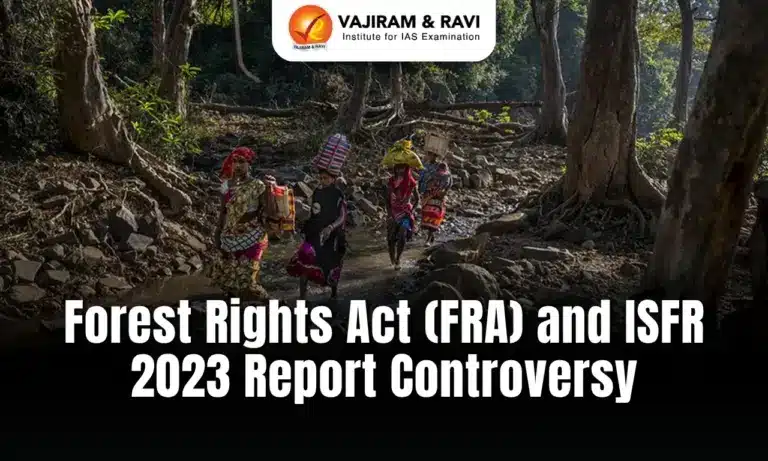
Forest Rights Act (FRA) and ISFR 2023 Report Controversy Latest News
- The India State of Forest Report (ISFR) 2023 attributed the “negative” change in forest and tree cover partly to the implementation of the Forest Rights Act (FRA), 2006.
- This has sparked a strong rebuttal from the Ministry of Tribal Affairs, which has questioned the scientific validity of this claim and expressed concerns about its implications for the implementation of FRA.
Findings of the ISFR 2023
- The 18th biennial assessment of India’s forests, ISFR 2023, by the Forest Survey of India, reveals a major drop in the country’s dense natural forests.
- Within the Recorded Forest Area (RFA), the country lost over 1,200 sq km of Mid-Dense Forest (MDF) and an equal area of Open Forest (OF). However, it has added over 2,400 sq km of Very Dense Forest.
- Outside the recorded forest area, India lost around 64 sq km of Dense Forest and over 416 sq km of Mid-Dense Forest.
- The report attributes the negative changes in forest coverage in RFA and non-RFA areas to –
- Human encroachments,
- Natural calamities like storms, floods and landslides,
- Harvesting of short rotation plantations or other forms of logging, and
- Finally, titles given to beneficiaries under the Forest Rights Act 2006.




The Forest Rights Act (FRA), 2006
- Official title: The Scheduled Tribes and Other Traditional Forest Dwellers (Recognition Of Forest Rights) Act, 2006.
- Objective:
- The act acknowledges and grants forest Dwelling Scheduled Tribes (FDST) and Other Traditional Forest Dwellers (OTFD), who have lived in these forests for generations, the right to occupy and use the forest.
- This is to undo historical injustice that occurred to forest dwelling communities, ensuring their livelihood.
- Eligibility: Rights can be claimed by any member or community that has for at least three generations (75 years) before the 13th day of December 2005 lived in the forest.
- Critical wildlife habitats: It provides that critical wildlife habitats of national parks and sanctuaries must remain inviolate for wildlife conservation.
- Authorities for vesting forest rights:
- Gram sabha: Initiate process for determining nature and extent of individual or community forest rights.
- Sub-divisional level committee: Constituted by state government for examining resolutions passed by gram sabha.
- District level committee: Final approval of forest rights.
Major Points of Contention
- FRA blamed for forest cover loss: This is the first time FRA has been explicitly cited in this context in any ISFR.
- Tribal Affairs Ministry’s rebuttal: The charge was contested by the Ministry, which said that –
- The ISFR 2023 lacks scientific evidence and “ground truthing.”
- Such claims may reinforce administrative bias against FRA implementation.
- FRA acknowledges pre-existing rights of forest dwellers; it does not legalise encroachments.
- It does not introduce new rights that may damage ecological balance.
Reaction from Civil Society and Official Clarifications
- Activist and civil society mobilisation:
- Over 150 organisations wrote to the Union government condemning the claim.
- They criticised the Ministry of Environment, Forest and Climate Change (MoEFCC) for delegitimising FRA through unverified conclusions.
- Environment Ministry’s clarification: ISFR 2023 showed substantial increase in forest cover, indicating community-led conservation. It called civil society’s inferences “devoid of merit.”
Conclusion
- The controversy reflects the delicate balance between environmental conservation and tribal rights.
- The demand for scientific backing before policy implications is crucial to protect the credibility of forest governance mechanisms and the integrity of tribal rights under FRA.
- This debate underlines the importance of evidence-based policymaking and inter-ministerial coordination in managing India’s forests sustainably.
Source: TH

 Last updated on March, 2026
→ UPSC Final Result 2025 is now out.
→ UPSC has released UPSC Toppers List 2025 with the Civil Services final result on its official website.
→ Anuj Agnihotri secured AIR 1 in the UPSC Civil Services Examination 2025.
→ UPSC Marksheet 2025 is now out.
→ UPSC Notification 2026 & UPSC IFoS Notification 2026 is now out on the official website at upsconline.nic.in.
→ UPSC Calendar 2026 has been released.
→ Check out the latest UPSC Syllabus 2026 here.
→ UPSC Prelims 2026 will be conducted on 24th May, 2026 & UPSC Mains 2026 will be conducted on 21st August 2026.
→ The UPSC Selection Process is of 3 stages-Prelims, Mains and Interview.
→ Prepare effectively with Vajiram & Ravi’s UPSC Prelims Test Series 2026 featuring full-length mock tests, detailed solutions, and performance analysis.
→ Enroll in Vajiram & Ravi’s UPSC Mains Test Series 2026 for structured answer writing practice, expert evaluation, and exam-oriented feedback.
→ Join Vajiram & Ravi’s Best UPSC Mentorship Program for personalized guidance, strategy planning, and one-to-one support from experienced mentors.
→ Shakti Dubey secures AIR 1 in UPSC CSE Exam 2024.
→ Also check Best UPSC Coaching in India
Forest Rights Act (FRA) and ISFR 2023 Report Controversy FAQs
Q1. Critically examine the implications of attributing forest cover loss to the implementation of the Forest Rights Act (FRA), 2006.+
Q2. Discuss the role of inter-ministerial coordination in ensuring the balanced implementation of developmental and environmental policies in India.+
Q3. Analyze how narratives around forest degradation can impact the implementation of the Forest Rights Act and the rights of forest-dwelling communities.+
Q4. Evaluate the role of civil society in safeguarding environmental justice and tribal rights in India.+
Q5. Explain the significance of scientific evidence and ground truthing in environmental policymaking, especially in the context of the India State of Forest Report.+
Tags: forest rights act (fra) and isfr 2023 report controversy mains articles upsc current affairs upsc mains current affairs