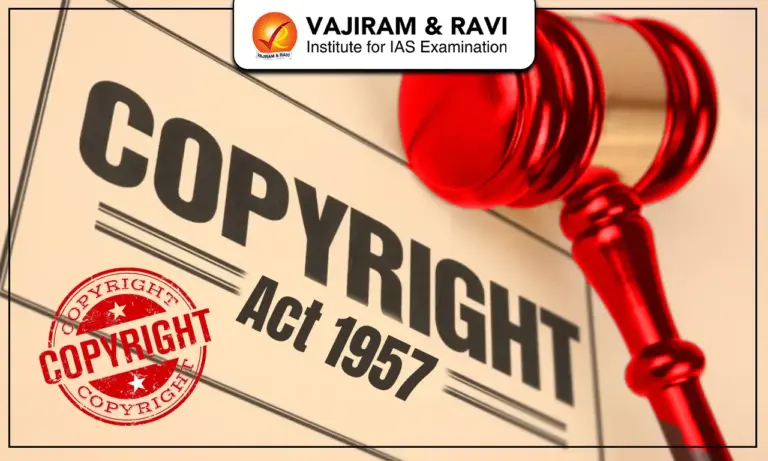
The Copyright Act 1957 is the central law governing copyright protection in India. It came into force on 21 January 1958 and remains the primary legislation defining the rights of authors, creators, and producers of literary, artistic, musical, dramatic, film and sound works. Copyright law in India has evolved from its colonial roots under British rule to a modern legal framework that aligns with major global treaties. The Act has been amended six times, the latest being the Copyright (Amendment) Act 2012, to keep pace with technological changes, digital content, and global standards. Today, copyright helps promote creativity while balancing the interests of authors and public access.
Copyright Act 1957
The Copyright Act 1957 was the first post-independence copyright law in India. It replaced the earlier Indian Copyright Act 1914 and aligned India’s legal system with international standards such as the Berne Convention 1886, Universal Copyright Convention 1951, Rome Convention 1961, and TRIPS Agreement. India later joined the WIPO Copyright Treaty (WCT) and WIPO Performances and Phonograms Treaty (WPPT) in 2013, strengthening digital copyright protection. Under this Act, copyright grants creators exclusive rights to reproduce, adapt, distribute, translate, and communicate their work to the public. The Act also defines ownership, assignment of rights, duration of protection, and exceptions under “fair dealing.”
Also Read: Indian Forest Act 1927
Copyright Act 1957 Provisions
The Copyright Act 1957 contains detailed provisions defining rights of authors, duration, assignments, ownership, remedies, and exceptions protecting creativity and public interest. Key Provisions of the act are:
- Defines copyright as a bundle of rights including reproduction, communication, translation and adaptation.
- Covers literary, musical, dramatic, artistic works, films and sound recordings.
- Author is the first owner, except in employer-employee relationships.
- Allows assignment of copyright only through written agreements under Section 19.
- Assignment without specifying duration lasts five years; territory defaults to India.
- Recognizes joint authorship when contributions cannot be distinguished.
- Provides civil remedies, criminal action, and administrative remedies like customs detention.
- Defines jurisdiction rules based on the place where cause of action arises (2015 Supreme Court ruling).




Copyright Act 1957 Historical Background
The evolution of copyright in India traces back to colonial legislation and later adapted to post-independence needs through the Copyright Act 1957.
- Before 1958, India followed the Indian Copyright Act 1914, based on the British Imperial Copyright Act 1911.
- The 1914 Act governed works created before 21 January 1958.
- Under the 1914 Act, photographs enjoyed 50-year copyright from creation.
- Copyright Act 1957 was India’s first independent copyright law.
- The Act underwent six amendments: 1983, 1984, 1992, 1994, 1999, and 2012.
- 2012 Amendment aligned Indian law with digital era requirements and rights of performers.
- India became party to WCT & WPPT in 2013.
- India is a member of major treaties like Berne, UCC, Rome, and TRIPS.
Also Read: Wetland (Conservation and Management) Rules 2010 & 2017
Copyright Act 1957 Criteria
The Copyright Act 1957 protects a wide range of intellectual and creative works, extending from texts and images to films, recordings and architectural creations. Types of work covered under the act are:
- Literary works: books, articles, software, databases.
- Dramatic works: scripts, choreography, recitation.
- Musical works: compositions excluding lyrics.
- Artistic works: paintings, drawings, sculptures, maps, photographs.
- Cinematograph films: movies, videos, digital films.
- Sound recordings: songs, audiobooks, albums, soundtracks.
- Includes architecture and works of artistic craftsmanship.
- Foreign works protected through International Copyright Order.
- Duration cannot exceed protection in the country of origin.
Copyright Act 1957 Exceptions
The Copyright Act 1957 includes important exceptions to balance creators’ rights with public access, research needs, education, reporting and cultural documentation. Key Exceptions given under the Section 52 Fair Dealing are:
- Fair dealing for private or personal use, including research.
- Use for education, teaching, or instruction.
- Use for criticism or review of a work.
- Reporting current events, including public lectures.
- Use of airport layouts or similar materials for public reporting.
- Freedom of Panorama (Sections 52(s), 52(t), 52(u)):
- Creating paintings, drawings or photographs of architecture permanently situated in public spaces.
- Depicting public sculptures or works of craftsmanship.
- Inclusion of such works in films if incidentally or permanently public.
Copyright Act 1957 Duration of Copyright
The duration of copyright varies under the Copyright Act 1957 depending on the type of work and ensures creators benefit from their creations over extended periods.
- Literary, dramatic, musical, artistic works: lifetime of author + 60 years after year of death.
- Anonymous/ pseudonymous works: 60 years from publication.
- Cinematograph films: 60 years from publication.
- Sound recordings: 60 years from publication.
- Government works: 60 years from publication.
- Public undertakings: 60 years from publication.
- International agencies: 60 years from publication.
- Photographs (post-1957 law): 60 years from publication.
- For foreign works: duration cannot exceed that in country of origin.
Copyright Act 1957 Case Laws
Several landmark cases have shaped the interpretation of the Copyright Act 1957, strengthening understanding of ownership, fair dealing, jurisdiction and moral rights.
- The Daily Calendar Supplying Bureau v. United Concern (1958, 1964): clarified freedom of panorama limits.
- Academy of General Education v. B. Malini Mallya (2009): discussed the scope of fair dealing.
- Civic Chandran v. Ammini Amma: transformative and critical use allowed.
- Delhi University Rameshwari Photocopy Case (2016): photocopying for education allowed under fair dealing (later reopened).
- Pine Labs Pvt. Ltd. v. Gemalto Terminals (2023): assignment without duration lasts five years.
- Najma Heptulla v. Orient Longman: defined joint authorship.
- Indian Performing Rights Society v. Sanjay Dalia (2015): jurisdiction based on place where cause of action arises; prevents harassment through distant filing.

 Last updated on March, 2026
→ UPSC Final Result 2025 is now out.
→ UPSC has released UPSC Toppers List 2025 with the Civil Services final result on its official website.
→ Anuj Agnihotri secured AIR 1 in the UPSC Civil Services Examination 2025.
→ UPSC Marksheet 2025 is now out.
→ UPSC Notification 2026 & UPSC IFoS Notification 2026 is now out on the official website at upsconline.nic.in.
→ UPSC Calendar 2026 has been released.
→ Check out the latest UPSC Syllabus 2026 here.
→ UPSC Prelims 2026 will be conducted on 24th May, 2026 & UPSC Mains 2026 will be conducted on 21st August 2026.
→ The UPSC Selection Process is of 3 stages-Prelims, Mains and Interview.
→ Prepare effectively with Vajiram & Ravi’s UPSC Prelims Test Series 2026 featuring full-length mock tests, detailed solutions, and performance analysis.
→ Enroll in Vajiram & Ravi’s UPSC Mains Test Series 2026 for structured answer writing practice, expert evaluation, and exam-oriented feedback.
→ Join Vajiram & Ravi’s Best UPSC Mentorship Program for personalized guidance, strategy planning, and one-to-one support from experienced mentors.
→ Shakti Dubey secures AIR 1 in UPSC CSE Exam 2024.
→ Also check Best UPSC Coaching in India
Copyright Act 1957 FAQs
Q1. What is the Copyright Act 1957?+
Q2. What types of works are protected under the Copyright Act 1957?+
Q3. What is the duration of copyright under the Copyright Act 1957?+
Q4. What is fair dealing under the Copyright Act 1957?+
Q5. Who is the first owner of copyright according to the Act?+
Tags: copyright act 1957