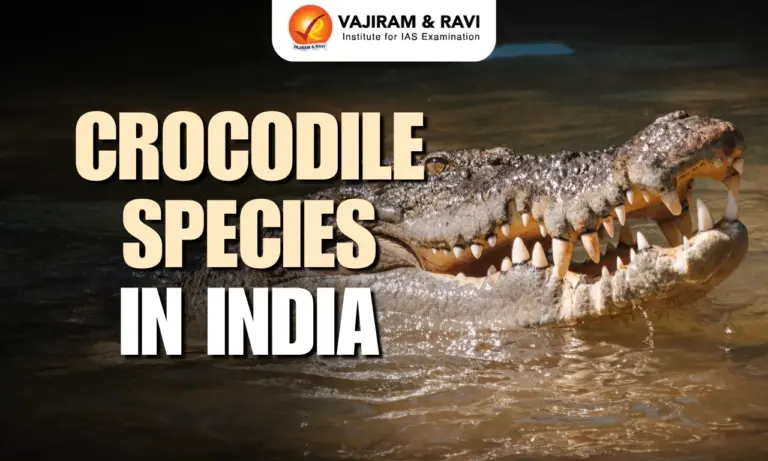
Crocodiles are among the most ancient reptiles on Earth, with evolutionary origins dating back over 200 million years. In India, crocodiles occupy a crucial ecological niche as apex predators in freshwater, estuarine and coastal ecosystems. Their presence indicates healthy aquatic systems, balanced fish populations and stable riverine and mangrove habitats. India is unique globally as it supports three distinct crocodilian species, each adapted to specific ecological conditions. These species reflect India’s rich biodiversity, complex river systems and long coastline, while also highlighting conservation challenges linked to habitat degradation and human-wildlife interaction.
Crocodile Species in India
India is home to three crocodilian species: Mugger or Marsh Crocodile (Crocodylus palustris), Gharial (Gavialis gangeticus) and Saltwater or Estuarine Crocodile (Crocodylus porosus). Odisha’s Kendrapara district is the only region in the country where all three species coexist, especially within and around Bhitarkanika National Park. These species differ significantly in habitat preference, physical structure, feeding behavior and conservation status. All three are protected under Schedule I of the Wildlife Protection Act 1972, reflecting their ecological importance and vulnerability to anthropogenic pressures such as river pollution, sand mining and habitat loss.
Mugger
Mugger crocodiles are adaptable freshwater crocodilians widely distributed across the Indian subcontinent, inhabiting rivers, lakes, reservoirs, marshes and even coastal lagoons.
- Taxonomy and Identity: Mugger crocodile belongs to the family Crocodylidae and is scientifically named Crocodylus palustris, recognised by its broad snout and robust body structure.
- Physical Dimensions: Adult males average 3-4 metres in length, while females usually measure 2.5-3 metres, making them medium sized compared to other crocodilians.
- Habitat Range: Muggers occupy diverse freshwater ecosystems across India, Iran, Pakistan and Sri Lanka, but are extinct in Bhutan and Myanmar.
- Behavioural Traits: They are hole nesting, egg laying reptiles known to dig burrows for shelter during extreme temperatures and dry seasons.
- Dietary Pattern: Mugger crocodiles are opportunistic feeders consuming fish, amphibians, reptiles, birds and small mammals depending on habitat availability.
- Ecological Role: As apex predators, they regulate aquatic food chains and help maintain ecological balance by controlling prey populations.
- Conservation Status: Listed as Vulnerable on the IUCN Red List, included in CITES Appendix I and protected under Schedule I of Indian law.





Gharial
Gharials are specialised riverine crocodilians endemic to the Indian subcontinent and are considered indicators of clean, fast flowing river systems.
- Distinct Morphology: Gharials possess an elongated, narrow snout adapted for fish catching, with mature males developing a bulbous nasal growth called “ghara”.
- Scientific Classification: They belong to the family Gavialidae and are scientifically known as Gavialis gangeticus, distinct from other crocodilians.
- Habitat Preference: Gharials inhabit deep, clear, freshwater rivers with sandy banks, primarily within Himalayan river systems.
- Core Distribution: The Chambal River hosts the largest wild population, with secondary habitats in Girwa, Ghaghara, Gandak, Son and Ramganga rivers.
- Feeding Behaviour: Predominantly piscivorous, gharials play a key role in regulating fish diversity and maintaining riverine ecological balance.
- Population Decline: Their numbers declined by nearly 98 percent since the 1940s due to dam construction, sand mining and river pollution.
- Recovery Efforts: Coordinated conservation has increased populations to over 1,000 individuals, with significant recovery recorded in the Chambal basin.
- Conservation Status: Classified as Critically Endangered by IUCN, included in CITES Appendix I and legally protected under Schedule I.
Salt Water Crocodile
Saltwater crocodiles are the largest living reptiles and the most widely distributed crocodilian species globally.
- Species Identity: Scientifically named Crocodylus porosus, this species belongs to the family Crocodylidae and is adapted to both marine and freshwater environments.
- Size Records: Adult individuals can reach lengths of up to 7 metres, with the largest recorded specimens found along India’s eastern coastline.
- Indian Distribution: Found in Bhitarkanika National Park, Sundarbans mangroves, Mahanadi delta and the Andaman and Nicobar Islands.
- Global Range: Extends across Southeast Asia, northern Australia and parts of the Indian and Pacific Oceans.
- Habitat Adaptability: Occupies estuaries, mangroves, coastal lagoons and lower stretches of rivers influenced by tidal movements.
- Behavioural Characteristics: Known for strong territorial instincts, exceptional swimming ability and opportunistic predatory behaviour.
- Threat Factors: Illegal hunting, habitat degradation and human-crocodile conflict due to proximity to coastal settlements.
- Conservation Status: Listed as Least Concern on the IUCN Red List, included in CITES Appendix I and protected under Schedule I in India.
Crocodile Species in India Conservation
India has implemented structured conservation initiatives to protect crocodilian populations and restore degraded habitats.
- Crocodile Conservation Project: Launched in 1975 with UNDP and FAO support, focusing on captive breeding, habitat protection and population monitoring.
- Bhitarkanika Success Model: Saltwater crocodile populations increased from fewer than 100 individuals in the 1970s to over 1000 by the mid 1990s.
- Gharial Recovery Programs: Captive breeding and release initiatives significantly revived gharial populations in Chambal and Girwa rivers.
- Legal Protection: All species are protected under Schedule I of the Wildlife Protection Act, ensuring strict penalties for hunting or trade.
- Community Incentives: Odisha announced financial incentives for reporting and conserving gharials in the Mahanadi river basin.
- Human-Wildlife Management: Relocation, habitat zoning and awareness programmes aim to reduce conflict near riverine and coastal settlements.
Crocodile Species Global Distribution
Globally, crocodiles regulate aquatic ecosystems, recycle nutrients and maintain biodiversity balance. Nearly 50% of crocodilian species worldwide face extinction risks due to habitat loss and climate change. Crocodilians inhabit tropical and subtropical regions as given below:
- Asian Distribution: Includes saltwater crocodiles and Siamese crocodiles across South and Southeast Asia.
- African Species: Nile crocodiles dominate freshwater systems, while West African crocodiles inhabit river basins and wetlands.
- American Region: American, Orinoco and Morelet’s crocodiles occupy river systems across Central and South America.
- Australian Habitat: Northern Australia supports both saltwater and freshwater crocodile species in rivers and estuaries.

 Last updated on March, 2026
→ UPSC Final Result 2025 is now out.
→ UPSC has released UPSC Toppers List 2025 with the Civil Services final result on its official website.
→ Anuj Agnihotri secured AIR 1 in the UPSC Civil Services Examination 2025.
→ UPSC Marksheet 2025 is now out.
→ UPSC Notification 2026 & UPSC IFoS Notification 2026 is now out on the official website at upsconline.nic.in.
→ UPSC Calendar 2026 has been released.
→ Check out the latest UPSC Syllabus 2026 here.
→ UPSC Prelims 2026 will be conducted on 24th May, 2026 & UPSC Mains 2026 will be conducted on 21st August 2026.
→ The UPSC Selection Process is of 3 stages-Prelims, Mains and Interview.
→ Prepare effectively with Vajiram & Ravi’s UPSC Prelims Test Series 2026 featuring full-length mock tests, detailed solutions, and performance analysis.
→ Enroll in Vajiram & Ravi’s UPSC Mains Test Series 2026 for structured answer writing practice, expert evaluation, and exam-oriented feedback.
→ Join Vajiram & Ravi’s Best UPSC Mentorship Program for personalized guidance, strategy planning, and one-to-one support from experienced mentors.
→ Shakti Dubey secures AIR 1 in UPSC CSE Exam 2024.
→ Also check Best UPSC Coaching in India
Crocodile Species in India FAQs
Q1. How many Crocodile Species are found in India?+
Q2. Which Crocodile Species in India is critically endangered?+
Q3. Which state hosts all three Crocodile Species in India?+
Q4. Which is the largest Crocodile Species found in India?+
Q5. Under which law are Crocodiles protected in India?+
Tags: crocodile species in india