Why in News?
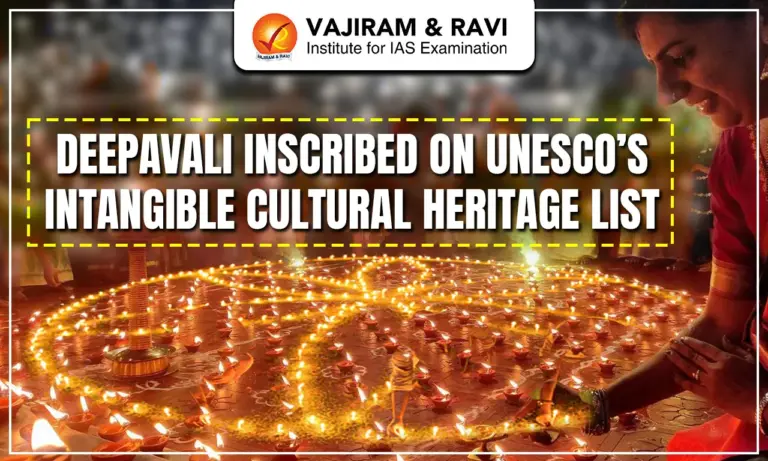
India’s Deepavali has recently been inscribed on UNESCO’s Representative List of the Intangible Cultural Heritage of Humanity.
UNESCO Representative List of Intangible Cultural Heritage of Humanity
The UNESCO Representative List of the Intangible Cultural Heritage of Humanity highlights and preserves living cultural traditions, practices, and expressions that communities value as part of their identity.
- Recognises and safeguards living cultural traditions practised by communities worldwide.
- Aims to promote cultural diversity, identity, and continuity of heritage.
- Encourages international cooperation for preserving intangible cultural heritage.
- Includes festivals, rituals, performing arts, traditional crafts, oral traditions, and community practices.
- Helps raise global awareness about the importance of protecting cultural knowledge and traditions.
- Ensures that these heritage elements are transmitted to future generations sustainably.





India’s Cultural Heritage on UNESCO’s List
16 India’s Cultural Heritage on UNESCO’s List have been tabulated below, along with the year of inscription and description for each cultural heritage.
| India’s Cultural Heritage on UNESCO’s List | |||
| No. | Heritage Element | Year | Description |
|
1 |
Deepawali |
2025 |
Deepawali (Diwali) is a major Hindu festival symbolising the victory of light over darkness and good over evil. It is celebrated with lamps, prayers, sweets, and family gatherings, marking joy, prosperity, and new beginnings. |
|
2 |
Nawrouz |
2024 |
A traditional spring festival celebrating nature, the sun, the universe, renewal, and harmony. Marked by rituals that symbolize rebirth and the arrival of spring across Asia. |
|
3 |
Garba of Gujarat |
2023 |
A ritualistic and devotional dance performed during Navaratri to worship feminine energy (Shakti). Danced in circles, symbolizing creation and cosmic rhythm. |
|
4 |
Durga Puja in Kolkata |
2021 |
An annual festival celebrating Goddess Durga, marked by elaborate artistic pandals, rituals, cultural performances, and mass community participation. |
|
5 |
Kumbh Mela |
2017 |
One of the largest peaceful gatherings in the world, where devotees take a holy dip in sacred rivers believing it cleanses sin and leads to spiritual merit. |
|
6 |
Yoga |
2016 |
An ancient Indian philosophy and physical–spiritual discipline influencing health, meditation, education, and holistic well-being in society. |
|
7 |
Traditional brass & copper utensil-making of the Thatheras of Jandiala Guru |
2014 |
A traditional craft involving hand-making brass and copper utensils using age-old techniques, metallurgy skills, and community-based craftsmanship. |
|
8 |
Sankirtana of Manipur |
2013 |
Ritual singing, drumming, and dancing performed during religious ceremonies and life-cycle events of the Vaishnava community of Manipur. |
|
9 |
Buddhist Chanting of Ladakh |
2012 |
Recitation of sacred Buddhist texts by lamas, reflecting the teachings, philosophy, and spiritual tradition of the trans-Himalayan Ladakh region. |
|
10 |
Kalbelia Folk Songs & Dances of Rajasthan |
2010 |
Traditional songs and dances of the Kalbelia community, evoking their history as snake charmers through fluid movements and distinct music. |
|
11 |
Chhau Dance |
2010 |
A dance-drama tradition depicting episodes from epics, folklore, and abstract themes, performed in three distinct regional styles in eastern India. |
|
12 |
Mudiyettu – Ritual Theatre of Kerala |
2010 |
A community-based ritual theatre depicting the mythological battle between Goddess Kali and demon Darika, performed by entire villages. |
|
13 |
Ramman Festival of Garhwal |
2009 |
An annual religious festival combining theatre, ritual, and dance to honor the local deity Bhumiyal Devta in Uttarakhand’s Garhwal region. |
|
14 |
Tradition of Vedic Chanting |
2008 |
One of the oldest oral traditions, preserving Sanskrit hymns, philosophical verses, and ritual incantations passed down for over 3,500 years. |
|
15 |
Ramlila – Traditional Performance of the Ramayana |
2008 |
A dramatic folk re-enactment of Lord Rama’s life from the Ramayana, performed with song, narration, dialogue, and community participation. |
|
16 |
Kutiyattam – Sanskrit Theatre |
2008 |
A 2,000-year-old classical theatre form of Kerala, blending Sanskrit drama, elaborate gestures, acting styles, and temple rituals. |
Deepawali (Diwali)
Deepawali, commonly known as Diwali, is one of India’s most important festivals symbolizing the victory of light over darkness and good over evil. Celebrated with lamps (diyas), prayers, family gatherings, sweets, and fireworks, it marks a time of spiritual renewal and cultural unity.
Different Forms of Deepawali in North and South India
1. Deepawali in North India
- Celebrated to mark Lord Rama’s return to Ayodhya after defeating Ravana.
- Homes and streets are decorated with rows of lamps (diyas) to welcome Rama.
- People perform Lakshmi Puja for prosperity and wealth.
- Major rituals include lighting lamps, fireworks, exchanging sweets, and playing traditional games.
- North India celebrates Diwali as a five-day festival including Dhanteras, Naraka Chaturdashi, Diwali, Govardhan Puja, and Bhai Dooj.
2. Deepawali in South India
- Primarily associated with Lord Krishna’s victory over Narakasura, celebrated as Naraka Chaturdashi.
- People wake up early, apply oil baths, and light lamps to symbolize the destruction of evil.
- Celebrations begin a day earlier than in North India.
- Temples hold special rituals, and homes are decorated with kolam (rangoli-style designs).
- Firecrackers are burst early in the morning, and traditional sweets and meals are prepared.

 Last updated on March, 2026
→ UPSC Final Result 2025 is now out.
→ UPSC has released UPSC Toppers List 2025 with the Civil Services final result on its official website.
→ Anuj Agnihotri secured AIR 1 in the UPSC Civil Services Examination 2025.
→ UPSC Marksheet 2025 is now out.
→ UPSC Notification 2026 & UPSC IFoS Notification 2026 is now out on the official website at upsconline.nic.in.
→ UPSC Calendar 2026 has been released.
→ Check out the latest UPSC Syllabus 2026 here.
→ UPSC Prelims 2026 will be conducted on 24th May, 2026 & UPSC Mains 2026 will be conducted on 21st August 2026.
→ The UPSC Selection Process is of 3 stages-Prelims, Mains and Interview.
→ Prepare effectively with Vajiram & Ravi’s UPSC Prelims Test Series 2026 featuring full-length mock tests, detailed solutions, and performance analysis.
→ Enroll in Vajiram & Ravi’s UPSC Mains Test Series 2026 for structured answer writing practice, expert evaluation, and exam-oriented feedback.
→ Join Vajiram & Ravi’s Best UPSC Mentorship Program for personalized guidance, strategy planning, and one-to-one support from experienced mentors.
→ Shakti Dubey secures AIR 1 in UPSC CSE Exam 2024.
→ Also check Best UPSC Coaching in India
Deepavali Inscribed on UNESCO’S Intangible Cultural Heritage list FAQs
Q1. What is Deepavali?+
Q2. When was Deepavali added to UNESCO’s Intangible Cultural Heritage list?+
Q3. Why was Deepavali included in the UNESCO list?+
Q4. What makes Deepavali culturally important?+
Q5. Is Deepavali celebrated the same way across India?+
Tags: deepavali inscribed on unescos intangible cultural heritage list