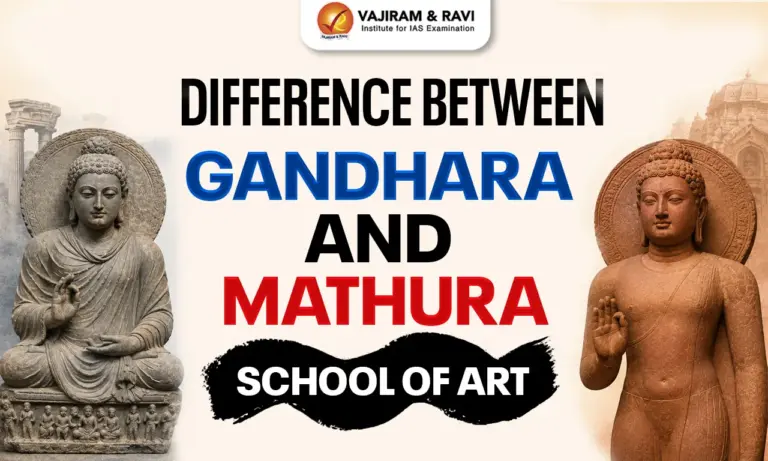
The Difference Between Gandhara and Mathura School of Art is one of the most important topics in Indian Art and Culture. Both schools emerged during the Kushana period and contributed significantly to the development of Indian sculpture and Buddhist iconography. They represent two distinct artistic traditions that flourished simultaneously but differed in terms of style, material, influence, and representation of religious figures.
Difference Between Gandhara and Mathura School of Art
The Difference Between Gandhara and Mathura School of Art lies in their artistic style, cultural influences, materials used, and representation of religious figures, which has been discussed below in the table.
| Difference Between Gandhara and Mathura School of Art | ||
|
Basis of Comparison |
Gandhara School of Art |
Mathura School of Art |
|
Origin |
Gandhara School of Art was developed in the Gandhara region covering present-day Pakistan and eastern Afghanistan. |
Mathura School of Art was developed in Mathura and surrounding regions of present-day Uttar Pradesh. |
|
Time Period |
Flourished from the 1st century BCE to the 5th century CE. |
Flourished from the 1st century BCE to the 6th century CE. |
|
Patronage |
Received patronage mainly from Kushana rulers, especially Kanishka. |
Patronized by Kushana rulers, local merchants, and religious communities. |
|
Artistic Influence |
Strong influence of Greek, Roman, and Persian artistic traditions. |
Purely indigenous Indian artistic tradition with roots in Yaksha cults and local sculpture. |
|
Nature of Art |
Realistic, naturalistic, and human-centered. |
Spiritual, symbolic, and idealized. |
|
Primary Material Used |
Grey schist stone, blue-grey mica schist, and stucco. |
Red spotted sandstone sourced from Sikri near Mathura. |
|
Representation of Buddha |
Buddha depicted as a human figure with realistic features and foreign artistic influence. |
Buddha depicted with Indian facial features and spiritual expressions. |
|
Facial Features of Buddha |
Sharp nose, deep-set eyes, defined jawline, and wavy hair. |
Round face, fuller cheeks, broad chest, and gentle smile. |
|
Hair Style |
Wavy hair arranged in curls resembling Greek sculptures. |
Hair represented in stylized curls or smooth cap-like treatment. |
|
Drapery Style |
Heavy robes with deep folds resembling Roman togas. |
Thin, transparent garments closely fitted to the body. |
|
Body Structure |
Anatomically accurate, muscular, and realistic. |
Strong, robust, and idealized body form. |
|
Expression |
Calm and detached expression emphasizing realism. |
Spiritual, serene, and divine expression emphasizing inner peace. |
|
Themes Depicted |
Mainly Buddhist themes, Jataka stories, and events from Buddha’s life. |
Buddhist, Jain, and Brahmanical (Hindu) themes. |
|
Religious Scope |
Primarily associated with Buddhism. |
|
|
Foreign Influence |
High degree of foreign influence. |
Minimal foreign influence. |
|
Decorative Elements |
Less ornamentation and greater emphasis on realism. |
Rich use of decorative symbols, lotus motifs, and auspicious signs. |
|
Architectural Influence |
Greek columns, Corinthian capitals, and Hellenistic motifs. |
Traditional Indian motifs and indigenous decorative patterns. |
|
Purpose of Art |
To present Buddha and Buddhist stories in a realistic manner. |
To convey spiritual power and divine qualities. |
|
Use of Halo |
Halo is simple and plain. |
Halo is often richly decorated and ornamented. |
|
Sculptural Technique |
Intricate carving with attention to minute details and folds. |
Simpler yet powerful carving with emphasis on symbolic representation. |
|
Depiction of Clothing |
Clothing covers most of the body with visible folds. |
Clothing appears almost transparent and reveals body contours. |
|
Cultural Character |
Represents cultural interaction between India and the West. |
Represents the development of native Indian artistic traditions. |
|
Major Centers |
Taxila, Peshawar, Begram, Bamiyan, and Swat Valley. |
Mathura, Kankali Tila, Sonkh, and surrounding regions. |
|
Important Contribution |
Introduced Greco-Buddhist artistic style and realistic Buddha images. |
Developed indigenous Buddha images and expanded Hindu and Jain iconography. |
|
Legacy |
Influenced Buddhist art in Central Asia, China, Korea, and Japan. |
Influenced Gupta art and later Indian temple sculpture traditions. |
|
Overall Character |
Cosmopolitan, realistic, and externally influenced. |
Indigenous, spiritual, and symbolically rich. |
Famous Examples of Gandhara School of Art
- Fasting Buddha (Sikri, Pakistan) – One of the most celebrated Gandhara sculptures showing Buddha during severe ascetic practices.
- Standing Buddha of Gandhara – Features wavy hair, Roman-style drapery, and realistic anatomy.
- Seated Buddha from Jamal Garhi – Famous for detailed folds of clothing and serene expression.
- Bodhisattva Maitreya Statue – Depicts the future Buddha with Greco-Roman artistic elements.
- Narrative Relief Panels at Taxila – Illustrate scenes from Buddha’s life and Jataka tales.


Famous Examples of Mathura School of Art
- Standing Buddha of Mathura – Made from red sandstone with a smiling and spiritual expression.
- Katra Keshav Dev Buddha Image – One of the earliest Buddha statues from Mathura.
- Jain Tirthankara Statues from Kankali Tila – Important examples of Jain art.
- Kushan Period Vishnu Images – Early representations of Hindu deities.
- Parkham Yaksha Statue – A pre-Kushana sculpture that influenced the Mathura style.
- Seated Bodhisattva Images from Mathura – Known for indigenous features and symbolic representation.

 Last updated on Oct, 2026
→ UPSC 2027 Notification will be released on 13 January 2027 at upsconline.nic.in.
→ Check Nobel Prize 2026 Winners List here.
→ Download PIB PRiSM Monthly Magazine 2026 here.
→ Check UPSC Monthly Current Affairs Magazine The Recitals here.
→ Check out the latest UPSC Syllabus here.
→ Download UPSC Model Answers for Mains 2026
→ UPSC Mains Question Paper 2026 is out now for Essay & GS Paper 1, 2, 3 & 4.
→ UPSC Calendar 2027 has been released.
→ Enroll in Vajiram & Ravi’s UPSC Mains Test Series 2027 for structured answer writing practice, expert evaluation, and exam-oriented feedback.
→ Join Vajiram & Ravi’s UPSC Mentorship Program 2027 for personalized guidance, strategy planning, and one-to-one support from experienced mentors.
→ Go through the UPSC Mains Previous Year Papers to enhance your preparation.
→ UPSC has released UPSC Toppers List 2025 with the Civil Services final result on its official website.
→ Also check Best UPSC Coaching in India
Difference Between Gandhara and Mathura School of Art FAQs
Q1. What is the main difference between Gandhara and Mathura School of Art?+
Q2. During which period did the Gandhara and Mathura schools flourish?+
Q3. Where did the Gandhara School of Art develop?+
Q4. Where did the Mathura School of Art originate?+
Q5. What materials were used in Gandhara and Mathura sculptures?+
Q6. How is Buddha depicted in Gandhara Art?+
Tags: difference between gandhara and mathura school of art history