Sustainable agriculture has become a central pillar of India’s developmental strategy in the 21st century. Excessive dependence on chemical fertilizers and pesticides during the Green Revolution era increased food production but also led to soil degradation, declining groundwater quality, biodiversity loss, and rising input costs for farmers.
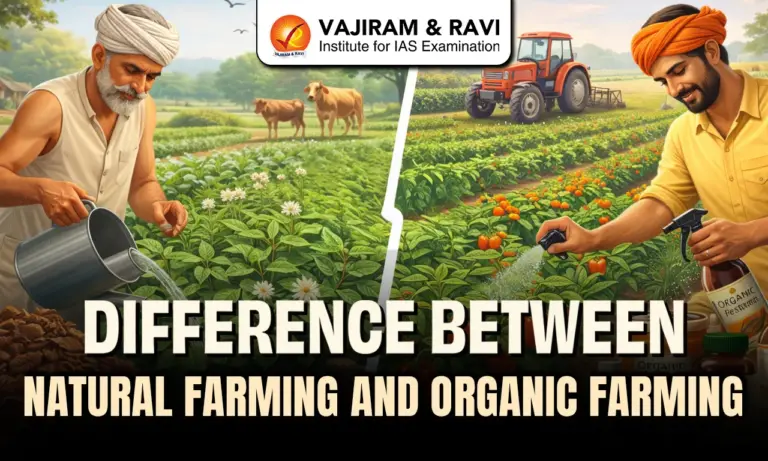
In response, alternative farming systems such as Natural Farming and Organic Farming have gained prominence. Although both seek to promote ecological balance and reduce chemical dependency, there is a difference between Natural Farming and Organic Farming.
Natural Farming
Natural farming means farming with Nature and without chemicals. It is a chemical-free agricultural practice based entirely on natural processes and locally available inputs. It emphasizes that nature is self-sustaining and that soil already contains adequate nutrients to support crops if biological activity is enhanced.
In India, natural farming was popularized by Subhash Palekar, who advocated Zero Budget Natural Farming (ZBNF).
Zero Budget Natural Farming (ZBNF)
The premise of ZBNF is that soil has all the nutrients plants need. To make these nutrients available to plants, we need the intermediation of microorganisms. For this, “four wheels of ZBNF” have been suggested:
- Bijamrit is the microbial coating of seeds with formulations of cow urine and cow dung.
- Jivamrit is the enhancement of soil microbes using an inoculum of cow dung, cow urine, and jaggery.
- Mulching is the covering of soil with crops or crop residues which creates humus and encourages the growth of friendly microorganisms.
- Waaphasa is the building up of soil humus to increase soil aeration
According to ZBNF principles, plants get 98% of their supply of nutrients from the air, water, and sunlight. And the remaining 2% can be fulfilled by good quality soil with plenty of friendly microorganisms. (Just like in forests and natural systems). The system requires cow dung and cow urine obtained from Indian breed cows only. In ZBNF, multi-cropping is encouraged over single crop methods.
Organic Farming
Organic farming is a method of agriculture that avoids synthetic fertilizers, pesticides, genetically modified organisms (GMOs), and chemical growth regulators. It uses organic wastes, biofertilizers, crop rotation, and biological pest control to maintain soil health and ensure sustainable production.
Organic Farming Key Features
- No use of chemical fertilizers or synthetic pesticides.
- Use of organic manure such as compost, farmyard manure, and vermicompost.
- Use of biofertilizers and biological pest control methods.
- Promotion of crop rotation, mixed cropping, and green manuring.
- Focus on soil health, biodiversity, and ecological balance.
- Requires certification to sell produce as organic in the market.
Organic Farming Main Practices
- Crop Rotation: Different crops are grown in sequence to maintain soil nutrients and reduce pests.
- Green Manuring: Growing plants like sunhemp or dhaincha and ploughing them into the soil to improve fertility.
- Composting and Vermicomposting: Using organic waste and earthworms to produce nutrient-rich manure.
- Biological Pest Control: Using natural predators, neem-based products, and biopesticides.
Organic farming follows globally recognized standards and certification systems. In India, it is promoted under the Paramparagat Krishi Vikas Yojana (PKVY) and the National Programme for Organic Production (NPOP).
Organic Farming Advantages
- Improves soil fertility and structure.
- Reduces water and soil pollution.
- Promotes biodiversity.
- Produces chemical-free, healthier food.
- Reduces dependence on expensive chemical inputs.
- Can fetch premium prices in the market.
Challenges of Organic Farming
- Lower yields during the transition period.
- Requires certification, which can be costly.
- Needs more labour and management.
- Limited availability of organic inputs in some regions.
- Market access and price realization can be uncertain.





Differences between Natural Farming and Organic Farming
- In organic farming, farmers apply organic manures such as compost, vermicompost, and farmyard manure, which are often sourced from outside the farm. In natural farming, no external fertilizers either chemical or organic, are added. Instead, nutrient cycling is maintained through microbial activity and decomposition on the soil surface.
- Organic farming involves standard agricultural operations like ploughing, tilling, mixing manures, and weeding. In contrast, Natural Farming minimizes soil disturbance, discouraging deep ploughing and heavy tillage, and promotes practices similar to natural ecosystems.
- Organic farming can be relatively costlier because it requires large quantities of organic inputs and certification. ZBNF (natural farming) is designed as a low-cost or zero-budget system, relying mainly on locally available resources and on-farm preparations.
- Organic farming is usually linked to formal certification and premium markets, while natural farming focuses more on self-reliance and cost reduction rather than certification-driven markets.
Similarities between Natural Farming
- Both systems aim to eliminate the use of chemical fertilizers and synthetic pesticides in agriculture.
- Both encourage farmers to use indigenous seed varieties and locally adapted crops.
- Both promote natural and non-chemical methods of pest management, such as herbal formulations and biological controls.
- Both focus on improving soil health, biodiversity, and long-term sustainability.
- Both seek to reduce farmers’ dependence on costly external chemical inputs.
- Both contribute to climate resilience and align with Sustainable Development Goals, particularly SDG 2 (Zero Hunger) and SDG 13 (Climate Action).

 Last updated on March, 2026
→ UPSC Final Result 2025 is now out.
→ UPSC has released UPSC Toppers List 2025 with the Civil Services final result on its official website.
→ Anuj Agnihotri secured AIR 1 in the UPSC Civil Services Examination 2025.
→ UPSC Marksheet 2025 is now out.
→ UPSC Notification 2026 & UPSC IFoS Notification 2026 is now out on the official website at upsconline.nic.in.
→ UPSC Calendar 2026 has been released.
→ Check out the latest UPSC Syllabus 2026 here.
→ UPSC Prelims 2026 will be conducted on 24th May, 2026 & UPSC Mains 2026 will be conducted on 21st August 2026.
→ The UPSC Selection Process is of 3 stages-Prelims, Mains and Interview.
→ Prepare effectively with Vajiram & Ravi’s UPSC Prelims Test Series 2026 featuring full-length mock tests, detailed solutions, and performance analysis.
→ Enroll in Vajiram & Ravi’s UPSC Mains Test Series 2026 for structured answer writing practice, expert evaluation, and exam-oriented feedback.
→ Join Vajiram & Ravi’s Best UPSC Mentorship Program for personalized guidance, strategy planning, and one-to-one support from experienced mentors.
→ Shakti Dubey secures AIR 1 in UPSC CSE Exam 2024.
→ Also check Best UPSC Coaching in India
Difference Between Natural Farming and Organic Farming FAQs
Q1. What is the main difference between natural farming and organic farming?+
Q2. What is Zero Budget Natural Farming (ZBNF)?+
Q3. Does organic farming require certification?+
Q4. Which system is more cost-effective for farmers?+
Q5. How are both systems similar?+
Tags: difference between natural farming and organic farming