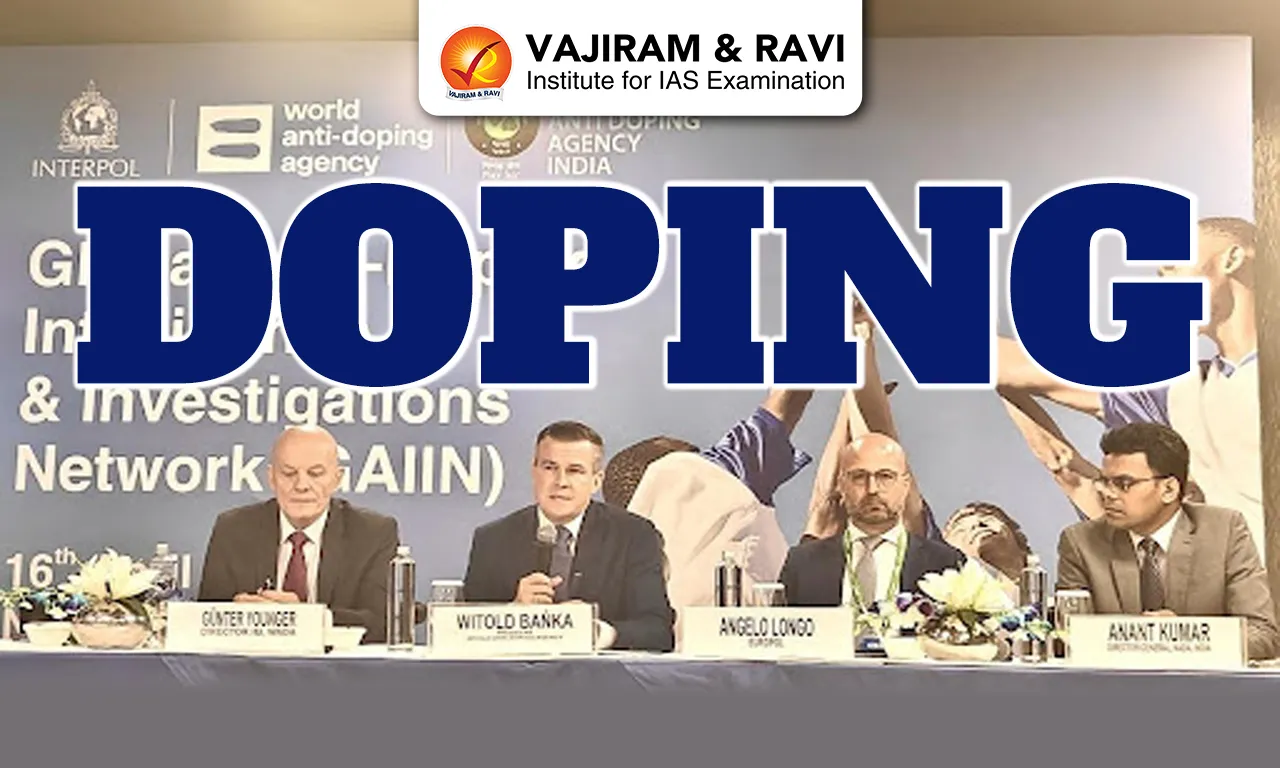
Doping Latest News
- India has been flagged as a high-risk country for doping by global athletics authorities, raising concerns ahead of its Olympic ambitions.
Doping in Sports
- Doping refers to the use of prohibited substances or methods by athletes to enhance performance unfairly.
- It violates the principles of fair play and sporting integrity. The global framework governing anti-doping is led by the World Anti-Doping Agency (WADA).
- Prohibited substances include anabolic steroids, stimulants, hormones, and masking agents. Prohibited methods include blood doping and gene doping.
- These substances artificially improve strength, endurance, or recovery, giving athletes an unfair advantage.
- Doping is detected through urine and blood tests conducted both during competitions and outside competitions.
- Anti-Doping Rule Violations (ADRVs) include not only testing positive but also refusal to test, tampering with samples, and trafficking banned substances.
- The consequences of doping include suspension, disqualification, loss of medals, and reputational damage. In serious cases, criminal penalties may also be imposed depending on national laws.
- Doping also has serious health risks. It can lead to hormonal imbalance, cardiovascular problems, liver damage, and psychological disorders.
- Therefore, anti-doping is not only about fairness but also about athlete welfare.


Steps Taken by the Government to Control Doping
- India has taken multiple institutional, legal, and administrative steps to tackle doping in sports.
- The National Anti-Doping Agency (NADA) is the primary body responsible for implementing anti-doping rules in India.
- It conducts testing, manages results, and ensures compliance with WADA standards.
- India has adopted the National Anti-Doping Act, 2022.
- This law provides statutory backing to anti-doping efforts and aligns India’s framework with international obligations.
- It strengthens investigation, adjudication, and enforcement mechanisms.
- Testing infrastructure has been expanded. More in-competition and out-of-competition tests are conducted to detect violations early. There is also a focus on expanding testing at state and district levels.
- Educational initiatives have been launched to create awareness among athletes, coaches, and support staff. These programmes aim to prevent inadvertent doping due to lack of knowledge.
- The government is also considering the criminalisation of doping.
- This includes action against coaches, suppliers, and networks involved in distributing banned substances. Such measures aim to create a strong deterrent effect.
- Coordination between stakeholders has improved. The Ministry of Sports, NADA, and sports federations are working together to strengthen monitoring and enforcement.
News Summary
- India’s doping challenge has come under global scrutiny, especially in the context of its bid to host the 2036 Olympics.
- According to the report, the Athletics Integrity Unit (AIU) has classified India as a high-risk country for doping and downgraded its athletics body.
- This reclassification means stricter anti-doping requirements for Indian athletes. National-level athletes will now undergo more rigorous testing, including pre-competition and out-of-competition checks.
- The data highlights a worrying trend. India recorded 48 Anti-Doping Rule Violations in 2022, 63 in 2023, and 71 in 2024, making it the worst performer globally in 2024.
- Further, India had 260 athletes testing positive for banned substances in 2024. This was the highest in the world, with no other country reporting triple-digit violations.
- India’s positivity rate stood at 3.6 per cent, which is significantly higher compared to countries like China, which conducted more tests but reported far fewer violations.
- The AIU noted that India’s anti-doping programme is not proportionate to the scale of the doping problem. It emphasised the need for reforms, including better intelligence gathering and more widespread testing.
- Officials have acknowledged the issue and called for stronger enforcement. Suggestions include criminalising doping and targeting the supply chains of banned substances.
- The downgrade places India in “Category A”, which requires stricter compliance with global anti-doping norms. This includes mandatory testing protocols for athletes participating in international events.
- The issue is particularly significant as it could impact India’s credibility and preparedness to host global sporting events like the Olympics.
Source: IE

 Last updated on Oct, 2026
→ UPSC 2027 Notification will be released on 13 January 2027 at upsconline.nic.in.
→ Asian Games 2026 are being held in Aichi-Nagoya, Japan, from 19 September to 4 October.
→ Check Nobel Prize 2026 Winners List here.
→ Download PIB PRiSM Monthly Magazine 2026 here.
→ Check UPSC Monthly Current Affairs Magazine The Recitals here.
→ Check out the latest UPSC Syllabus here.
→ Download UPSC Model Answers for Mains 2026
→ UPSC Mains Question Paper 2026 is out now for Essay & GS Paper 1, 2, 3 & 4.
→ UPSC Calendar 2027 has been released.
→ Enroll in Vajiram & Ravi’s UPSC Mains Test Series 2027 for structured answer writing practice, expert evaluation, and exam-oriented feedback.
→ Join Vajiram & Ravi’s UPSC Mentorship Program 2027 for personalized guidance, strategy planning, and one-to-one support from experienced mentors.
→ Go through the UPSC Mains Previous Year Papers to enhance your preparation.
→ UPSC has released UPSC Toppers List 2025 with the Civil Services final result on its official website.
→ Also check Best UPSC Coaching in India
Doping FAQs
Q1. What is doping in sports?+
Q2. What are Anti-Doping Rule Violations (ADRVs)?+
Q3. Which body regulates anti-doping globally?+
Q4. What is India’s anti-doping authority?+
Q5. Why was India flagged as high-risk for doping?+
Tags: doping mains articles upsc current affairs upsc mains current affairs