


India-South Korea Relations Latest News
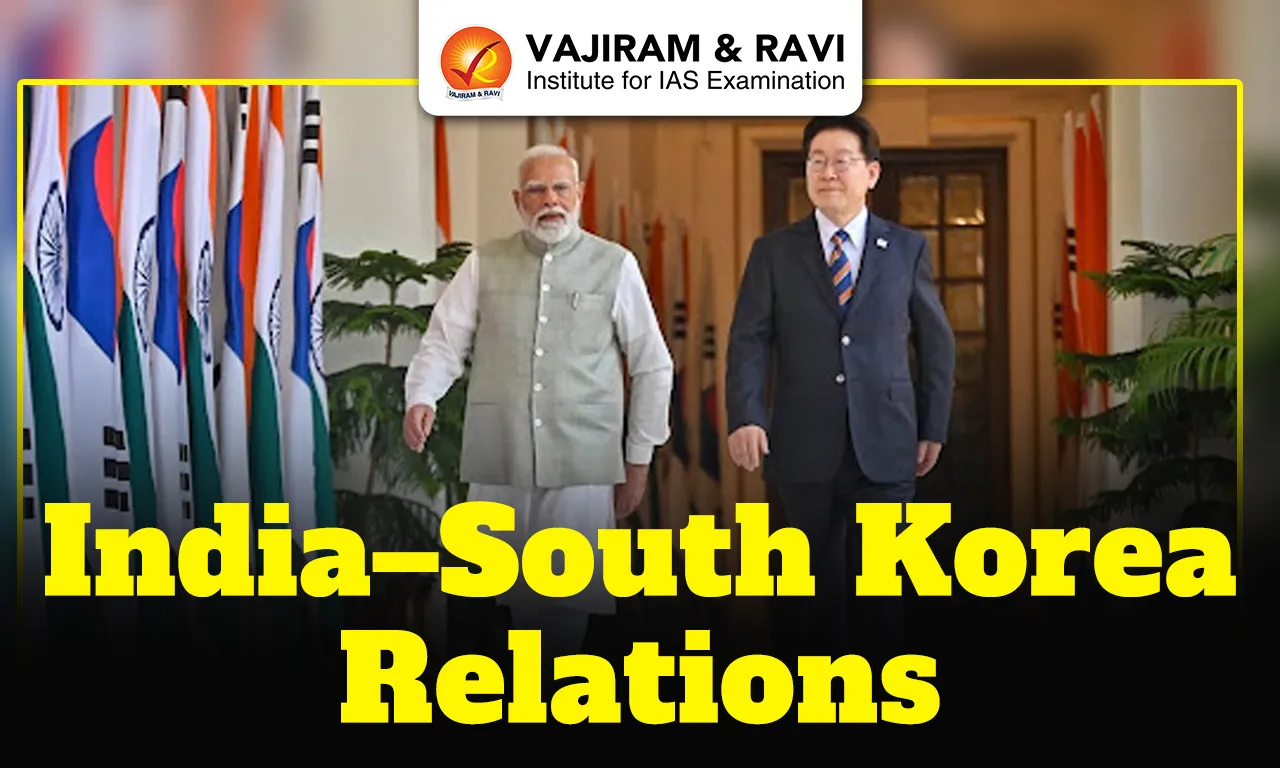
- The visiting South Korean President Lee Jae Myung held a bilateral meeting with the Indian Prime Minister at Hyderabad House, New Delhi.
- The visit marks a significant step in elevating the India–South Korea Special Strategic Partnership, with both nations signing multiple agreements spanning trade, technology, maritime, and culture.
India-South Korea Relations
- Background: Established in 1973, the relations have evolved into a “Special Strategic Partnership” (2015) driven by –
- Robust economic trade,
- Technological and security convergence,
- Defense collaboration, and
- Investments by major Korean conglomerates (Samsung, Hyundai).
- Key aspects:
- Political and strategic: Relations are supported by the convergence of India’s “Act East Policy” and South Korea’s “New Southern Policy”.
- Defense and technology: A key focus is the defense sector, including joint production and research, exemplified by the K9 Vajra-T gun system, manufactured in India using South Korean technology. Cooperation also includes AI and shipbuilding.
- Cultural bonds: Deepening cultural ties are facilitated by initiatives like the Queen Suriratna memorial in Ayodhya.
- Significance: The relationship remains crucial for security in the Indo-Pacific region and the economic development of both nations.


Key Outcomes of the Meeting
- Trade and economic cooperation:
- Both leaders set an ambitious target of scaling bilateral trade from the current $27 billion to $50 billion by 2030.
- India and South Korea agreed to restart CEPA (Comprehensive Economic Partnership Agreement) upgrade negotiations.
- CEPA, in force since 2010, has seen bilateral trade grow nearly 90% — from $14.2 billion to $26.89 billion (2024–25). However, India runs a significant trade deficit with South Korea (imports ~$21 billion vs exports ~$5.8 billion).
- Recent developments:
- 11 rounds of CEPA upgradation talks have already been held.
- An India–Korea Financial Forum was launched to facilitate bilateral financial flows.
- An Industrial Cooperation Committee was established to strengthen business ties.
- An Economic Security Dialogue was initiated to enhance cooperation in critical technologies and supply chains — a term of growing geopolitical relevance.
- Digital and industrial partnership:
- Launch of the India–Korea Digital Bridge — a landmark initiative for deeper collaboration in AI, semiconductors, and information technology.
- Agreements on digital cooperation in AI and support for Small and Medium Enterprises (SMEs).
- A Korean Industrial Township to be established in India to ease market entry for Korean businesses, especially SMEs.
- Maritime and shipbuilding:
- A Comprehensive Framework for Partnership in Shipbuilding, Shipping, and Maritime Logistics was signed — a strategic move given India’s ambitions under Maritime India Vision 2030.
- Korea brings advanced shipbuilding technology; India offers policy support, land, and a growing order base — a complementary partnership.
- A foreign ministry-level dialogue on climate change, the Arctic, and maritime cooperation was also launched.
- Multilateral and geopolitical alignment:
- South Korea joined the International Solar Alliance (ISA) and the Indo-Pacific Oceans Initiative (IPOI) — both Indian-led frameworks.
- Both nations agreed on the need to reform global institutions to address contemporary challenges.
- They exchanged views on the wars in West Asia and Europe, agreeing that restoring peace in the Middle East is vital to global security and economic stability.
- Cultural diplomacy – Growing people-to-people connect:
- K-pop and K-dramas are gaining traction in India; Indian cinema is gaining recognition in Korea.
- Launch of the Mumbai Korea Centre as a permanent K-pop performance hall and international hub for Korean culture — a space where K-pop and Bollywood can collaborate.
- An India–Korea Friendship Festival to be organised in 2028.
Challenges
- Trade imbalances: Remains a structural concern. Limited outcomeS of the CEPA upgrade talks reflect the complexity of aligning tariff structures and non-tariff barriers.
- Building shipbuilding capacity in India: Requires sustained infrastructure investment, skilled labour development, and regulatory streamlining.
- Geopolitical uncertainties: Risk disrupting energy supply chains that both countries depend on.
- Challenges in grounding of MoUs: Especially for SMEs and technology transfer — remains a persistent implementation challenge.
Way Forward
- Fast-track: CEPA renegotiation with a focus on reducing India’s trade deficit and expanding market access for Indian goods, especially in pharmaceuticals, textiles, and IT services.
- Leverage: Digital technology to co-develop semiconductor supply chains — critical in the context of global chip geopolitics.
- Attract: Korean FDI and manufacturing into India’s industrial corridors.
- Build: Resilient supply chains for critical minerals and emerging technologies.
- Align: Shipbuilding cooperation with India’s Sagarmala Project and Maritime India Vision for mutual strategic depth.
- Position: The Indo-Pacific as a zone of cooperative prosperity.
Conclusion
- The recent meeting signals a deliberate shift from a conventional bilateral relationship to a forward-looking, technology-driven strategic partnership. The “chips to ships, talent to technology” formulation captures the breadth of this vision.
- As India seeks to diversify its strategic partnerships and build resilient economic frameworks, South Korea — a technologically advanced middle power with shared democratic values — emerges as a key partner in navigating the challenges of a multipolar world.
Source: IE

 Last updated on Oct, 2026
→ UPSC 2027 Notification will be released on 13 January 2027 at upsconline.nic.in.
→ Check Nobel Prize 2026 Winners List here.
→ Download PIB PRiSM Monthly Magazine 2026 here.
→ Check UPSC Monthly Current Affairs Magazine The Recitals here.
→ Check out the latest UPSC Syllabus here.
→ Download UPSC Model Answers for Mains 2026
→ UPSC Mains Question Paper 2026 is out now for Essay & GS Paper 1, 2, 3 & 4.
→ UPSC Calendar 2027 has been released.
→ Enroll in Vajiram & Ravi’s UPSC Mains Test Series 2027 for structured answer writing practice, expert evaluation, and exam-oriented feedback.
→ Join Vajiram & Ravi’s UPSC Mentorship Program 2027 for personalized guidance, strategy planning, and one-to-one support from experienced mentors.
→ Go through the UPSC Mains Previous Year Papers to enhance your preparation.
→ UPSC has released UPSC Toppers List 2025 with the Civil Services final result on its official website.
→ Also check Best UPSC Coaching in India
India–South Korea Relations FAQs
Q1. How India–South Korea relations are increasingly becoming technology-driven? +
Q2. What is the significance of upgrading the India–South Korea CEPA? +
Q3. How does India–South Korea cooperation strengthen India’s Indo-Pacific vision? +
Q4. How South Korea supports India’s manufacturing and supply chain diversification strategy? +
Q5. How soft power diplomacy is emerging as an important pillar of India–South Korea relations? +
Tags: india–south korea relations mains articles upsc current affairs upsc mains current affairs








