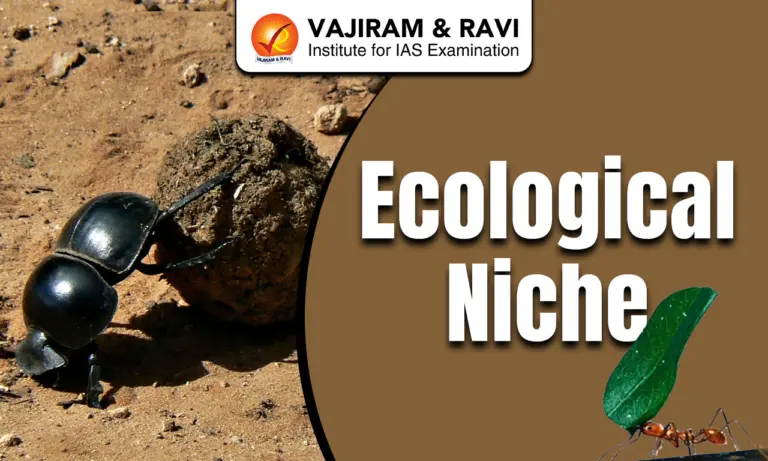
An Ecological Niche refers to the role or position of a living organism in its environment. It describes how a plant or animal lives, survives, and interacts with other organisms and its surroundings. This includes what it eats, where it lives, how it behaves, and how it contributes to the ecosystem.
About Ecological Niche
- An Ecological Niche refers to the unique role, position, and way of life of a species within its ecosystem. It explains how a species survives, grows, and interacts with its surroundings.
- In simple words, a niche is like the “job” or “function” of an organism in nature, including everything it does to live.
- It includes not just the place where an organism lives, but also how it uses resources, how it behaves, and how it affects other organisms.
- The concept of Ecological Niche was introduced by Charles Elton, who described it as the functional role of a species in an ecosystem.
- It includes:
- What resources a species uses
- How and when it uses those resources
- How it interacts with other species in the ecosystem
- Key Components of an Ecological Niche
- Habitat (where it lives): This refers to the physical location of the organism, such as forests, deserts, rivers, or soil.
- Food habits (what it eats): It includes the type of food an organism consumes, whether it is a producer, consumer, or decomposer, and the organisms it competes with for food.
- Reproductive pattern: This explains how, when, and where a species reproduces and raises its young.
- Environmental conditions: These include abiotic factors like temperature, rainfall, humidity, soil type, sunlight, and land features, all of which influence survival.
- Interactions with other organisms: It involves relationships like predation, competition, parasitism, and mutualism.
- Importance of Ecological Niche
- Ecological Niche plays a very important role in the conservation and protection of species, as it helps us understand the exact requirements needed for their survival.
- If we want to conserve a species in its natural habitat, it is essential to maintain all aspects of its niche, including food availability, shelter, and suitable environmental conditions.
- It also helps scientists understand the interrelationship between organisms and their environment, including both living (biotic) and non-living (abiotic) components.
- Role of Niche in Ecosystem Functioning
- A niche explains how a species responds to the availability of resources and how it is affected by factors such as predators, parasites, diseases, and competition.
- When resources are abundant and threats are low, species tend to grow and reproduce more successfully.
- At the same time, species also influence their environment by:
- Consuming resources and limiting their availability to others
- Acting as prey for predators and helping maintain food chains
- Controlling populations of other organisms
- Uniqueness of Niche
- Each species has its own unique Ecological Niche, which means no two species can have exactly the same role and resource use pattern for a long time.
- Even if species appear similar, they usually differ in some aspect such as feeding time, habitat use, or behavior, which allows them to coexist.
- Formation of Ecological Niche
- The formation of a niche is influenced by both abiotic factors (such as climate, soil, and temperature) and biotic factors (such as competition, predation, and food availability).
- Through the process of natural selection, species develop special adaptations that help them survive and function efficiently in their specific environment.
- Over time, these adaptations become more specialized, making the species well-suited to its niche.
- Example: Xerophytic Plants
- Xerophytic plants are those that live in dry and arid conditions, where water is scarce, and they have developed special adaptations to survive in such niches.
- These plants conserve water through several features such as:
- A thick waxy coating (cuticle) to reduce evaporation
- Reduced or modified leaves (like spines) to minimize water loss
- Thick or hairy leaf surfaces to protect against heat
- Some plants, especially succulents, show a special adaptation where they open their stomata at night and close them during the day, reducing water loss in hot conditions.
- Niche and Ecosystem Stability: The stability of an ecosystem depends on the diversity of niches present within it. Greater niche diversity leads to:
- Better and more efficient flow of energy
- Reduced competition for the same resources
- Less fluctuation in species populations
- Overall greater ecosystem stability
- Competitive Exclusion Principle: According to the Law of Competitive Exclusion, two species cannot occupy the exact same niche for a long time if they compete for the same resources. In such situations, one species may:
- Move to a different niche (migration)
- Adapt by changing its behavior or habits
- Become extinct if unable to compete
- Resource Partitioning: To avoid direct competition, species often divide resources among themselves, a process known as resource partitioning. This allows different species to use the same resource in different ways, such as:
- Feeding at different times
- Using different parts of the habitat
- Consuming different types of food
- This helps multiple species coexist within the same ecosystem.
- Dominant vs Less Dominant Species
- Dominant species usually have a broader Ecological Niche, meaning they can use a wide range of resources and tolerate different environmental conditions.
- Less dominant species have a narrower niche, meaning they are more specialized and depend on specific conditions for survival.
Difference Between Niche and Habitat
- The habitat of a species is the place where it lives (its “address”), such as a forest, river, or desert, while the Ecological Niche is the role it plays (its “profession”), including how it lives, feeds, and interacts with others.
- A habitat can be shared by many species, but each species has its own unique niche based on how it uses resources.
- No two species can have the same niche for long, because they will compete for the same resources like food and space.
- Due to this competition, one species may adapt, move to another niche, or get eliminated.
- However, species can coexist in the same habitat by using resources in different ways.
- For example, insects living on the same plant may feed on different parts like leaves, roots, or stems, so they have different niches and avoid direct competition.


 Last updated on Oct, 2026
→ UPSC 2027 Notification will be released on 13 January 2027 at upsconline.nic.in.
→ Check Nobel Prize 2026 Winners List here.
→ Download PIB PRiSM Monthly Magazine 2026 here.
→ Check UPSC Monthly Current Affairs Magazine The Recitals here.
→ Check out the latest UPSC Syllabus here.
→ Download UPSC Model Answers for Mains 2026
→ UPSC Mains Question Paper 2026 is out now for Essay & GS Paper 1, 2, 3 & 4.
→ UPSC Calendar 2027 has been released.
→ Enroll in Vajiram & Ravi’s UPSC Mains Test Series 2027 for structured answer writing practice, expert evaluation, and exam-oriented feedback.
→ Join Vajiram & Ravi’s UPSC Mentorship Program 2027 for personalized guidance, strategy planning, and one-to-one support from experienced mentors.
→ Go through the UPSC Mains Previous Year Papers to enhance your preparation.
→ UPSC has released UPSC Toppers List 2025 with the Civil Services final result on its official website.
→ Also check Best UPSC Coaching in India
Ecological Niche FAQs
Q1. What is an Ecological Niche?+
Q2. What are the main components of an Ecological Niche?+
Q3. Why is Ecological Niche important in an ecosystem?+
Q4. What is the difference between habitat and Ecological Niche?+
Q5. What is the Competitive Exclusion Principle?+
Tags: ecological niche environment environment notes