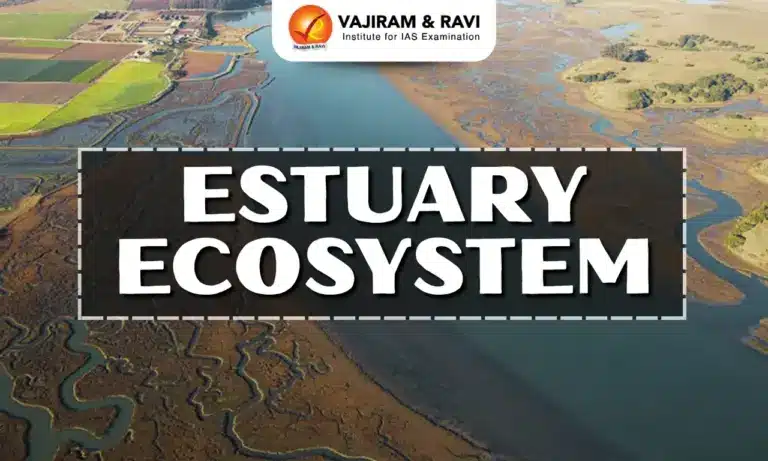
Estuaries are partially enclosed coastal water bodies where freshwater from rivers mixes with saline seawater, creating brackish conditions. The Estuary Ecosystem represents a dynamic transition zone between terrestrial, freshwater and marine environments. These ecosystems are shaped by tidal action, river discharge, sediment deposition and salinity gradients. Because they receive nutrients from both land and sea, Estuarine Ecosystems rank among the most productive natural systems on Earth. They function as ecological connectors, linking river basins to oceans while supporting high biological productivity, complex food webs and essential ecosystem services for both nature and human societies.
Estuary Ecosystem
An Estuary Ecosystem is a semi enclosed coastal ecosystem with a free connection to the open sea, where seawater is measurably diluted by freshwater inflow from rivers, streams, or land runoff. Salinity typically ranges between 0 and 35 parts per thousand, depending on tidal cycles, river discharge, evaporation and seasonal variations. Estuaries act as Ecotones, meaning overlapping zones of riverine and marine ecosystems. They are influenced simultaneously by fluvial processes such as sediment transport and marine forces like tides and waves, resulting in constantly changing physical, chemical and biological conditions.
Estuary Ecosystem Features
Estuary Ecosystems exhibit unique physical, chemical and biological characteristics driven by freshwater-seawater interaction, tidal rhythms, nutrient enrichment and sediment dynamics.
- Estuary waters show fluctuating salinity from freshwater dominance upstream to marine conditions near the mouth, requiring organisms to possess strong osmoregulatory adaptations for survival.
- Regular tidal inflow causes daily mixing, sediment resuspension and nutrient redistribution, shaping Estuary circulation patterns and influencing species distribution and productivity.
- Rivers deliver nitrogen, phosphorus and organic matter, while tidal waters resupply minerals, making Estuaries among the world’s most nutrient rich aquatic systems.
- Estuaries are more productive than most freshwater and marine ecosystems due to constant nutrient recycling and high primary productivity by phytoplankton and vegetation.
- Reduced wave energy allows fine sediments, clay and alluvium to settle, supporting delta formation and stabilising coastlines.
- As transitional zones, Estuaries support freshwater, marine and terrestrial species simultaneously, enhancing ecological interactions and adaptive diversity.
- Sheltered geography creates calmer waters, providing refuge and breeding grounds for larvae, juvenile fish and invertebrates.
- Oxygen levels, turbidity and nutrient concentrations fluctuate seasonally and daily, making Estuaries environmentally variable yet resilient ecosystems.
Read About: Terrestrial Ecosystem





Estuary Ecosystem Biodiversity
Estuary Ecosystems host diverse plant and animal communities adapted to fluctuating salinity, water levels and sediment conditions. The major Flora and Fauna found in the Estuary Ecosystem has been given below:
- Phytoplankton Communities: Diatoms dominate Estuary phytoplankton due to high nutrient availability, followed by dinoflagellates, green algae and cyanobacteria, forming the primary producers driving high Estuary productivity.
- Mangrove Vegetation: Mangroves such as Rhizophora, Avicennia and Sonneratia thrive in Estuaries using salt filtration, pneumatophores and prop roots, stabilizing sediments and supporting complex food webs.
- Salt Marsh Grasses: Cordgrasses, Sedges and saltworts dominate marsh habitats, providing organic matter and acting as nutrient sources for detritus based food chains.
- Seagrass Meadows: Seagrasses such as Eelgrass grow in shallow Estuary zones, enhancing oxygen levels, stabilizing sediments and serving as nurseries for juvenile fish and invertebrates.
- Zooplankton Assemblages: Copepods, cladocerans and larval crustaceans dominate Estuary zooplankton, transferring energy from phytoplankton to higher trophic levels efficiently.
- Invertebrate Fauna: Worms, molluscs, crabs and burrowing organisms inhabit Estuary sediments, enhancing nutrient cycling and sediment aeration through bioturbation.
- Fish Diversity: Estuaries serve as nurseries for commercially important fish and anadromous species migrating between rivers and seas such as mullets, catfish, prawns, salmon, catadromous, etc.
- Avian Species: Wading birds like herons, egrets, pelicans and migratory shorebirds rely on Estuaries for feeding, nesting and seasonal stopovers.
- Microbial Communities: Bacteria and fungi drive decomposition, nutrient cycling and biogeochemical processes such as nitrogen fixation, denitrification, etc. essential for Estuary productivity.
Estuary Ecosystem in India
India hosts a wide range of Estuary Ecosystems shaped by monsoonal rivers, long coastlines and tropical climatic conditions. The features of the Estuary Ecosystem in India have been given below:
- River Network Contribution: Fourteen major, forty four medium and over one hundred sixty minor rivers drain into the sea through Estuaries across India.
- East Coast Dominance: Most major Indian Estuaries occur along the Bay of Bengal due to large rivers such as Ganga, Godavari, Krishna, Mahanadi and Cauvery.
- West Coast Characteristics: Estuaries along the Arabian Sea, including Mandovi and Zuari, are smaller, steeper and strongly tidal due to narrow coastal plains.
- Delta-Estuary Systems: Large deltaic Estuaries like Hooghly and Godavari function as combined Estuary-delta ecosystems with high sediment and nutrient loads.
- Mangrove Integration: Indian Estuaries support extensive mangroves, with the Sundarbans forming the world’s largest continuous mangrove ecosystem.
- Economic Significance: Major ports such as Kolkata, Paradip and Visakhapatnam are located within Estuary systems due to sheltered waters and navigability.
- Biodiversity Hotspots: Estuaries like Chilika and Pulicat support fish migrations, bird habitats and complex food webs critical to regional ecology.
- Human Dependence: Millions depend on Indian Estuaries for fisheries, aquaculture, transport and coastal livelihoods.
Estuary Ecosystem Challenges
Estuary Ecosystems face growing environmental stress from natural variability and intense human pressures as highlighted below:
- Salinity Fluctuation Stress: Rapid changes in salinity limit species diversity, allowing only highly adapted organisms to survive in Estuary conditions.
- Pollution Load: Industrial effluents, sewage discharge, agricultural runoff, heavy metals and hydrocarbons degrade water quality and disrupt biological processes.
- Eutrophication: Excess nutrients cause algal blooms, oxygen depletion and habitat degradation, reducing fish productivity and ecosystem resilience.
- Habitat Loss: Urban expansion, port construction, aquaculture ponds and land reclamation permanently destroy Estuary wetlands and mudflats.
- Overexploitation: Intensive fishing, prawn seed collection and small mesh nets reduce fish stocks and disturb trophic balance.
- Climate Change Impact: Sea level rise shifts salinity zones inland, causing Estuary squeeze where habitats cannot migrate due to embankments and development.
- Sediment Flow Alteration: Dams and river diversions reduce sediment supply, affecting delta stability and Estuary productivity.
- Mangrove Degradation: Clearing for agriculture, aquaculture and industry weakens coastal protection and biodiversity support systems.
| Also Check Other Posts | |
| Climate Change | Coastal Regulation Zone |
| Global Plastic Treaty | Nitrogen Cycle |
| Carbon Cycle | |

 Last updated on March, 2026
→ UPSC Final Result 2025 is now out.
→ UPSC has released UPSC Toppers List 2025 with the Civil Services final result on its official website.
→ Anuj Agnihotri secured AIR 1 in the UPSC Civil Services Examination 2025.
→ UPSC Marksheet 2025 is now out.
→ UPSC Notification 2026 & UPSC IFoS Notification 2026 is now out on the official website at upsconline.nic.in.
→ UPSC Calendar 2026 has been released.
→ Check out the latest UPSC Syllabus 2026 here.
→ UPSC Prelims 2026 will be conducted on 24th May, 2026 & UPSC Mains 2026 will be conducted on 21st August 2026.
→ The UPSC Selection Process is of 3 stages-Prelims, Mains and Interview.
→ Prepare effectively with Vajiram & Ravi’s UPSC Prelims Test Series 2026 featuring full-length mock tests, detailed solutions, and performance analysis.
→ Enroll in Vajiram & Ravi’s UPSC Mains Test Series 2026 for structured answer writing practice, expert evaluation, and exam-oriented feedback.
→ Join Vajiram & Ravi’s Best UPSC Mentorship Program for personalized guidance, strategy planning, and one-to-one support from experienced mentors.
→ Shakti Dubey secures AIR 1 in UPSC CSE Exam 2024.
→ Also check Best UPSC Coaching in India
Estuary Ecosystem FAQs
Q1. What is an Estuary Ecosystem?+
Q2. Why are Estuaries called highly productive ecosystems?+
Q3. What type of salinity is found in Estuaries?+
Q4. Name two major functions of Estuary Ecosystems.+
Q5. What are major threats to Estuary Ecosystems?+
Tags: estuary ecosystem