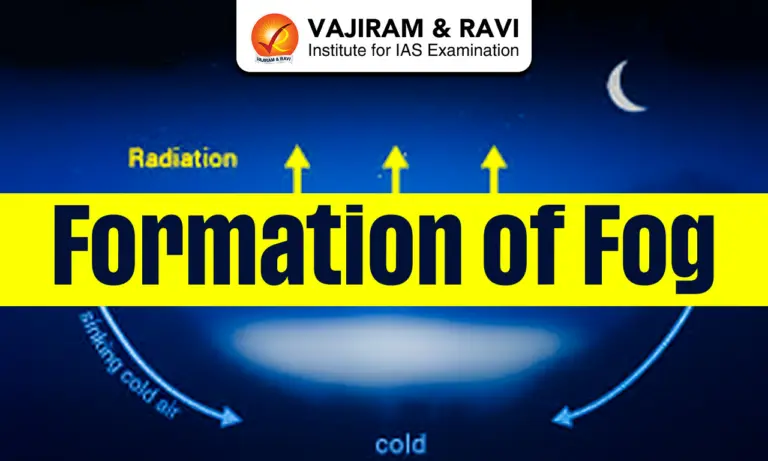
Formation of Fog is a common atmospheric phenomenon formed when water vapour condenses near the Earth’s surface due to cooling and saturation conditions. It develops under specific combinations of temperature, humidity and wind patterns, often during calm nights. Fog behaves like a low lying cloud and shows high spatial variability depending on local factors such as moisture availability, terrain and proximity to water bodies, making it an important element of weather systems.
What is Fog?
Fog is a visible suspension of tiny water droplets or ice crystals in the air near the ground that reduces visibility to less than 1 kilometre. It forms when air becomes saturated either by cooling to the dew point or by adding moisture. Unlike clouds, fog occurs at ground level and is strongly influenced by local sources like soil moisture, rivers and surface cooling processes.
Fog Types
Different fog types are classified based on their formation mechanisms, temperature conditions and movement of air masses across surfaces.
- Radiation Fog: Forms during clear nights when the Earth loses heat rapidly through radiation, cooling the air near the surface to the dew point. It is common in plains and usually dissipates after sunrise.
- Advection Fog: Develops when warm, moist air moves horizontally over a colder surface, leading to cooling and condensation. It is widespread, long lasting and often seen in coastal and large plain regions.
- Valley Fog: Occurs when cold, dense air settles in valleys and gets trapped due to surrounding topography. It remains for longer durations because the cold air cannot escape easily.
- Freezing Fog: Forms when supercooled water droplets freeze upon contact with surfaces at temperatures below 0°C, leading to ice deposition on objects like trees, roads and power lines.
- Evaporation Fog: Develops when water vapour is added to cold air through evaporation, such as when cold air passes over warm water bodies, causing saturation and condensation.
- Upslope Fog: Occurs when moist air is forced to rise along slopes of hills or mountains, cooling adiabatically and forming fog over elevated terrains.
- Hail Fog: A rare type formed after hailstorms when melting hail cools the surrounding warm, moist air to its dew point, producing shallow and localized fog.
- Ice Fog: Found in extremely cold regions where water vapour directly forms tiny ice crystals suspended in air, common in polar conditions.
- Steam Fog: Forms when cold air moves over warmer water, causing evaporation and rapid condensation, giving a smoky appearance above water surfaces.





Formation of Fog Process
Formation of Fog is a gradual process driven by cooling, moisture saturation and atmospheric stability near the surface.
- During the night, land loses heat through radiation, cooling the air close to the ground. This reduces the air’s capacity to hold moisture and initiates condensation conditions.
- Presence of water vapour from rivers, soil moisture, or nearby water bodies increases humidity levels, which is essential for fog formation near the surface layer.
- When air temperature falls close to the dew point, typically within a small margin, saturation occurs and water vapour begins to condense into tiny droplets.
- Light or calm winds prevent mixing of air layers, allowing cooled air to remain near the surface and support stable fog formation.
- Water vapour condenses on dust, salt, or particulate matter acting as condensation nuclei, forming visible droplets suspended in the air.
- Fog becomes densest during early morning hours when temperature reaches its lowest level, enhancing condensation and reducing visibility significantly.
- High humidity and low temperature together strengthen fog intensity, while variations in these factors cause spatial differences in fog density.
- After sunrise, solar heating increases temperature, reducing relative humidity and causing evaporation of droplets, leading to gradual fog clearance.
- Visibility Classification: According to IMD, fog is categorized as very dense (0-50 m), dense (51-200 m), moderate (201-500 m) and shallow (up to 1 km visibility).
Formation of Fog Impacts
The Formation of Fog significantly influences human activities, environmental conditions and atmospheric processes due to reduced visibility and moisture presence.
- Transportation Disruption: Dense fog reduces visibility to near zero, increasing road accidents, delaying flights and affecting railway operations due to safety concerns.
- Aviation Challenges: Airports require advanced landing systems as fog restricts runway visibility, often causing flight delays, diversions, or cancellations during peak fog conditions.
- Agricultural Effects: Fog provides moisture beneficial for crops but prolonged exposure can promote fungal diseases and damage sensitive agricultural produce.
- Air Quality Deterioration: Fog traps pollutants near the surface due to temperature inversion, worsening air quality and increasing respiratory problems in urban areas.
- Economic Impact: Disruptions in transport, logistics and agriculture lead to financial losses and increased operational costs in multiple sectors.
- Temperature Regulation: Fog reduces daytime heating by blocking sunlight, leading to prolonged cold conditions, especially during winter months.
- Ecosystem Influence: Certain ecosystems depend on fog for moisture, while excessive fog may alter biodiversity patterns and ecological balance.
Formation of Fog in India
Fog formation in India is largely influenced by seasonal temperature changes, moisture sources and regional atmospheric conditions.
- Dense fog has recently enveloped the northwestern region of India including Delhi, Punjab, Haryana, parts of Uttar Pradesh and Rajasthan due to falling temperatures and increased moisture availability.
- Minimum temperatures significantly below normal during cold wave conditions enhance cooling of surface air, favouring fog formation across northern plains.
- The Indo Gangetic Plain region is highly prone to fog, especially in December and January, experiencing prolonged spells lasting several weeks.
- Storms originating in the Mediterranean Sea bring moisture bearing winds, increasing humidity levels and supporting fog formation over northwest India.
- In absence of western disturbances, rivers, soil moisture and surface evaporation act as local contributors to atmospheric moisture.
- Calm winds over the Indo Gangetic Plain prevent mixing of air, allowing fog to persist for longer durations during winter mornings.
- Delhi recorded minimum temperature around 6°C, creating favourable conditions for dense fog development.
- Fog occurrence shows seasonal variation, with some years experiencing 25 to 35 days of dense fog, while others show minimal events.
Pollution and Formation of Fog
Pollution plays a critical role in enhancing fog formation and increasing its intensity, especially in urban regions.
- Pollutants provide particles on which water vapour condenses, increasing the likelihood and density of fog formation in polluted cities.
- Interaction of fog with pollutants results in Smog Formation, significantly affecting visibility, health and environmental quality.
- Due to higher pollution levels, Delhi records more fog days compared to less polluted regions, as per IMD observations.
- Falling temperatures reduce wind speed and bring down the inversion layer, trapping pollutants and moisture within the boundary layer.
- Temperature inversion limits upward movement of air, causing pollutants and fog droplets to remain concentrated near the surface.
- Fog episodes coincide with severe AQI levels, as particulate matter accumulates and remains suspended within the fog layer.
- Longer lasting advection fog leads to secondary particulate formation, causing rapid buildup of pollutants in the atmosphere.
- With rising temperature during the day, fog disperses, improving air mixing and reducing pollutant concentration temporarily.

 Last updated on March, 2026
→ UPSC Final Result 2025 is now out.
→ UPSC has released UPSC Toppers List 2025 with the Civil Services final result on its official website.
→ Anuj Agnihotri secured AIR 1 in the UPSC Civil Services Examination 2025.
→ UPSC Marksheet 2025 is now out.
→ UPSC Notification 2026 & UPSC IFoS Notification 2026 is now out on the official website at upsconline.nic.in.
→ UPSC Calendar 2026 has been released.
→ Check out the latest UPSC Syllabus 2026 here.
→ UPSC Prelims 2026 will be conducted on 24th May, 2026 & UPSC Mains 2026 will be conducted on 21st August 2026.
→ The UPSC Selection Process is of 3 stages-Prelims, Mains and Interview.
→ Prepare effectively with Vajiram & Ravi’s UPSC Prelims Test Series 2026 featuring full-length mock tests, detailed solutions, and performance analysis.
→ Enroll in Vajiram & Ravi’s UPSC Mains Test Series 2026 for structured answer writing practice, expert evaluation, and exam-oriented feedback.
→ Join Vajiram & Ravi’s Best UPSC Mentorship Program for personalized guidance, strategy planning, and one-to-one support from experienced mentors.
→ Shakti Dubey secures AIR 1 in UPSC CSE Exam 2024.
→ Also check Best UPSC Coaching in India
Formation of Fog FAQs
Q1. What is fog and how is it formed? +
Q2. At what time does Formation of Fog usually occur? +
Q3. Which region in India is most affected by the Formation of Fog? +
Q4. How does pollution affect Formation of Fog? +
Q5. What are the main conditions required for Formation of Fog?+
Tags: formation of fog geography geography notes