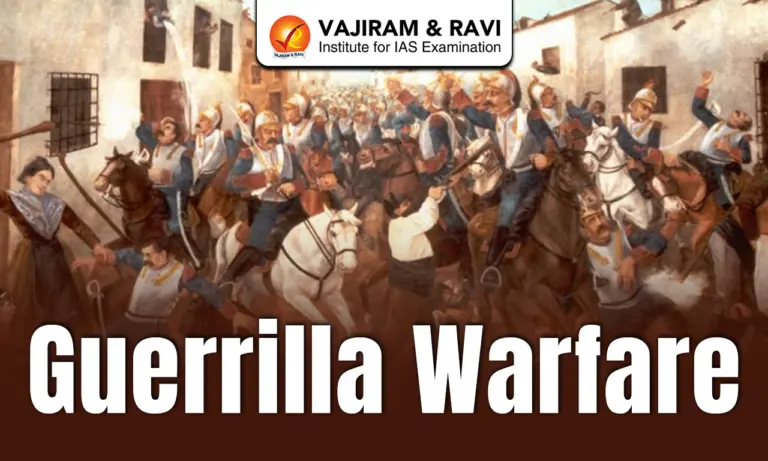
Guerrilla Warfare is a type of fighting where small groups of people use irregular and flexible tactics instead of traditional large-scale battles. Instead of facing the enemy directly, they rely on methods like surprise attacks, ambushes, and quick movements to weaken a stronger opponent. It is usually carried out in difficult terrains like forests, mountains, or rural areas, where fighters can hide easily.
About Guerrilla Warfare
- Guerrilla Warfare is a type of fighting carried out by small, irregular groups who use quick and flexible methods instead of traditional large-scale battles. These fighters usually attack stronger military or police forces through surprise actions like ambushes and then retreat quickly.
- The term “guerrilla” comes from the Spanish word guerra (meaning war) and became popular during the Peninsular War (1808-1814), when Spanish and Portuguese fighters helped defeat French forces using such tactics.
- Over time, people involved in Guerrilla Warfare have been called by different names such as rebels, insurgents, partisans, and irregulars. While some see them as freedom fighters, others have criticized them using terms like bandits or terrorists.
- The French military thinker Henri, Baron de Jomini described Guerrilla Warfare as a “national war,” while Carl von Clausewitz referred to such fighters as a kind of scattered or informal force. Later, these conflicts were often called “small wars.”
- Historically, Guerrilla Warfare has been used as a method of resistance, either against foreign invaders or against governments seen as unjust. It has sometimes achieved major success, but in other cases, it has also failed badly.
- During the Cold War, Guerrilla Warfare became more common and many guerrilla groups received support such as money, weapons, and training from different countries. Conflicts were often made more complex by ethnic, political, and religious differences.
- In recent times, some guerrilla groups in regions like Colombia, Peru, Northern Ireland, and Spain have shifted towards criminal activities, including involvement with drug networks and organized crime.
Guerrilla Warfare Purpose and Motivation
- A key principle of Guerrilla Warfare is having a strong purpose or cause, which motivates people to take part in the struggle.
- The guerrilla cause can appear in different forms depending on the situation. It may be presented as a fight to free a country from colonial rule or foreign invasion, giving it a broader national appeal.
- For peasants and rural communities, the cause may focus on freedom from exploitation, such as unfair rents, harsh taxes, or control by powerful landlords.
- For the middle class, the motivation may be the establishment or restoration of democratic governance, especially in opposition to military rule or authoritarian regimes.
- The driving force behind guerrilla movements can come from political ideas, religion, nationalism, or simply a genuine desire for a better and more just life.
- Public support is crucial. Guerrilla fighters rely heavily on the sympathy, cooperation, and assistance of local people, making it essential for their cause to be widely accepted.
- The main strategy of Guerrilla Warfare is long-term (protracted) struggle, where small groups continuously harass the enemy instead of fighting direct large battles. The aim is to slowly weaken and exhaust the opponent over time.
- Guerrilla fighters use flexible and subtle tactics such as ambushes, surprise attacks, and quick retreats. These “hit-and-run” methods help them avoid heavy losses while keeping pressure on stronger forces.


Guerrilla Warfare Contemporary Relevance
- Still widely used in modern times: Even after the end of colonial rule, Guerrilla Warfare continues to be an important method of resistance in many parts of the world. It is especially common in regions where governments are weak or unable to fully control their territory.
- Occurs in areas with strong grievances: Guerrilla movements often emerge in places where people feel neglected, oppressed, or treated unfairly. Issues like poverty, political exclusion, ethnic tensions, and lack of development create conditions where such movements can grow.
- Seen across different regions: From Latin America to Southeast Asia and Sub-Saharan Africa, guerrilla groups have been active in fighting against colonial powers in the past and now against authoritarian governments or foreign military presence.
- Blending with modern forms of conflict: Today, some insurgent groups combine guerrilla tactics with terrorism. They may carry out surprise attacks, bombings, or target civilians to create fear and gain attention for their cause.
- Difficult for traditional armies to handle: Guerrilla Warfare does not follow conventional battlefield rules. Fighters use hit-and-run tactics, hide among civilians, and avoid direct confrontation. This makes it challenging for regular armies, which are trained for open and structured warfare.
- Forces changes in military strategy: Governments must adopt new approaches like counterinsurgency strategies, intelligence gathering, and community engagement instead of relying only on military strength.
- Dependence on local population: Guerrilla fighters often rely on local people for shelter, food, and information. This close connection with civilians makes conflicts more complex and harder to resolve.
- Raises ethical and humanitarian concerns: Since Guerrilla Warfare happens within civilian areas, innocent people are often caught in the middle. This raises serious questions about civilian safety, human rights, and the moral limits of violence.
- Blurs the line between combatants and civilians: It becomes difficult to distinguish between fighters and ordinary people, which increases the risk of wrongful targeting and human rights violations.
- Challenges state-building efforts: In fragile or failed states, ongoing guerrilla conflicts weaken institutions, slow down development, and make it harder to establish stable governance.
- Debate over legitimacy: Some view Guerrilla Warfare as a justified struggle for freedom and justice, while others see it as unlawful violence. The legitimacy often depends on the context and methods used.
Guerrilla Warfare History
- Guerrilla Warfare may sound like a modern idea, but its basic strategies are actually very old. Even though the word “guerrilla” became popular in the 1800s, the tactics were used thousands of years ago.
- One of the earliest thinkers to talk about such strategies was Sun Tzu in The Art of War. He explained the importance of surprise attacks, speed, and confusing the enemy instead of fighting directly.
- In ancient Rome, Quintus Fabius Maximus Verrucosus used a similar approach against the powerful army of Hannibal. Instead of direct battles, he delayed, avoided fights, and slowly weakened the enemy. This method later became known as the “Fabian strategy.”
- In Chinese history, General Peng Yue also used irregular tactics like surprise attacks to defeat stronger enemies.
- A common feature of Guerrilla Warfare throughout history is that weaker groups fight stronger armies. They make up for their lack of strength by using smart tactics, local knowledge, and strong motivation.
- Guerrilla fighters often depend on support from local people and sometimes even from foreign countries that share similar political or ideological goals.
- The British commander Arthur Wellesley was among the first to officially use the term “guerrilla” to describe both the fighters and their tactics.
- Guerrilla Warfare became even more important during World War II. One of the most famous examples was the resistance movement led by Josip Broz Tito in Yugoslavia. His group, known as the Partisans, fought against Nazi forces using guerrilla tactics.
- These fighters kept attacking and weakening the enemy, forcing them to spread their forces thin and lose control over large areas.
- Similar resistance movements were seen in many parts of Europe and Asia, showing how effective Guerrilla Warfare had become on a global level.
- Overall, Guerrilla Warfare has had a huge impact on history, especially in situations where weaker groups had to fight stronger powers using intelligence, strategy, and local support. Over time, the meaning of the word changed. Today, it mainly refers to the style of fighting rather than the fighters themselves.
Guerrilla Warfare Tactics by Maratha Empire
- Effective Use of Terrain
- The Marathas, under Chhatrapati Shivaji Maharaj, made excellent use of the Western Ghats’ hilly and forested terrain.
- These regions had narrow passes, steep hills, and dense forests, which made it difficult for large enemy armies to move or fight effectively.
- Important forts like Raigad and Pratapgad were strategically built in such areas to act as defensive strongholds and military bases.
- After attacking, Maratha forces could quickly retreat into these hills, making it nearly impossible for enemies to chase them.
- Thus, geography acted as a natural shield, giving the Marathas a major strategic advantage.
- Swift Cavalry Raids (Ganimi Kava)
- The Marathas followed the principle of Ganimi Kava, meaning using the enemy’s weaknesses against them.
- They relied heavily on fast-moving cavalry units that could travel quickly across large distances.
- These forces targeted enemy supply lines, communication routes, and weak points instead of engaging in direct battles.
- Sudden attacks created confusion and panic among enemy forces, especially larger Mughal armies.
- This method ensured maximum damage with minimum risk, making it highly effective.
- Use of Small and Flexible Units
- Instead of maintaining large armies, the Marathas preferred small, mobile groups of soldiers.
- These units could move quickly, hide easily, and respond rapidly to changing battlefield situations.
- Smaller groups required fewer resources like food and supplies, reducing logistical pressure.
- This flexibility allowed the Marathas to fight in multiple locations simultaneously and maintain constant pressure on the enemy.
- It also made their movements unpredictable, which was a key advantage in Guerrilla Warfare.
- Hit-and-Run Tactics
- The Maratha army focused on quick surprise attacks followed by immediate retreat.
- They avoided long, direct battles which could lead to heavy losses.
- These repeated attacks gradually weakened the enemy’s strength, morale, and resources.
- Hit-and-run tactics also allowed the Marathas to stay active and aggressive without risking major defeat.
- Over time, this strategy exhausted even powerful enemies like the Mughals.
- Strong Intelligence and Spy Network
- Intelligence was one of the strongest pillars of Maratha success under Shivaji Maharaj.
- A well-organized network of spies and informants kept track of enemy movements and plans.
- This helped the Marathas to choose the right time and place for attacks.
- It also enabled them to avoid traps and exploit enemy weaknesses effectively.
- Good intelligence ensured better planning and gave them a decisive edge in warfare.

 Last updated on Oct, 2026
→ UPSC 2027 Notification will be released on 13 January 2027 at upsconline.nic.in.
→ Check Nobel Prize 2026 Winners List here.
→ Download PIB PRiSM Monthly Magazine 2026 here.
→ Check UPSC Monthly Current Affairs Magazine The Recitals here.
→ Check out the latest UPSC Syllabus here.
→ Download UPSC Model Answers for Mains 2026
→ UPSC Mains Question Paper 2026 is out now for Essay & GS Paper 1, 2, 3 & 4.
→ UPSC Calendar 2027 has been released.
→ Enroll in Vajiram & Ravi’s UPSC Mains Test Series 2027 for structured answer writing practice, expert evaluation, and exam-oriented feedback.
→ Join Vajiram & Ravi’s UPSC Mentorship Program 2027 for personalized guidance, strategy planning, and one-to-one support from experienced mentors.
→ Go through the UPSC Mains Previous Year Papers to enhance your preparation.
→ UPSC has released UPSC Toppers List 2025 with the Civil Services final result on its official website.
→ Also check Best UPSC Coaching in India
Guerrilla Warfare FAQs
Q1. What is Guerrilla Warfare?+
Q2. Why is Guerrilla Warfare effective against stronger armies?+
Q3. Where is Guerrilla Warfare usually practiced?+
Q4. What is the main strategy behind Guerrilla Warfare?+
Q5. How important is public support in Guerrilla Warfare?+
Tags: guerrilla warfare polity polity notes