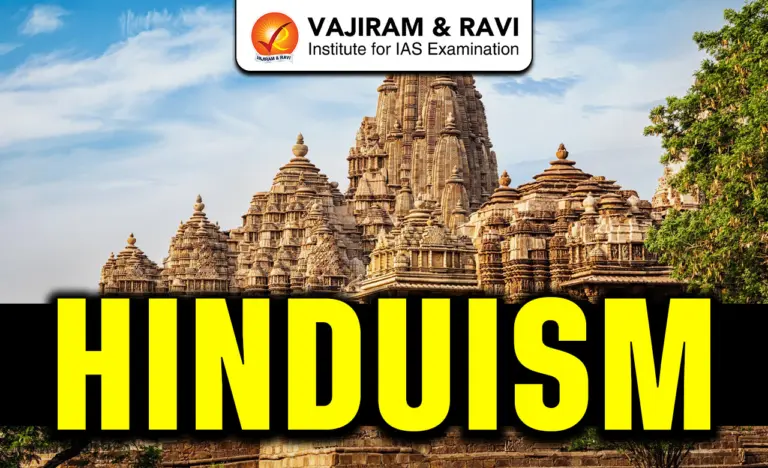
Hinduism, also known as Sanatana Dharma, is regarded as one of the oldest living religious traditions in the world. With approximately 1.2 billion followers, it is the third largest religion in the world, predominantly practiced in India, Nepal, and Mauritius. Unlike many other major religions, Hinduism does not have a single founder, a central religious authority, or one universally accepted scripture. Instead, it represents a broad and inclusive system of beliefs, philosophies, and cultural practices.
Hinduism is often described not merely as a religion but as a way of life, as it governs social conduct, ethical values, rituals, and spiritual pursuits.
Hinduism Nature and Features
Hinduism is unique due to its diversity and adaptability, which can be understood through the following features:
- Hinduism believes in the oneness of existence, where all beings are manifestations of the same ultimate reality. This idea promotes the concept of Vasudhaiva Kutumbakam, meaning the world is one family.
- Hinduism does not impose a single rigid doctrine; rather, it upholds pluralism and accommodates a wide variety of beliefs, allowing individuals the freedom to interpret spiritual truths in their own way.
- It includes both monotheistic and polytheistic elements, meaning that while some followers believe in one supreme reality, others worship multiple gods and goddesses as different manifestations of that reality.
- The religion places greater emphasis on spiritual experience and realization than on strict adherence to rituals or dogmas, thereby making it flexible and inclusive.
- It is non-proselytizing in nature, meaning it does not actively seek converts from other religions.
- Hinduism is syncretic, meaning it has the capacity to absorb and integrate ideas from various traditions over time.
Hinduism Historical Evolution
The historical evolution of Hinduism reflects a continuous process of cultural synthesis, philosophical development, and social transformation, through which it has adapted to changing contexts while preserving its core spiritual foundations.
Indus Valley Background
The early cultural roots of Hinduism can be traced back to the Indus Valley Civilization, where archaeological findings indicate the worship of nature, fertility symbols, and proto-forms of deities like Shiva. Although direct continuity is debated, these elements influenced later religious developments.
Vedic Period
During the Vedic Period, the religious system was centered on the Vedas, which were composed in Sanskrit. Society practiced elaborate rituals and sacrifices known as yajnas, which were conducted by priests. The focus was on appeasing natural forces such as fire, rain, and wind, represented by deities like Agni and Indra.
Upanishadic Phase
In the later Vedic period, there was a shift from ritualism to philosophical inquiry. The Upanishads introduced deeper metaphysical concepts such as Brahman (ultimate reality) and Atman (soul). This period emphasized knowledge and introspection as the means to attain liberation.
Epic and Puranic Period
During this period, Hinduism became more accessible to the common people through devotional practices. Texts like the Ramayana and Mahabharata popularized moral values and religious teachings. The concept of Bhakti (devotion) emerged as a major path to salvation.
Medieval Period
The Medieval Period witnessed the rise of the Bhakti Movement, which emphasized personal devotion to God and rejected rigid social hierarchies. Saints and poets played a crucial role in spreading religious ideas in regional languages, thereby making religion more inclusive.
Modern Period
Under colonial rule, Hindu society underwent significant reforms. Social and religious reformers worked to eliminate practices such as untouchability and promote equality. In the modern era, Hinduism continues to evolve while retaining its core philosophical principles.






Core Philosophical Concepts
Hindu philosophy revolves around some fundamental and interconnected ideas:
- Dharma refers to moral duty, righteousness, and the ethical order that sustains the universe. It varies based on one’s stage of life, occupation, and individual capacity.
- Karma is the universal law of cause and effect, where every action — physical, mental, or verbal — produces corresponding consequences in this life or future lives.
- Samsara represents the continuous cycle of birth, death, and rebirth driven by accumulated karma.
- Moksha is liberation from this cycle and the ultimate goal of human life, achieved through knowledge, devotion, or selfless action.
- Brahman is the infinite, universal, and impersonal ultimate reality underlying all existence.
- Atman is the individual soul or self, which many schools believe is ultimately identical to Brahman.
- Maya refers to cosmic illusion — the veil that prevents individuals from perceiving ultimate reality and causes attachment to the material world.
- Ahimsa (non-violence) is one of the highest ethical values in Hindu thought, influencing law, diet, and social conduct.
- Satya (truth) is considered the foundation of dharma and moral life.
Goals of Human Life (Purusharthas)
Hindu philosophy outlines four essential goals that guide human life:
- The pursuit of Dharma ensures that individuals lead a life based on moral and ethical principles.
- The attainment of Artha involves acquiring wealth and material well-being through legitimate means.
- The fulfillment of Kama allows individuals to enjoy desires and pleasures in a balanced and controlled manner.
- The realization of Moksha represents the highest goal, which is spiritual liberation and self-realization.
Hinduism Sacred Texts and Sources of Knowledge
Hindu scriptures are extraordinarily vast and are broadly divided into Shruti and Smriti.
Shruti (Revealed Texts):
- The Vedas, Rigveda, Samaveda, Yajurveda, and Atharvaveda, form the foundation of Hindu knowledge and are considered eternal and self-revealed.
- The Upanishads (108 in number) explore deep philosophical questions about the nature of reality, self, and consciousness. They form the philosophical core of Hinduism and are collectively called Vedanta.
- The Aranyakas and Brahmanas deal with forest meditations and ritual explanations respectively.
Smriti (Remembered Texts):
- The narrates the life, values, and ideals of Lord Rama as a model of dharmic conduct.
- The Mahabharata is the world’s longest epic and discusses dharma, ethics, politics, and human dilemmas in extraordinary depth. It includes the Bhagavad Gita.
- The Puranas (18 major Puranas) explain complex philosophical ideas through accessible stories and narratives and popularized the worship of Vishnu, Shiva, and Devi.
- The Manusmriti and Dharmashastra literature codified social and legal norms.
- Texts like Arthashastra (statecraft by Kautilya) and Ayurveda demonstrate the practical, scientific, and administrative dimensions of Hindu knowledge traditions.
Concept of God and Deities
Hinduism presents a highly flexible understanding of God:
- It recognizes a single supreme reality, Brahman, which can be worshipped in various forms and manifestations.
- The Trimurti concept explains the cosmic functions through three principal deities: Brahma as the creator, Vishnu as the preserver, and Shiva as the destroyer.
- The worship of the divine feminine, or Shakti, highlights the importance of female energy in the universe.
- Various deities such as Krishna, Rama, Lakshmi, Saraswati, and Ganesha represent different aspects of life and human values.
Major Sects of Hinduism
- Vaishnavism focuses on the worship of Vishnu and his incarnations, emphasizing devotion and surrender to God.
- Shaivism regards Shiva as the supreme deity and emphasizes meditation, asceticism, and inner realization.
- Shaktism centers around the worship of the Goddess as the ultimate source of power and creation.
- Smartism follows a more philosophical approach and allows the worship of multiple deities as equal manifestations of the same ultimate reality.
Schools of Philosophy (Darshanas)
Hinduism developed six orthodox philosophical systems that accept the authority of the Vedas. Each school provides a distinct approach to knowledge, reality, and liberation.
- Nyaya (Founder: Gautama): This school focuses on logic and epistemology, explaining that valid knowledge can be attained through reasoning and analysis. It emphasizes methods such as perception and inference to remove ignorance and achieve liberation.
- Vaisheshika (Founder: Kanada): This school explains the physical world through an atomistic theory, stating that everything is composed of atoms. It classifies reality into categories like substance and quality to systematically understand the universe.
- Sankhya (Founder: Kapila): This philosophy presents a dualistic framework where reality consists of Purusha (consciousness) and Prakriti (matter). Liberation is achieved by realizing the distinction between these two.
- Yoga (Founder: Patanjali): This school provides a practical method for spiritual realization through discipline of body and mind. It outlines the Eightfold Path to control mental fluctuations and attain liberation.
- Mimamsa (Founder: Jaimini): This school emphasizes the performance of Vedic rituals and duties. It considers correct action and adherence to dharma as essential for maintaining cosmic order and achieving spiritual progress.
- Vedanta (Founder: Badarayana): This school explores the nature of ultimate reality (Brahman) and the soul (Atman), emphasizing knowledge as the path to liberation. It has three main sub-schools:
- Advaita (by Adi Shankaracharya) teaches non-dualism, where Atman and Brahman are identical.
- Vishishtadvaita (by Ramanuja) teaches qualified non-dualism, where the soul is part of Brahman but not identical.
- Dvaita (by Madhvacharya) teaches dualism, where God and the soul are completely distinct.
Paths to Liberation
Hinduism recognizes that individuals have different temperaments and therefore offers multiple paths for attaining moksha:
- Jnana Yoga: the path of knowledge, focusing on self-realization through wisdom, inquiry, and philosophical understanding.
- Bhakti Yoga: the path of devotion, emphasizing love, surrender, and personal connection with a chosen deity.
- Karma Yoga: the path of selfless action, involving performance of duties without attachment to results, as taught in the Bhagavad Gita.
Concept of Avatars (Dashavatara)
The Avatara doctrine refers to the descent of the divine into the world to restore cosmic order (dharma) whenever it is threatened. The ten principal avatars of Vishnu — known as Dashavatara — include Matsya, Kurma, Varaha, Narasimha, Vamana, Parashurama, Rama, Krishna, Buddha, and Kalki. This doctrine demonstrates Hinduism’s belief in divine participation in human history and its capacity to absorb and integrate the Buddha within its framework
Hinduism Religious Practices
- Worship in Hinduism, known as puja, involves offering prayers, flowers, food, and incense to deities either in temples or at home.
- Pilgrimages to sacred places are considered spiritually significant and are believed to purify the soul.
- Festivals play an important role in social and religious life, celebrating various aspects of mythology, seasons, and cultural traditions.
Caste System and Society
- The caste system originated as a division of labor based on qualities and duties but gradually became rigid and birth-based.
- It divided society into hierarchical groups, which influenced social interactions and occupations.
- Although legally abolished, remnants of caste-based discrimination still exist in some areas.
Relevance of Hinduism in Contemporary India and the World
Hindu philosophy continues to have deep relevance in the modern world:
- Yoga and Ayurveda have been recognized globally as valuable contributions to human well-being. The United Nations declared June 21 as International Yoga Day in 2015.
- The concept of Vasudhaiva Kutumbakam has been adopted as a guiding principle of India’s foreign policy and G20 presidency in 2023.
- Hindu environmental ethics, viewing nature as sacred and interconnected, are increasingly relevant in the context of climate change and ecological degradation.
- The pluralistic and non-exclusive character of Hinduism offers a philosophical framework for addressing religious conflict and promoting interfaith dialogue.
- Hindu concepts of consciousness and the nature of the mind are increasingly engaging with neuroscience, quantum physics, and modern psychology.

 Last updated on April, 2026
→ UPSC Final Result 2025 is now out.
→ UPSC has released UPSC Toppers List 2025 with the Civil Services final result on its official website.
→ Anuj Agnihotri secured AIR 1 in the UPSC Civil Services Examination 2025.
→ UPSC Marksheet 2025 is now out.
→ UPSC Notification 2026 & UPSC IFoS Notification 2026 is now out on the official website at upsconline.nic.in.
→ UPSC Calendar 2026 has been released.
→ Check out the latest UPSC Syllabus 2026 here.
→ UPSC Prelims 2026 will be conducted on 24th May, 2026 & UPSC Mains 2026 will be conducted on 21st August 2026.
→ The UPSC Selection Process is of 3 stages-Prelims, Mains and Interview.
→ Prepare effectively with Vajiram & Ravi’s UPSC Prelims Test Series 2026 featuring full-length mock tests, detailed solutions, and performance analysis.
→ Enroll in Vajiram & Ravi’s UPSC Mains Test Series 2026 for structured answer writing practice, expert evaluation, and exam-oriented feedback.
→ Join Vajiram & Ravi’s Best UPSC Mentorship Program for personalized guidance, strategy planning, and one-to-one support from experienced mentors.
→ Shakti Dubey secures AIR 1 in UPSC CSE Exam 2024.
→ Also check Best UPSC Coaching in India
Hinduism FAQs
Q1. What is Hinduism and why is it called a way of life?+
Q2. What are the core beliefs of Hinduism?+
Q3. What are the main sects within Hinduism?+
Q4. What is the concept of Brahman in Hinduism?+
Q5. How does Hinduism explain the cycle of life and death?+
Q6. Why is Hinduism considered relevant in the modern world?+
Tags: hinduism