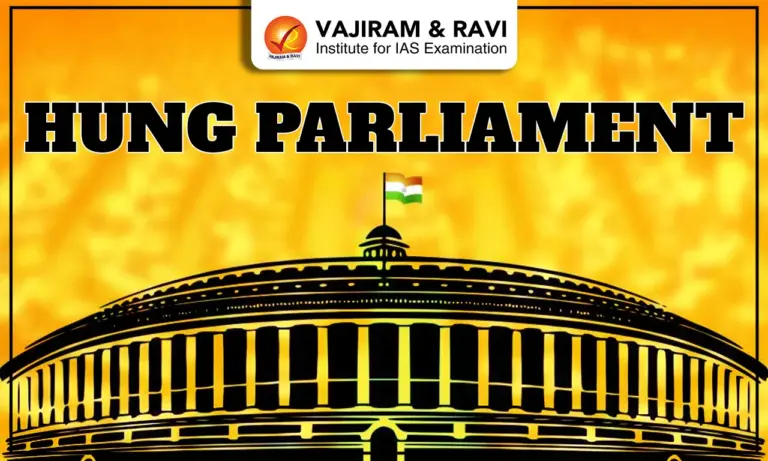
A Hung Parliament is an important phenomenon in parliamentary democracies, where no single political party is able to secure an absolute majority of seats in the legislature. The inability of a party or pre-poll alliance to cross the halfway mark significantly influences the course of governance, policymaking, and stability of the political system. It often sets the stage for negotiations, alliances, or even political uncertainty. In this article, we are going to cover the Hung Parliament, its importance in India, historical background, causes and implications.
Hung Parliament
A Hung Parliament occurs when no political party or alliance secures a clear majority in the legislature after an election. This absence of majority implies that no party can independently form the government and run the executive. Such situations necessitate coalition building, minority governments, or fresh elections.
The term is widely used in parliamentary democracies like the United Kingdom, Canada, and India. A Hung Parliament is not inherently dysfunctional but does create a political landscape filled with uncertainties, compromises, and negotiations, often leading to coalition politics.
Hung Parliament Historical Background in India
During the first decade after independence, India saw stable governments led by the Indian National Congress, which commanded comfortable majorities. This dominance began to change after the 1977 general election, when the Emergency’s backlash led to the rise of the Janata Party, marking India’s first significant experience of a Hung Parliament at the Union level.
The 1990s saw frequent Hung Parliaments, giving rise to fragile governments. Examples include:
- H.D. Deve Gowda’s United Front Government (1996-97)
- I.K. Gujral’s short tenure (1997-98)
These governments highlighted the inherent challenges of functioning without a stable majority. However, the Atal Bihari Vajpayee-led NDA coalition (1999-2004) demonstrated that even coalition governments could deliver stability and growth if built on structured alliances.
Thus, India’s experience shows both the fragility and resilience of democracy under a Hung Parliament.





Hung Parliament Causes
The causes of Hung Parliament includes:
- Strength of Regional Parties: The rise of regional parties has been the most important factor. From 27 seats in 1989, regional parties increased their share to nearly 159 seats in 2004, making it almost impossible for a single national party to secure a majority. Their growing power fragments the mandate, often compelling coalition arrangements.
- Declining Dominance of National Parties: The weakening dominance of the INC and the emergence of the BJP as a national alternative created an era of bipolar competition, but with neither party always assured of majority. This competitive environment increases the chances of Hung Parliaments.
- Low Election Turnout: The average turnout in India’s general elections has hovered around 60%, which dilutes the mandate of national parties and amplifies the role of regional and issue-specific parties. Low participation makes it harder for one party to sweep the electorate.
- Social and Political Fragmentation: India’s diverse caste, religious, linguistic, and regional identities often find expression in regional parties. This fragmented voting behavior ensures no single party represents all groups, leading to fractured verdicts.
Hung Parliament Implications
Hung Parliament had the following implications:
- Political Instability: Hung Parliaments lead to political instability. Coalition governments depend on constant negotiations and compromises, sometimes leading to incoherent policies or frequent changes in leadership.
- Impact on Economy and Trade: Markets prefer stable governments. For example, after the 2004 Hung Parliament, the Sensex crashed by over 900 points in a single day. Investors and businesses face uncertainty as long-term policies may be compromised by coalition compulsions.
- Minority Governments: When coalitions cannot hold, minority governments are formed, dependent on outside support. These governments are vulnerable to no-confidence motions and often make short-term populist policies instead of long-term reforms.
- Erosion of Public Confidence: Frequent elections or unstable coalitions create a perception of weak governance, eroding the trust of citizens in political institutions.
Hung Parliament and Role of President
In India, the President’s role becomes central in resolving a Hung Parliament. The President exercises discretion in inviting parties to form a government, guided by constitutional conventions and judicial precedents.
The Sarkaria Commission guidelines are often referred to in such situations:
- First Preference: A pre-poll alliance with a majority.
- Second Preference: The single largest party, even without a majority.
- Third Preference: A post-poll coalition commanding a majority.
- Last Preference: A coalition where some parties join the government while others provide outside support.
If no combination proves workable, the President’s Rule may be imposed, followed by fresh elections.
Hung Parliament Global Comparison
A Hung Parliament is not just a political event but a reflection of India’s pluralistic democracy. While it often brings instability, compromises, and uncertainty, it also shows the diversity of political voices in the country.
| Aspect | India | United Kingdom | Canada |
|
System of Government |
Parliamentary democracy, federal structure |
Parliamentary democracy, constitutional monarchy |
Parliamentary democracy, federal structure |
|
Notable Instances of Hung Parliament |
1977 (Janata Party), 1989, 1996–99 (United Front), 2004 (UPA I) |
2010 (Conservatives + Liberal Democrats), 2017 (Conservatives relying on DUP) |
Multiple instances common at federal level (e.g., 2004, 2006, 2008, 2019) |
|
Outcome of Hung Parliament |
Coalition governments (often fragile, e.g., Deve Gowda, Gujral) or minority governments with outside support |
Stable coalition in 2010, confidence-and-supply arrangements in 2017 |
Minority governments often formed; rely on smaller parties for issue-based support |
|
Stability of Governance |
Mixed some governments short-lived, others (like Vajpayee NDA, UPA I) lasted full term |
Relatively stable; 2010 coalition completed term |
Functional but requires constant negotiations; minority governments may fall early |
|
Role of Head of State |
President invites party/coalition to prove majority; may impose President’s Rule if no solution |
Monarch (formally) invites party leader to form government; based on conventions |
Governor General invites leader most likely to command confidence of House |
|
Impact on Politics |
Rise of coalition politics, regional parties gaining influence, frequent instability in 1990s |
Strengthened role of compromise and coalition-building |
Institutionalized minority governments; culture of negotiation and cooperation |
|
Impact on Economy & Policy |
Sometimes market instability (e.g., 2004 Sensex crash); coalition compulsions affect reforms |
Markets usually stable; coalition agreements ensure policy continuity |
Policies shaped by compromises; minority govts focus on consensus-building |
|
Public Perception |
Often seen as unstable, but also reflects India’s diversity and pluralism |
Seen as a temporary phase requiring compromise |
Widely accepted as a normal outcome of fragmented politics |
| Also Check Other Posts | |
| Important Articles of Indian Constitution | 9th Schedule |
| Schedules of Indian Constitution | Anti Defection Law |
| 5th Schedule | Preamble of the Indian Constitution |
| 6th Schedule | |

 Last updated on March, 2026
→ UPSC Final Result 2025 is now out.
→ UPSC has released UPSC Toppers List 2025 with the Civil Services final result on its official website.
→ Anuj Agnihotri secured AIR 1 in the UPSC Civil Services Examination 2025.
→ UPSC Marksheet 2025 is now out.
→ UPSC Notification 2026 & UPSC IFoS Notification 2026 is now out on the official website at upsconline.nic.in.
→ UPSC Calendar 2026 has been released.
→ Check out the latest UPSC Syllabus 2026 here.
→ UPSC Prelims 2026 will be conducted on 24th May, 2026 & UPSC Mains 2026 will be conducted on 21st August 2026.
→ The UPSC Selection Process is of 3 stages-Prelims, Mains and Interview.
→ Prepare effectively with Vajiram & Ravi’s UPSC Prelims Test Series 2026 featuring full-length mock tests, detailed solutions, and performance analysis.
→ Enroll in Vajiram & Ravi’s UPSC Mains Test Series 2026 for structured answer writing practice, expert evaluation, and exam-oriented feedback.
→ Join Vajiram & Ravi’s Best UPSC Mentorship Program for personalized guidance, strategy planning, and one-to-one support from experienced mentors.
→ Shakti Dubey secures AIR 1 in UPSC CSE Exam 2024.
→ Also check Best UPSC Coaching in India
Hung Parliament FAQs
Q1. What is a Hung Parliament?+
Q2. What are the causes of the Hung Parliament?+
Q3. What are the implications of the Hung Parliament?+
Q4. When does the Hung Parliament take place in India?+
Tags: hung parliament