Plant Treaty Latest News
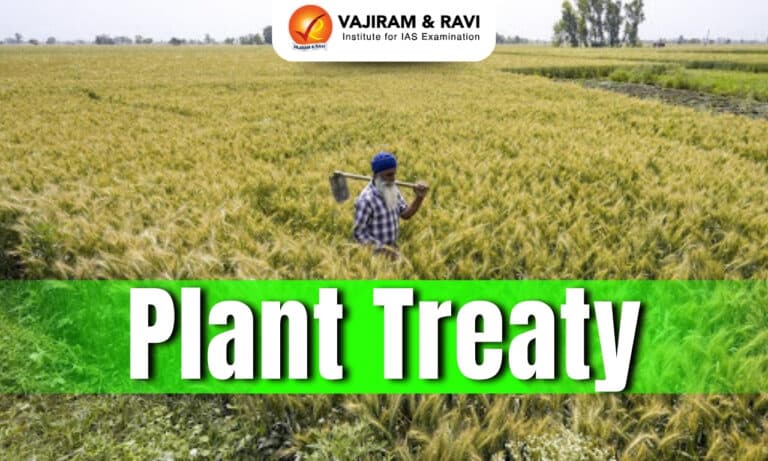
- The Union government and farmers’ groups have raised concerns over proposed amendments to the International Plant Treaty, warning that they may dilute farmers’ rights and undermine India’s sovereignty over its plant genetic resources.
India Stands Against Proposed Amendments to the Plant Treaty
- As global negotiations on plant genetic resources unfold in Peru, India has voiced serious objections to proposed amendments to the International Treaty on Plant Genetic Resources for Food and Agriculture (commonly known as the Plant Treaty).
- The concerns stem from fears that the amendments would undermine India’s seed sovereignty and the rights of its farmers.





About the Plant Treaty
- The International Treaty on Plant Genetic Resources for Food and Agriculture (ITPGRFA is a legally binding global agreement adopted in 2001 under the Food and Agriculture Organisation (FAO) of the United Nations.
- The treaty aims to:
- Conserve plant genetic resources (PGRFA).
- Promote sustainable use of these resources.
- Ensure fair and equitable sharing of benefits arising from their use, especially in research and development.
- India ratified the treaty in 2002.
About the Recent Negotiations
- The 10th session of the Governing Body of the Plant Treaty is being held in Peru from July 7 to 11, 2025.
- An Ad Hoc Open-Ended Working Group is considering amendments to Annex I of the treaty to expand the coverage of the Multilateral System (MLS) to all Plant Genetic Resources for Food and Agriculture (PGRFA).
- This proposed expansion implies that India and other countries would be obligated to share all of their plant germplasm under standard international agreements, potentially overriding national terms and conditions.
Core of the Concern: Sovereignty and Farmers’ Rights
- Indian farmers’ organisations such as Bharath Beej Swaraj Manch and Rashtriya Kisan Mahasangh have publicly opposed these amendments. They argue that:
- Annexe I’s expansion would bring all plant genetic material, without exception, under international access frameworks.
- This move contradicts the treaty’s original mandate, which only facilitated access to a limited list of crops critical for food security.
- India’s sovereign rights over seeds and plant varieties would be compromised.
- Farmers’ rights to save, use, exchange, and sell seeds would be diluted under a globally determined material transfer system.
Institutional Response and Representation
- The Indian Council of Agricultural Research (ICAR) has stated that national interest will be safeguarded.
- India’s official representative at the Peru negotiations is Sunil Archak, Principal Scientist at ICAR’s National Bureau of Plant Genetic Resources and also the Co-Chairperson of the ongoing working group.
- ICAR emphasised that Mr. Archak’s visit was approved and timely, and he is considered highly capable of defending India’s concerns during the negotiations.
States’ Role and Constitutional Implications
- Kerala Government has emphasised that agriculture is a State subject under Schedule VII of the Indian Constitution.
- The State Government criticised the lack of consultation with State Governments and farmers’ groups, warning that the amendments could also sideline State Biodiversity Boards and their regulatory role over local genetic resources.
- Such unilateral shifts in treaty obligations, without broader domestic deliberation, risk undermining India’s federal structure in agricultural policymaking.
Broader Implications for India’s Agricultural Policy
- The proposal to include all PGRFA in the MLS system could:
- Impact India’s capacity to regulate access to indigenous germplasm.
- Reduce incentives for local innovation in seed conservation and development.
- Facilitate foreign entities’ access to India’s rich genetic heritage without proportionate benefit-sharing.
- The proposed Standard Material Transfer Agreement (SMTA), if universally applied, would mean India cannot tailor access rules based on the type or origin of the germplasm, which may have long-term implications for India’s bioprospecting potential and intellectual property frameworks.
Source: TH

 Last updated on March, 2026
→ UPSC Final Result 2025 is now out.
→ UPSC has released UPSC Toppers List 2025 with the Civil Services final result on its official website.
→ Anuj Agnihotri secured AIR 1 in the UPSC Civil Services Examination 2025.
→ UPSC Marksheet 2025 is now out.
→ UPSC Notification 2026 & UPSC IFoS Notification 2026 is now out on the official website at upsconline.nic.in.
→ UPSC Calendar 2026 has been released.
→ Check out the latest UPSC Syllabus 2026 here.
→ UPSC Prelims 2026 will be conducted on 24th May, 2026 & UPSC Mains 2026 will be conducted on 21st August 2026.
→ The UPSC Selection Process is of 3 stages-Prelims, Mains and Interview.
→ Prepare effectively with Vajiram & Ravi’s UPSC Prelims Test Series 2026 featuring full-length mock tests, detailed solutions, and performance analysis.
→ Enroll in Vajiram & Ravi’s UPSC Mains Test Series 2026 for structured answer writing practice, expert evaluation, and exam-oriented feedback.
→ Join Vajiram & Ravi’s Best UPSC Mentorship Program for personalized guidance, strategy planning, and one-to-one support from experienced mentors.
→ Shakti Dubey secures AIR 1 in UPSC CSE Exam 2024.
→ Also check Best UPSC Coaching in India
Plant Treaty FAQs
Q1. What is the key concern in the proposed amendment to the Plant Treaty?+
Q2. Who is representing India in the Peru meeting on the Plant Treaty?+
Q3. What is Annex I of the Plant Treaty?+
Q4. Why are Indian farmers’ organisations opposing the amendments?+
Q5. What constitutional issue has been raised by Kerala’s Agriculture Minister?+
Tags: mains articles plant treaty upsc current affairs upsc mains current affairs