Global Income Equality Latest News
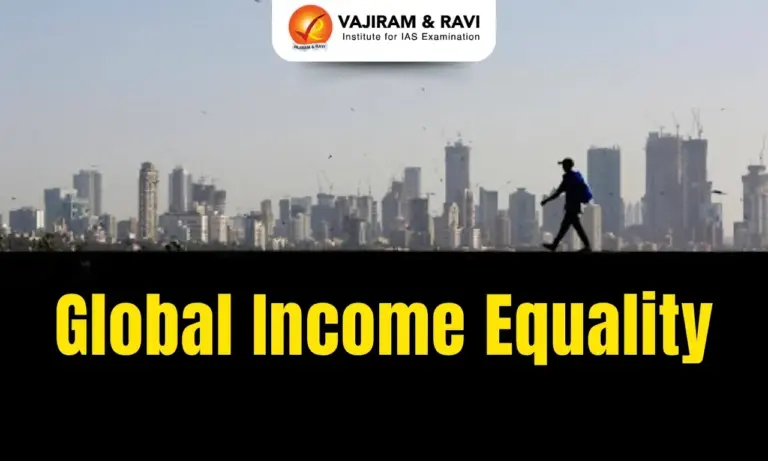
According to a World Bank report, inequality in India has come down significantly between 2011-12 and 2022-23, making it the fourth-most equal country globally.
India Emerges as the Fourth Most Equal Country in the World
- According to the World Bank’s latest estimates, India has achieved a remarkable position as the fourth most income-equal country globally, with a Gini Index score of 25.5. Only the Slovak Republic, Slovenia, and Belarus have recorded better equality indicators.
- This development comes alongside a significant reduction in extreme poverty, falling from 16.2% in 2011-12 to just 2.3% in 2022-23.
- Over 171 million Indians have been lifted out of extreme poverty in the last decade, signalling the success of India’s welfare-oriented policy architecture.




Understanding the Gini Index and India’s Score
- The Gini Index is a statistical measure used to gauge inequality in income, wealth, or consumption. A score of 0 represents perfect equality, while 100 denotes maximum inequality.
- India’s Gini Index (2022-23) is 25.5. In comparison, China: 35.7, United States: 41.8, G7/G20 Averages: Significantly higher than India
- India’s placement within the “moderately low inequality” category (Gini score of 25-30) positions it far ahead of many advanced economies and closer to the “low inequality” threshold.
Decline in Extreme Poverty as a Key Driver
- A major contributor to India’s improved income equality is the substantial decline in poverty rates. Based on the global poverty line of USD 2.15/day, India’s extreme poverty rate dropped from 16.2% in 2011 to just 2.3% in 2022-23.
- This progress has resulted in 171 million Indians exiting the poverty trap in a decade, making it one of the most significant anti-poverty achievements globally in recent years.
Government Schemes and Inclusive Policy Interventions
- The World Bank attributes this achievement not only to economic growth but to India’s focused, inclusive welfare policies. Key initiatives include:
- Financial Inclusion and Direct Transfers
- PM Jan Dhan Yojana: Over 55 crore bank accounts have expanded financial access, especially for rural and underbanked citizens.
- Aadhaar-linked Direct Benefit Transfers (DBT): Enabled efficient and leak-proof delivery of government benefits, saving over ₹3.48 lakh crore by March 2023.
- Health and Social Security
- Ayushman Bharat: Offers ₹5 lakh in health insurance, with over 41 crore cards issued to date.
- PMGKAY: Provided free food grains to over 80 crore beneficiaries, contributing to food security and nutrition.
- Livelihood and Entrepreneurship
- Stand-Up India: Supports SC/ST and women entrepreneurs with loans and financial assistance.
- PM Vishwakarma Yojana: Aims to uplift traditional artisans with training, credit, and market support.
Balancing Growth with Equity
- India’s journey reflects a rare convergence of economic reform with social protection.
- According to the Social Welfare Department’s statement, “India’s path to income equality has been steady and focused… The Gini Index of 25.5 reflects real change in people’s lives, better access to food, jobs, healthcare, and banking.”
- The country’s progress in this domain is being seen as a model for developing economies that aim to pursue growth with fairness.
Global Context and India’s Distinct Approach
- India’s achievement stands out among 167 countries surveyed. Other nations in the “moderately low inequality” category include Scandinavian welfare states like Norway, Finland, and Belgium, as well as rapidly growing economies like Poland and the UAE.
- While many of these nations have relied on long-standing welfare systems, India’s success has come through digital inclusion, targeted cash transfers, and integrated rural support, making it a unique example of equity in a large, diverse democracy.

 Last updated on March, 2026
→ UPSC Final Result 2025 is now out.
→ UPSC has released UPSC Toppers List 2025 with the Civil Services final result on its official website.
→ Anuj Agnihotri secured AIR 1 in the UPSC Civil Services Examination 2025.
→ UPSC Marksheet 2025 is now out.
→ UPSC Notification 2026 & UPSC IFoS Notification 2026 is now out on the official website at upsconline.nic.in.
→ UPSC Calendar 2026 has been released.
→ Check out the latest UPSC Syllabus 2026 here.
→ UPSC Prelims 2026 will be conducted on 24th May, 2026 & UPSC Mains 2026 will be conducted on 21st August 2026.
→ The UPSC Selection Process is of 3 stages-Prelims, Mains and Interview.
→ Prepare effectively with Vajiram & Ravi’s UPSC Prelims Test Series 2026 featuring full-length mock tests, detailed solutions, and performance analysis.
→ Enroll in Vajiram & Ravi’s UPSC Mains Test Series 2026 for structured answer writing practice, expert evaluation, and exam-oriented feedback.
→ Join Vajiram & Ravi’s Best UPSC Mentorship Program for personalized guidance, strategy planning, and one-to-one support from experienced mentors.
→ Shakti Dubey secures AIR 1 in UPSC CSE Exam 2024.
→ Also check Best UPSC Coaching in India
Global Income Equality FAQs
Q1. What is India’s current Gini Index score according to the World Bank?+
Q2. How many Indians have been lifted out of extreme poverty in the past decade?+
Q3. What is the significance of the Gini Index in assessing equality?+
Q4. Which government schemes contributed to India’s rise in income equality?+
Q5. How does India compare with the US and China in terms of income inequality?+
Tags: global income equality mains articles upsc current affairs upsc mains current affairs