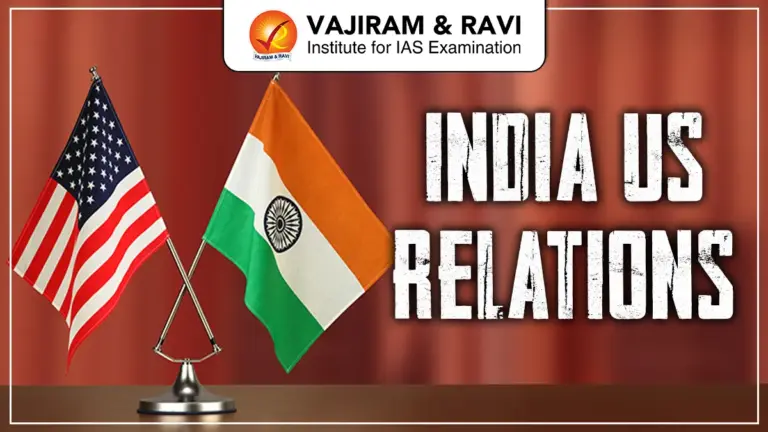
India-US Relations have evolved into a comprehensive strategic partnership, covering defence, trade, technology, and people-to-people ties. Over the years, both countries have strengthened political, economic, and security cooperation while collaborating on global and regional issues. Despite shared strategic interests, the relationship faces challenges in trade, technology, and foreign policy. Moving forward, sustained dialogue, mutual trust, and partnership in innovation and security can further deepen bilateral ties.
India-US Relations Evolution
- Cold War Phase (1947-1991): Relations remained limited due to India’s non-aligned stance and closer ties with the Soviet Union, while the U.S. aligned with Pakistan during this period.
- Post-Cold War Re-engagement (1991-2000): India’s economic liberalisation and the end of the Cold War opened new avenues for cooperation, particularly in trade and investment.
- Strategic Breakthrough (2005-2008): The India-US Civil Nuclear Deal (2005) ended India’s nuclear isolation and symbolised mutual strategic trust.
- Institutionalisation of Strategic Dialogue (2008-2015): Expansion of defence cooperation, regular strategic dialogues, and growing people-to-people ties strengthened bilateral engagement.
- Major Defence Partner Status (2016): The U.S. designated India as a Major Defence Partner, enabling access to advanced defence technologies.
- Foundational Agreements Era (2016-2020): Signing of LEMOA, COMCASA, and BECA enhanced interoperability, logistics support, and intelligence sharing.
- Comprehensive Global Strategic Partnership (2020 onwards): Elevation of ties to a comprehensive partnership covering defence, technology, energy, climate change, and global issues.
- Focus on Emerging Technologies & Indo-Pacific (Recent Years): Initiatives like iCET, Quad cooperation, and supply-chain resilience reflect the future-oriented nature of the partnership.
Read About: India China Relations
India-US Relations Political and Diplomatic
Political and diplomatic engagement forms the backbone of India-US relations, providing strategic direction and continuity to the partnership.
- High-Level Political Visits: Frequent exchanges at the level of the Prime Minister of India and the U.S. President have strengthened mutual trust and delivered strategic outcomes. Leaders also interact regularly at G20 Summits, Quad Leaders’ Summits, and India-US-Japan Trilateral meetings.
- Institutionalised Dialogue Mechanisms: A wide-ranging dialogue architecture provides long-term stability to the relationship, including:
- India-US 2+2 Ministerial Dialogue (Foreign and Defence Ministers)
- India-US Commercial Dialogue
- Economic and Financial Partnership
- Trade Policy Forum (TPF)
- Strategic Energy Partnership
- Homeland Security Dialogue
- Strategic Coordination on Global Issues: India and the US closely consult on counter-terrorism, Indo-Pacific security, climate change, and global governance reforms, reflecting growing strategic convergence.
- Multilateral and Minilateral Engagement: Both countries coordinate positions in forums such as the Quad, UN, G20, and WTO, enhancing their collective diplomatic influence.





India-US Relations Defence and Security Cooperation
Defence and security cooperation has emerged as a core pillar of the India-US strategic partnership, driven by shared security concerns, growing mutual trust, and convergence in the Indo-Pacific. Over the years, cooperation has expanded from limited engagement to deep military interoperability, defence trade, intelligence sharing, and joint operational coordination.
- Defence Trade and Technology Cooperation: The United States has become one of India’s leading defence suppliers, with defence procurements exceeding USD 15 billion. The Defence Technology and Trade Initiative (DTTI) promotes co-development and co-production of advanced defence technologies, aligning with India’s Make in India and Atmanirbhar Bharat goals.
- Major Defence Partner Status: In 2016, the US designated India as a Major Defence Partner, facilitating access to advanced technologies and placing India on par with Washington’s closest defence allies in terms of technology sharing.
- Foundational Defence Agreements:The signing of four key agreements has institutionalised defence cooperation and enhanced interoperability:
- GSOMIA (2002): Protection of classified military information
- LEMOA (2016): Logistics support for refuelling and replenishment
- COMCASA (2018): Secure and encrypted military communications
- BECA (2020): Sharing of geospatial intelligence and satellite data
- Joint Military Exercises and Interoperability: India conducts more military exercises with the US than with any other country. Major exercises include Yudh Abhyas, Vajra Prahar, Cope India, and the Malabar naval exercise under the Quad framework, enhancing combat readiness and interoperability.
- Maritime Security and Indo-Pacific Cooperation: Both countries cooperate in maritime domain awareness, anti-piracy operations, freedom of navigation, and humanitarian assistance and disaster relief (HADR), reinforcing a free and open Indo-Pacific.
Read About: India Pakistan Relations
India-US Relations Economic and Trade Ties
Economic and trade engagement is a key pillar of India-US relations, underpinned by growing market complementarities, investment flows, and innovation-driven cooperation.
- Trade Volume and Composition: The U.S. is India’s largest trading partner, with bilateral trade covering pharmaceuticals, gems and jewellery, machinery, electronics, textiles, chemicals, and agricultural products. In 2024, India exported goods worth about USD 87.3 billion to the U.S., reflecting deepening economic interdependence.
- Investment and Corporate Linkages: American firms are among the top investors in India, particularly in technology, defence, manufacturing, financial services, and clean energy. At the same time, Indian companies in IT, pharmaceuticals, steel, and automotive sectors have invested heavily in the U.S., generating jobs and innovation.
- Technology, Innovation, and Supply Chains: Economic ties increasingly focus on semiconductors, digital trade, AI, and critical minerals, strengthening supply chain resilience and reducing over-dependence on single sources.
- Challenges in Trade Relations: Persistent issues include tariff disputes, absence of a Free Trade Agreement, IPR concerns, regulatory barriers, and differences over data localisation and visa policies.
India-US Relations Science, and Space Cooperation
Science, technology, and space cooperation is a future-defining pillar of India-US relations, reflecting shared innovation-driven growth objectives and strategic trust.
- Institutional Framework for S&T Cooperation: India-US collaboration is anchored in the Science and Technology Cooperation Agreement (2005), renewed for ten years in 2019.
- Emerging and Critical Technologies: Both countries prioritise cooperation in artificial intelligence, quantum computing, semiconductors, biotechnology, cybersecurity, and advanced materials. The Initiative on Critical and Emerging Technologies (iCET) provides a strategic framework for government-industry-academia collaboration.
- Research, Innovation and Academic Linkages: Extensive partnerships between universities, research institutions, and startups support joint R&D, skill development, and innovation ecosystems, strengthening long-term technological competitiveness.
- Space Cooperation (ISRO-NASA Partnership): India and the US have a long history of cooperation in earth observation, satellite navigation, space science, and planetary exploration. The India-US Joint Working Group on Civil Space Cooperation regularly reviews progress and identifies new collaboration areas.
- Future-Oriented Space Collaboration: ISRO and NASA are working together on Mars exploration, heliophysics, space situational awareness, and human spaceflight-related research, enhancing scientific capability and strategic trust.
India-US Relations Cooperation in Multilateral Forums
India and the United States closely cooperate in multilateral and minilateral forums to address global governance challenges, regional security, and economic stability.
- Quadrilateral Security Dialogue (Quad): India, the US, Japan, and Australia work together to ensure Indo-Pacific security, uphold freedom of navigation, and cooperate on critical areas such as climate action, critical technologies, resilient supply chains, and quality infrastructure development.
- I2U2 Group (India-Israel-UAE-US): This emerging minilateral platform focuses on practical economic cooperation, particularly in clean energy, food security, advanced technology, and infrastructure, linking South Asia, the Middle East, and the US.
- Indo-Pacific Economic Framework for Prosperity (IPEF): A US-led initiative aimed at deepening economic engagement in the Indo-Pacific, with India playing a key role in pillars related to supply chains, clean energy, and fair economic practices.
- Global Multilateral Institutions (UN, G20, WTO, IMF, World Bank): India and the US coordinate positions to reform global governance, promote inclusive and sustainable growth, and address transnational challenges such as pandemics, trade disruptions, financial stability, and development financing.
- Minerals Security Partnership (MSP): India’s participation enhances critical mineral supply chain resilience, reduces dependence on single-source suppliers, and supports energy transition and advanced manufacturing goals.
- Artemis Accords: Cooperation under the Artemis Accords strengthens peaceful and transparent space exploration, enabling collaboration in lunar exploration, space science, and the responsible use of outer space.
People-to-People Ties and Indian Diaspora in the US
- Largest Skilled Diaspora: The Indian diaspora, about 4.8 million strong, is one of the most educated and economically influential communities in the US.
- Technology & Innovation Linkages: Indian-origin engineers and scientists play a key role in Silicon Valley, AI, and startup ecosystems, strengthening tech cooperation.
- Political Influence: Indian-Americans have growing representation in the US Congress, administration, and local governance, shaping pro-India policies.
- Education & Academic Exchanges: Over 200,000 Indian students in the US enhance educational ties, research collaboration, and knowledge exchange.
- Business & Investment Bridge: Indian-origin CEOs and entrepreneurs promote two-way investments, startups, and global value chains.
- Cultural Diplomacy: Festivals, yoga, cinema, and cultural institutions promote soft power, mutual understanding, and societal goodwill.
India-US Relations Areas of Divergence and Challenges
- Tariff Escalation & Trade Barriers: The U.S. has doubled tariffs on Indian goods to 50%, including punitive duties linked to India’s Russian oil purchases, impacting exports in sectors like textiles, gems, and seafood.
- Trade Deficit & Market Access Issues: The U.S.-India trade deficit rose to ~$45.8 billion in 2024-25, with deep disagreements over agricultural access, dairy, and non-tariff barriers, complicating bilateral economic talks.
- H-1B Visa Policy Tensions: The U.S. introduced a $100,000 fee on H-1B visa applications, increasing costs for Indian IT firms and creating uncertainty for thousands of professionals amid processing delays.
- Technology & Data Regulation Friction: India’s data localisation and digital policy frameworks continue to clash with U.S. demands for open cross-border data flows and stronger IP protections, affecting tech and digital services cooperation. (based on ongoing policy debates)
- Geopolitical Divergence – Russia & Energy: Continued Indian imports of Russian crude have drawn U.S. trade threats and tariff pressure, reflecting deeper strategic differences over the Russia-Ukraine conflict and sanctions policy.
- Strategic Autonomy vs U.S. Policy Expectations: India’s multi-aligned approach balancing ties with Russia, Iran, and Western partners, often contrasts with U.S. geopolitical priorities, creating diplomatic friction despite shared Indo-Pacific goals.
Way Forward for India-US Relations
- Deepen Strategic Trust: Enhance high-level political dialogue and defence cooperation to manage differences while strengthening the Indo-Pacific partnership.
- Resolve Trade & Economic Frictions: Pursue a balanced trade framework by addressing tariffs, market access, digital trade, and mobility issues (H-1B visas) through institutional mechanisms.
- Strengthen Technology & Innovation Ties: Expand cooperation in semiconductors, AI, defence tech, clean energy, and space, ensuring mutually acceptable data governance and IP regimes.
- Respect Strategic Autonomy: Acknowledge India’s multi-alignment approach while aligning on shared interests such as maritime security, supply chains, and regional stability.
- People-to-People & Talent Mobility: Facilitate smoother movement of students, researchers, and professionals to sustain innovation-led growth and soft power linkages.
Cooperate on Global Challenges: Work together on climate action, global health, supply chain resilience, and reform of multilateral institutions to promote inclusive global governance.

 Last updated on March, 2026
→ UPSC Final Result 2025 is now out.
→ UPSC has released UPSC Toppers List 2025 with the Civil Services final result on its official website.
→ Anuj Agnihotri secured AIR 1 in the UPSC Civil Services Examination 2025.
→ UPSC Marksheet 2025 is now out.
→ UPSC Notification 2026 & UPSC IFoS Notification 2026 is now out on the official website at upsconline.nic.in.
→ UPSC Calendar 2026 has been released.
→ Check out the latest UPSC Syllabus 2026 here.
→ UPSC Prelims 2026 will be conducted on 24th May, 2026 & UPSC Mains 2026 will be conducted on 21st August 2026.
→ The UPSC Selection Process is of 3 stages-Prelims, Mains and Interview.
→ Prepare effectively with Vajiram & Ravi’s UPSC Prelims Test Series 2026 featuring full-length mock tests, detailed solutions, and performance analysis.
→ Enroll in Vajiram & Ravi’s UPSC Mains Test Series 2026 for structured answer writing practice, expert evaluation, and exam-oriented feedback.
→ Join Vajiram & Ravi’s Best UPSC Mentorship Program for personalized guidance, strategy planning, and one-to-one support from experienced mentors.
→ Shakti Dubey secures AIR 1 in UPSC CSE Exam 2024.
→ Also check Best UPSC Coaching in India
India-US Relations FAQs
Q1. Why are India-US relations important for India?+
Q2. What is the strategic significance of India-US relations?+
Q3. What are the key areas of cooperation between India and the US?+
Q4. What defence agreements have strengthened India-US relations?+
Q5. What are the main challenges in India-US relations?+
Tags: india-us relations