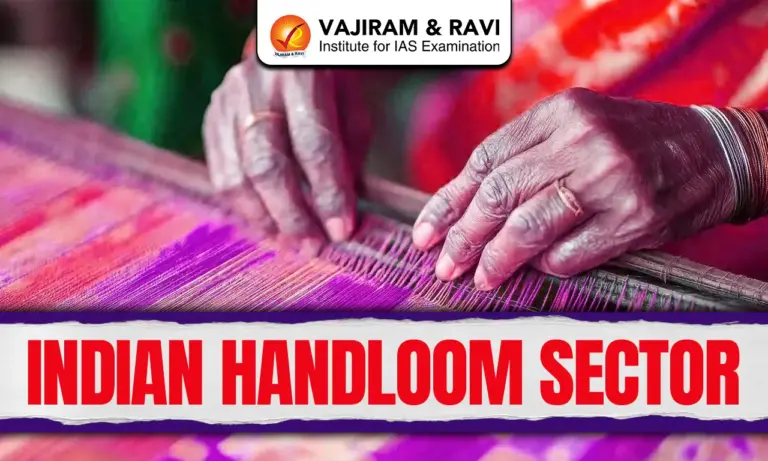
The India Handloom Sector is one of the largest unorganized sectors in India. It holds a long history and is known for its skilled artisans. The handloom industry reflects India’s rich cultural heritage and helps preserve traditional designs and craftsmanship.
India Handloom Sector Background
- The tradition of handloom weaving in India is very ancient. It goes back to the time of the Indus Valley Civilization. Excavations at Mohenjo-Daro and Harappa show that people knew the art of spinning and weaving thousands of years ago. Over time, handloom weaving became an important part of the culture and traditions of different regions of India.
- During British rule, the importance of handlooms increased further. In 1905, when Bengal was partitioned by the British, the Swadeshi Movement started as a protest. People were encouraged to boycott foreign goods, especially British cloth and use Indian-made handloom products. This movement promoted self-reliance and national unity.
- The spinning wheel, known as the charkha, became a strong symbol of freedom. Mahatma Gandhi promoted hand-spinning as a way to achieve economic independence and social equality. Because of this, handloom weaving became closely connected with India’s freedom struggle.
- Today, National Handloom Day, which is celebrated on 7th August every year reminds us that the handloom sector is not only about business and trade. It also represents India’s culture, patriotism and rich heritage.
Indian Handloom Sector Status
- India’s handloom weavers are globally recognized for their traditional skills in spinning, weaving and hand-printing. Most of the weavers live in villages and small towns, where these skills are passed down through generations.
- The handloom sector is the largest cottage industry in India, with about 28 lakh looms and provides employment to nearly 35 lakh people in rural areas.
- It produces both traditional items like sarees, shawls and kurtas, and modern products such as bed sheets and home furnishings. The sector requires low investment, uses minimal electricity and is eco-friendly.
- According to the Handloom Census 2019-20, around 35 lakh people work in this sector, with women forming nearly 75% of the workforce, highlighting its role in women empowerment and rural development.
- It produces traditional and modern textile products using eco-friendly methods with low investment and minimal electricity.





India Handloom Sector Export Trends
- India mainly exports handloom items such as mats, carpets, rugs, bed sheets, cushion covers and other handmade textile products. Among these, mats and mattings made up around 12% of the total handloom exports in FY23. Home textile products like bed linen, curtains and other furnishing materials form more than 60% of India’s total handloom exports. In FY25, exports of carpets and other textile floor coverings were worth about US$ 1.63 billion. During April to July of FY26, these exports were valued at around US$ 531 million.
- Silk scarves made on handlooms are also in high demand across the world. In FY23, these scarves contributed about ₹106 crore (around US$ 13 million) to India’s handloom export earnings.
- Linen products made from handlooms, such as cotton bed sheets, pillow covers, napkins, tablecloths, kitchen and toilet linen accounted for nearly 27% of total exports in FY23.
- Some of the main centres for handloom exports in India are Karur, Panipat, Varanasi and Kannur. These places are known for producing items like bed linen, table linen, floor coverings, embroidered fabrics and curtains for international markets. In FY25, India exported cotton yarn, fabrics, made-ups and handloom products worth about US$ 10.56 billion.
India Handloom Export Destination
- India exports handloom products to over 20 countries, including the USA, UAE, Netherlands, France, UK, Germany and Australia.
- The USA is the largest buyer, importing goods worth about US$ 139 million in FY25 and accounting for nearly 28% of total exports. The UAE is the second-largest importer (about US$ 21 million, 15% share), followed by the Netherlands (6%). Other importers include South Africa, Sweden, Brazil, Canada, Portugal, Russia, Denmark, Belgium, Poland and Israel.
Indian Handloom Artistry and Craftmanship
- Indian handloom textiles show great beauty, creativity and traditional skill. Different regions of the country have their own special weaving styles. Each fabric is made carefully by hand and reflects the history, culture and traditions of the local people. These textiles are not just clothes, but a part of India’s rich heritage.
- In Varanasi, Banarasi silk sarees are famous for their heavy zari (gold and silver thread) work. These sarees are often worn at weddings and festivals. In South India, Kanjeevaram silk sarees are known for their bright colours and strong fabric, made from fine silk and rich borders.
- The Ikat textiles of Pochampally and Odisha are popular for their special tie-and-dye weaving method that creates beautiful designs. Chanderi sarees from Madhya Pradesh are light in weight and slightly transparent with a shiny look. Jamdani weaving from Bengal is a very old art form and has been recognised by UNESCO as an important cultural heritage.
- Handloom weaving needs great patience and skill. Weavers must understand different types of fibres like cotton, silk and wool. The designs often include flowers, shapes and patterns that show stories from mythology, nature and daily life. Every handloom product is unique and reflects the talent of the weaver and the culture of the community.
Indian Handloom Sector Challenges
- The handloom sector faces strong competition from power looms and machine-made textiles, which are cheaper and produced faster. This makes it difficult for traditional weavers to compete in price and market demand.
- Weavers often suffer from irregular income, lack of direct market access and dependence on middlemen. High cost and irregular supply of raw materials like yarn further increase their problems.
- The younger generation is leaving this occupation due to low and uncertain earnings, threatening the continuation of traditional skills.
- Policy issues have also affected the sector. For instance, the 2021 amendment to the Flag Code of India allowed machine-made polyester flags, reducing demand for hand-spun khadi.
- In addition, weak branding, GST on raw materials, limited institutional support and low wages continue to hamper the growth and sustainability of the handloom industry.
Government Initiatives for Handloom Sector
- National Handloom Development Programme (NHDP):
- Supports overall growth of the sector through Cluster Development Programme (66 clusters assisted in FY22), Handloom Marketing Assistance, Urban Haats and handloom awards. Mega clusters are given financial assistance up to ₹30 crore to support around 10,000 looms.
- Market Access Initiative (MAI):
- Launched in 2018 and revised in 2021 (valid till March 2026). Promotes exports through product-specific strategy, market studies, trade fairs, exhibitions, buyer-seller meets and support for meeting international standards, with fixed budget limits.
- Raw Material Supply Scheme (RMSS):
- Implemented from 2021-22 to 2025-26. Provides quality yarn at subsidised rates, 15% price subsidy on selected yarns and freight reimbursement. Benefits are given through Direct Benefit Transfer (DBT).
Handloom Export Promotion Council (HEPC)
- The Handloom Export Promotion Council (HEPC) was established in 1965 as a non-profit body under the Ministry of Textiles, Government of India. Its main aim is to promote the export of Indian handloom products such as fabrics, home furnishings, carpets and floor coverings.
- HEPC supports exporters by conducting market research, sharing trade information, advising the government and providing guidance to members. It also organizes and participates in international trade fairs and buyer-seller meets in India and abroad to expand global markets.
- The council was initially formed with 96 members and now has around 1,500 members across the country.
Indian Handloom Sector Revival and Innovation
- Despite challenges, the handloom sector is showing signs of revival. Government schemes like the National Handloom Development Programme, Yarn Supply Scheme and Handloom Mark support weavers through financial help and quality assurance.
- Cooperatives, designers and entrepreneurs are introducing new designs while preserving traditional skills, helping products reach urban and global markets. Digital platforms and e-commerce have improved direct market access and reduced dependence on middlemen.
- Women-led groups in states like West Bengal and Odisha are reviving traditional weaving and improving local livelihoods. Overall, the sector is emerging as a model of sustainable development, cultural preservation and inclusive growth.

 Last updated on March, 2026
→ UPSC Final Result 2025 is now out.
→ UPSC has released UPSC Toppers List 2025 with the Civil Services final result on its official website.
→ Anuj Agnihotri secured AIR 1 in the UPSC Civil Services Examination 2025.
→ UPSC Marksheet 2025 is now out.
→ UPSC Notification 2026 & UPSC IFoS Notification 2026 is now out on the official website at upsconline.nic.in.
→ UPSC Calendar 2026 has been released.
→ Check out the latest UPSC Syllabus 2026 here.
→ UPSC Prelims 2026 will be conducted on 24th May, 2026 & UPSC Mains 2026 will be conducted on 21st August 2026.
→ The UPSC Selection Process is of 3 stages-Prelims, Mains and Interview.
→ Prepare effectively with Vajiram & Ravi’s UPSC Prelims Test Series 2026 featuring full-length mock tests, detailed solutions, and performance analysis.
→ Enroll in Vajiram & Ravi’s UPSC Mains Test Series 2026 for structured answer writing practice, expert evaluation, and exam-oriented feedback.
→ Join Vajiram & Ravi’s Best UPSC Mentorship Program for personalized guidance, strategy planning, and one-to-one support from experienced mentors.
→ Shakti Dubey secures AIR 1 in UPSC CSE Exam 2024.
→ Also check Best UPSC Coaching in India
Indian Handloom Sector FAQs
Q1. Why is the Indian handloom sector important for the economy?+
Q2. What are the major export products of the handloom sector?+
Q3. Which countries are the major importers of Indian handloom products?+
Q4. What are the major challenges faced by the handloom sector?+
Q5. What is the role of the Handloom Export Promotion Council (HEPC)?+
Tags: economy economy notes Indian Handloom Sector