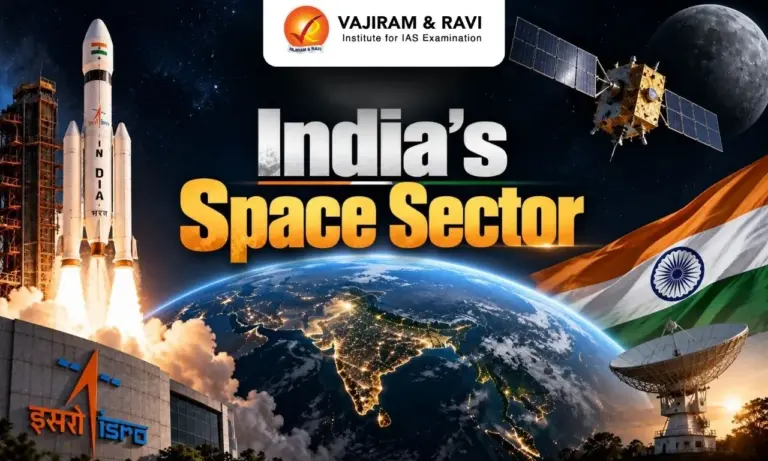
India’s Space Sector has undergone a major transformation over the past decade. From lunar and Mars missions to human spaceflight, space stations, satellite navigation and private space startups, India has steadily expanded its capabilities in space.
India’s Space Sector is also becoming increasingly commercial, with growing participation from startups and private companies, liberalised foreign investment rules and greater opportunities for technology transfer and satellite services. As India moves towards Space Vision 2047 and Viksit Bharat 2047, the focus is on building an innovative, self-reliant and globally competitive space ecosystem.
Evolution of India’s Space Sector
India’s space sector has evolved from a modest programme focused on using satellites for national development into a broad ecosystem covering space exploration, advanced launch vehicles, navigation, commercial activities and human spaceflight. The growth has been driven by ISRO’s technological progress, policy reforms and increasing participation of private companies.
- 1962: Indian National Committee for Space Research (INCOSPAR) was established under the leadership of Vikram Sarabhai.
- 1969: ISRO was established to develop and apply space technology for national development.
- 1975: Aryabhata, India’s first satellite, was launched, marking an important step in indigenous satellite development.
- 1980: Rohini RS-1 became the first Indian satellite placed in orbit by an Indian launch vehicle, SLV-3.
- 1994: The successful PSLV mission established a reliable indigenous launch capability.
- 2008: Chandrayaan-1 marked India’s first lunar mission and provided evidence of water-related molecules on the Moon.
- 2013–14: Mangalyaan demonstrated India’s capability in interplanetary exploration by successfully entering Mars orbit.
- 2016 onwards: The sector saw increasing emphasis on commercialisation and private participation, with the creation of NSIL and later IN-SPACe.
- 2017: PSLV-C37 set a record by launching 104 satellites in a single mission, demonstrating India’s multi-satellite launch capability.
- 2019: The Gaganyaan programme was formally approved, marking a major step towards human spaceflight.
- 2023: Chandrayaan-3 achieved a successful soft landing near the lunar south polar region, while Aditya-L1 began India’s dedicated solar exploration programme.
- 2024–25: SpaDeX demonstrated orbital docking and undocking capabilities, supporting future space-station and human-spaceflight missions.
- 2025 onwards: Greater focus is being placed on private-sector growth, FDI, commercial launches, reusable launch technologies, human spaceflight and the Bharatiya Antariksh Station.
Major Achievements of India’s Space Sector
India’s Space Sector has achieved major milestones in lunar and planetary exploration, space science, satellite navigation, launch technology and human spaceflight.
Chandrayaan Programme
India’s Chandrayaan programme is a series of lunar missions aimed at studying the Moon’s surface, composition, resources and environment. The programme has progressed from Chandrayaan-1’s discovery of water-related evidence to Chandrayaan-3’s historic soft landing near the lunar south pole.
- Chandrayaan-1 (2008): India’s first Moon mission, which provided evidence of water molecules and hydroxyl on the lunar surface.
- Chandrayaan-2 (2019): Its orbiter continues to study the Moon and has provided high-resolution images and scientific data.
- Chandrayaan-3 (2023): Successfully soft-landed near the lunar south pole, making India the first country to achieve this feat.
- Chandrayaan-4: Planned lunar sample-return mission aimed at collecting Moon samples and bringing them back to Earth.
- Chandrayaan-5/LUPEX: India-Japan mission planned to explore the lunar south polar region and investigate water and other volatile materials.
Aditya-L1, AstroSat and XPoSat
India has expanded its space science programme beyond the Moon and Mars to study the Sun and distant cosmic objects. These missions have strengthened India’s capabilities in solar physics, astronomy and space-based observations.
- Aditya-L1: India’s first space-based solar observatory, launched in September 2023, studies the Sun’s corona, solar atmosphere and space weather from the L1 point.
- AstroSat: India’s first dedicated multi-wavelength space observatory, launched in 2015, observes celestial objects in ultraviolet, optical and X-ray wavelengths.
- XPoSat: Launched in January 2024, it is India’s first dedicated mission to study X-ray polarisation and the polarisation of cosmic X-ray sources.
SpaDeX Mission
Space Docking Experiment (SpaDeX) is designed to demonstrate India’s ability to perform autonomous rendezvous, docking and undocking of spacecraft in orbit. The technology is important for future human spaceflight, space stations and complex multi-spacecraft missions.
- Two small spacecraft, SDX01 and SDX02, were launched together in December 2024.
- The spacecraft successfully demonstrated autonomous docking in January 2025.
- India also demonstrated undocking and subsequent redocking, strengthening its orbital docking capabilities.
- The technology can support future missions involving space stations, satellite servicing and sample-return operations.
Venus Orbiter Mission
Venus Orbiter Mission, also known as Shukrayaan-1, aims to study Venus and understand its atmosphere, surface and geological processes. It will help improve scientific understanding of how Venus evolved and how it differs from Earth.
- The mission will study the Venusian atmosphere and surface.
- It will investigate the planet’s atmospheric composition and dynamics.
- Scientific instruments will examine Venus’s surface and subsurface characteristics.
- The mission will strengthen India’s capability in interplanetary exploration.
Gaganyaan India’s Human Spaceflight Programme
Gaganyaan is India’s first human spaceflight programme, aimed at demonstrating the country’s capability to send humans to low-Earth orbit and safely return them to Earth. The programme involves developing human-rated launch systems, crew modules, life-support systems and astronaut safety technologies.
- The mission plans to carry Indian astronauts, known as Vyomnauts, into low-Earth orbit.
- The Human-Rated Launch Vehicle Mark-3 (HLVM3) is being developed for crewed missions.
- India has conducted multiple tests of the crew escape system and other safety technologies.
- The programme includes uncrewed test missions before the human spaceflight.
- Gaganyaan will build technologies and experience needed for India’s long-term human presence in space.
Axiom-4 Mission and India’s Human Spaceflight Preparation
India’s participation in the Axiom-4 mission provided an important opportunity to gain practical experience in human spaceflight and conduct scientific activities aboard the International Space Station (ISS). Indian astronaut Shubhanshu Shukla participated in the mission as the pilot, supporting India’s preparations for future human spaceflight.
- Shubhanshu Shukla became the first Indian to visit the ISS.
- The mission included scientific experiments and technology demonstrations relevant to microgravity research.
- The experience provided Indian teams with exposure to crew operations, mission planning and space-station activities.
- Lessons from the mission can contribute to India’s preparation for Gaganyaan and future human-spaceflight missions.
Bharatiya Antariksh Station
Bharatiya Antariksh Station (BAS) is India’s planned indigenous space station aimed at establishing a long-term human presence in low-Earth orbit. It is expected to support scientific research, technology development and future human spaceflight missions.
- The first module of BAS is planned to be launched around 2028.
- The station is targeted for completion by 2035.
- It will support microgravity experiments, space-based research and technology demonstrations.
- BAS will build on technologies developed through Gaganyaan and SpaDeX.
- It is expected to provide a platform for long-duration human space missions.
- The station will strengthen India’s capabilities in human spaceflight, orbital operations and space science.


FDI Reforms in India’s Space Sector
India has opened its space sector to greater foreign investment to attract global capital, advanced technology and private participation. The reforms aim to strengthen domestic space capabilities and expand India’s role in the global space economy.
- 100% FDI is permitted under the automatic route for manufacturing components and systems or sub-systems for satellites, ground segments and user segments.
- Up to 74% FDI is allowed under the automatic route for satellite manufacturing and operation, satellite data products, and ground and user segments.
- Up to 49% FDI is permitted under the automatic route for launch vehicles and associated systems or subsystems, as well as spaceports for launching and receiving spacecraft.
- FDI beyond the automatic-route limits requires government approval.
- The reforms are intended to attract global space companies and private investment into India.
- Increased foreign investment can support technology transfer, domestic manufacturing, employment and integration with global space supply chains.
Role of IN-SPACe and NSIL
IN-SPACe and NSIL play important roles in expanding private participation and commercial activities in India’s space sector.
- IN-SPACe: Acts as a single-window agency to promote, facilitate and authorise private sector space activities.
- It enables private companies to use ISRO facilities, infrastructure and technical expertise for developing and testing space technologies.
- It supports the growth of start-ups and private space companies in areas such as launch vehicles, satellites and space applications.
- NSIL: The commercial arm of the Department of Space, responsible for commercialising ISRO technologies and space services.
- NSIL undertakes activities such as launch services, satellite services, technology transfer and commercial use of space-based capabilities.
- Together, IN-SPACe and NSIL help strengthen public-private collaboration and the commercial space ecosystem in India.
India’s Space Economy
India’s Space Sector is moving from being largely government-led towards a more diverse and commercially driven ecosystem. Growing private participation, satellite services, launch capabilities and space-based applications are creating new opportunities across the economy.
- India’s space economy is estimated at around US$8.4 billion, with a target of reaching US$44 billion by 2033.
- The country has witnessed rapid growth in space start-ups and private space companies.
- Private firms are increasingly involved in satellite manufacturing, launch vehicles, space data, communication and other applications.
- Satellite-based services are supporting sectors such as agriculture, telecommunications, navigation, banking and disaster management.
- Earth observation data is being used for resource mapping, urban planning, infrastructure development and environmental monitoring.
- Reforms such as the Indian Space Policy 2023 and FDI liberalisation are intended to attract greater domestic and international investment.
India’s Launch Vehicle Capability
India has developed a strong launch vehicle capability through programmes such as PSLV and LVM3. These systems support satellite launches, planetary missions and future human spaceflight, while newer technologies aim to improve payload capacity and reusability.
- PSLV: Known as India’s workhorse launch vehicle, it has launched Earth observation, navigation and scientific satellites and has also carried out several international commercial launches.
- GSLV: Uses a cryogenic upper stage and is designed to launch heavier satellites into Geosynchronous Transfer Orbit (GTO).
- LVM3: India’s heavy-lift launch vehicle, used for missions such as Chandrayaan-3 and selected for the Gaganyaan human spaceflight programme.
- SSLV: Designed for the quick and cost-effective launch of smaller satellites, with shorter preparation and launch cycles.
- Next Generation Launch Vehicle (NGLV): Being developed as a more powerful and versatile launch system to support heavier payloads, commercial launches and future space missions.
- Reusable Launch Vehicle (RLV): ISRO is testing reusable technologies to reduce launch costs and improve the efficiency of future space transportation systems.
NavIC India’s Indigenous Navigation System
NavIC (Navigation with Indian Constellation) is India’s regional satellite navigation system developed by ISRO. It provides accurate positioning, navigation and timing services over India and areas extending about 1,500 km beyond the Indian mainland.
- NavIC was earlier known as IRNSS (Indian Regional Navigation Satellite System).
- It provides Standard Positioning Service (SPS) for civilian users and Restricted Service (RS) for authorised users.
- The system supports applications in transportation, disaster management, surveying, mapping and location-based services.
- NavIC can assist with navigation for ships, aircraft, vehicles and personal devices.
- It provides an independent navigation capability, reducing dependence on foreign satellite navigation systems.
- ISRO is working to expand NavIC’s capabilities and improve its coverage, accuracy and compatibility with modern navigation devices.
Space Technology for Agriculture and Water Security
Space Technology supports agriculture and water management by providing satellite-based data on crops, soil, weather, groundwater and water resources. This helps improve planning, monitoring and the efficient use of natural resources.
- Crop monitoring: Satellite images help assess crop health, acreage and changes in cropping patterns.
- Weather forecasting: Satellite data supports weather prediction and helps farmers prepare for droughts, heavy rainfall and other extreme events.
- Soil and moisture assessment: Remote sensing helps identify soil conditions and monitor soil moisture.
- Water resource mapping: Satellites help map rivers, reservoirs, wetlands and groundwater potential zones.
- Irrigation planning: Satellite-based information can support better planning and efficient use of irrigation water.
- Drought monitoring: Remote sensing helps identify drought-affected areas and assess their severity for timely intervention.
Space Technology in Disaster Management
Satellite-based systems provide real-time and large-area information that helps authorities monitor disasters, assess damage and coordinate relief operations. They are particularly useful when ground infrastructure is damaged or inaccessible.
- Flood monitoring: Satellite imagery helps identify flooded areas and track changes in flood extent.
- Cyclone tracking: Meteorological satellites provide data on cyclone formation, movement and intensity.
- Landslide monitoring: Remote sensing can help identify landslide-prone areas and assess affected regions.
- Forest fire detection: Satellite observations help detect forest fires and monitor their spread.
- Damage assessment: Before-and-after satellite images help estimate damage to buildings, roads, crops and infrastructure.
- Emergency communication: Satellite communication can provide connectivity when terrestrial communication networks are disrupted.
Space Technology in Healthcare and Education
Space technology is also being used to improve access to healthcare and education, particularly in remote and underserved regions. Satellite communication can connect distant locations with doctors, teachers and specialised services.
- Telemedicine: Satellite connectivity can link patients in remote areas with specialist doctors and hospitals.
- Health services: Space-enabled communication can support remote consultation, medical training and healthcare delivery.
- Tele-education: Satellite networks can connect schools and students in rural and geographically isolated areas with teachers and educational resources.
- Digital learning: Space-based communication can support the delivery of online classes, lectures and educational content.
- Emergency healthcare: Satellite communication can help maintain connectivity for medical teams during disasters and emergencies.
Geoportals and Digital Platforms
Geoportals and digital platforms use satellite imagery, remote sensing and geospatial data to support planning, governance and decision-making. India has developed several platforms that make space-based information accessible to government agencies, researchers and other users.
- Bhuvan: ISRO’s geoportal provides satellite imagery and geospatial information for mapping, planning and resource management.
- VEDAS: The Visualisation of Earth Observation Data and Archival System provides access to Earth observation data and analytical tools.
- MOSDAC: The Meteorological and Oceanographic Satellite Data Archival Centre provides satellite-based information on weather, oceans and atmospheric conditions.
- Bhuvan Panchayat: Supports rural planning and development by providing geospatial information at the panchayat level.
- National Geospatial Policy: Promotes wider use of geospatial data and technologies for governance, economic development and innovation.
India’s Global Space Partnerships
India has built 300+ space cooperation agreements with 61 countries and five multilateral organisations, covering joint missions, satellite applications, space science, navigation and capacity building.
- India–USA: The India-US partnership has expanded significantly through NASA-ISRO cooperation in Earth observation, human spaceflight and space science. The NISAR mission, jointly developed by NASA and ISRO, was successfully launched on 30 July 2025 and uses advanced radar technology to monitor changes in Earth’s land, ice and ecosystems. In August 2026, the two countries also discussed future cooperation in human spaceflight, lunar exploration and scientific data sharing.
- India–France: ISRO and France’s CNES cooperate in Earth observation, climate science and space technology. The TRISHNA mission is being developed to provide high-resolution thermal infrared observations for studying water stress, land-surface temperature and environmental changes. Cooperation is also expanding into human spaceflight, advanced technologies and space industry partnerships.
- India–Japan: India and Japan are working together on the Chandrayaan-5/LUPEX mission, designed to study lunar polar volatiles, including water, through in-situ exploration. The mission received financial sanction in 2025, its implementation arrangement was signed in August 2025, and its Preliminary Design Review has been completed.
- India–Russia: India and Russia continue cooperation in human spaceflight, launch technologies and planetary exploration. Russia is also contributing an international payload, VIRAL, to India’s Venus Orbiter Mission, while technical discussions are progressing on space propulsion cooperation.
- India–Australia: Australia is supporting India’s Gaganyaan programme, particularly in areas related to crew recovery operations. Cooperation also includes the establishment of a temporary tracking terminal at the Cocos (Keeling) Islands, strengthening support for future human-spaceflight missions.
- India–European Space Agency (ESA): India and ESA cooperate in space science, Earth observation, satellite tracking and mission support. Such cooperation helps provide ground-station and technical support for Indian missions and promotes the exchange of scientific and space data.
- India–Germany: Cooperation with Germany focuses on Earth observation, space science and satellite applications. These partnerships support the use of space-based data for climate studies, environmental monitoring and scientific research.
- India–Italy: India and Italy cooperate in space science, Earth observation and satellite-based applications. India has also strengthened international navigation cooperation through the installation of a NavIC timing receiver at Italy’s National Institute of Metrological Research (INRIM).
- India–Bhutan: India has supported Bhutan in developing its space capabilities through satellite cooperation and capacity building. The India-Bhutan SAT, launched in 2022, has strengthened cooperation in Earth observation, satellite data and space technology applications.
- India–Mauritius: India and Mauritius cooperate in Earth observation, satellite applications and capacity building. Space-based technologies are being used to support areas such as resource management, environmental monitoring and disaster management.
- India–BIMSTEC: India promotes the use of space technology for regional cooperation among BIMSTEC countries, particularly in disaster management, remote sensing, weather services and capacity building.

 Last updated on Oct, 2026
→ UPSC 2027 Notification will be released on 13 January 2027 at upsconline.nic.in.
→ Asian Games 2026 are being held in Aichi-Nagoya, Japan, from 19 September to 4 October.
→ Check Nobel Prize 2026 Winners List here.
→ Download PIB PRiSM Monthly Magazine 2026 here.
→ Check UPSC Monthly Current Affairs Magazine The Recitals here.
→ Check out the latest UPSC Syllabus here.
→ Download UPSC Model Answers for Mains 2026
→ UPSC Mains Question Paper 2026 is out now for Essay & GS Paper 1, 2, 3 & 4.
→ UPSC Calendar 2027 has been released.
→ Enroll in Vajiram & Ravi’s UPSC Mains Test Series 2027 for structured answer writing practice, expert evaluation, and exam-oriented feedback.
→ Join Vajiram & Ravi’s UPSC Mentorship Program 2027 for personalized guidance, strategy planning, and one-to-one support from experienced mentors.
→ Go through the UPSC Mains Previous Year Papers to enhance your preparation.
→ UPSC has released UPSC Toppers List 2025 with the Civil Services final result on its official website.
→ Also check Best UPSC Coaching in India
India’s Space Sector FAQs
Q1. What is India’s space sector?+
Q2. What are the major achievements of India’s space sector?+
Q3. What is the role of ISRO?+
Q4. What is the role of IN-SPACe?+
Q5. What is the role of NSIL?+
Q6. What is the Indian Space Policy 2023?+
Tags: india’s space india’s space sector