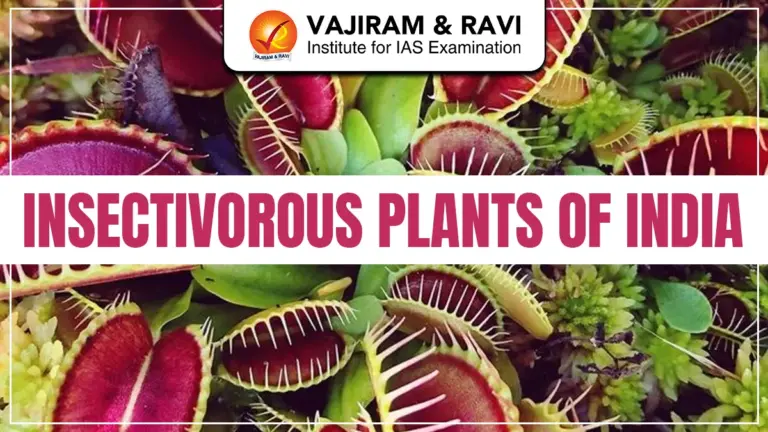
Insectivorous plants of India are specialised green plants that supplement their nutrition by trapping and digesting insects. They grow in habitats where soil nutrients, especially nitrogen, are extremely low. Despite performing photosynthesis like normal plants, these species evolved unique trapping mechanisms to survive in acidic, waterlogged, and rain washed ecosystems such as bogs, marshes, and wetlands across India.
Insectivorous Plants of India Features
The key features of the Insectivorous Plants of India has been discussed below:
- Specialised Nutrition Strategy: These plants photosynthesise normally but obtain nitrogen and minerals by digesting insects, compensating for poor soil fertility in wetlands and acidic habitats.
- Active and Passive Traps: Indian insectivorous plants include Active Traps that move rapidly and Passive Pitfall Traps where insects slip into specialised structures.
- Habitat Adaptation: They thrive in rain washed, acidic, oxygen poor soils where microbial decomposition is limited and nutrients remain unavailable to normal plants.
- Attraction Mechanisms: Bright colours, sweet nectar secretions, sticky fluids, and scent compounds are used to lure insects efficiently.
Read About: Parts of Plants
Insectivorous Plants of India Types
India hosts around 40 insectivorous plant species, concentrated largely in the Western Ghats, Eastern Himalayas, Northeast India, and wetland ecosystems. The Insectivorous Plants of India generally belong to the three classes of Insectivorous Plants family: Droseraceae, Nepenthaceae and Lentibulariaceae.





Droseraceae
Droseraceae includes Indian insectivorous plants that mainly use sticky or snap-trap mechanisms and are adapted to both aquatic and marshy habitats. There are 3 species under the Droseraceae family. Examples of Insectivorous Plants belonging to this family are:
1. Drosera (Sundew)
Drosera species grow in wet, infertile soils and marshes, using glandular leaf tentacles secreting sticky mucilage to trap and digest insects rich in nitrogen. Each leaf bears numerous hair like tentacles ending in adhesive droplets that immobilise insects upon contact. Enzymes secreted by leaf glands break down insect tissues, allowing nutrient absorption directly through leaf surfaces.
2. Aldrovanda (Waterwheel Plant)
Aldrovanda is a free floating, rootless aquatic plant found in Indian wetlands, including the Sundarbans and freshwater ponds. Aldrovanda leaves close rapidly along the midrib using sensitive trigger hairs, trapping small aquatic insects and crustaceans.
Also Read: Plant Tissue
Nepenthaceae
Nepenthaceae in India are represented by a single but ecologically significant Pitcher Plant species adapted to high rainfall hill ecosystems. The major example under this family of Insectivorous Plants is ‘Nepenthes khasiana’.
1. Nepenthes khasiana
This evergreen insectivorous plant is endemic to India (Garo, Khasi and Jaintia Hills, Meghalaya). Modified leaves form deep pitcher shaped traps with slippery inner walls that prevent insects from escaping. Glands inside the pitcher secrete proteolytic enzymes that digest trapped insects into absorbable nutrients.
Lentibulariaceae
Lentibulariaceae is the most diverse insectivorous plant family in India, adapted to aquatic, semi aquatic, and alpine environments. There are 36 species under the Lentibulariaceae family. Examples of Insectivorous Plants under this family are:
1. Utricularia (Bladderworts)
Utricularia species inhabit freshwater wetlands and waterlogged soils, using bladder like traps to capture microscopic aquatic organisms. Sensitive hairs trigger trap doors, creating suction that pulls insects and water into bladders for digestion. India hosts numerous Utricularia species, making this family the most widespread among Indian insectivorous plants.
2. Pinguicula (Butterwort)
Pinguicula grows in alpine Himalayan regions along cold stream sides and boggy soils. Entire leaves act as traps, secreting adhesive substances that immobilise insects, followed by leaf margin curling for digestion.

 Last updated on March, 2026
→ UPSC Final Result 2025 is now out.
→ UPSC has released UPSC Toppers List 2025 with the Civil Services final result on its official website.
→ Anuj Agnihotri secured AIR 1 in the UPSC Civil Services Examination 2025.
→ UPSC Marksheet 2025 is now out.
→ UPSC Notification 2026 & UPSC IFoS Notification 2026 is now out on the official website at upsconline.nic.in.
→ UPSC Calendar 2026 has been released.
→ Check out the latest UPSC Syllabus 2026 here.
→ UPSC Prelims 2026 will be conducted on 24th May, 2026 & UPSC Mains 2026 will be conducted on 21st August 2026.
→ The UPSC Selection Process is of 3 stages-Prelims, Mains and Interview.
→ Prepare effectively with Vajiram & Ravi’s UPSC Prelims Test Series 2026 featuring full-length mock tests, detailed solutions, and performance analysis.
→ Enroll in Vajiram & Ravi’s UPSC Mains Test Series 2026 for structured answer writing practice, expert evaluation, and exam-oriented feedback.
→ Join Vajiram & Ravi’s Best UPSC Mentorship Program for personalized guidance, strategy planning, and one-to-one support from experienced mentors.
→ Shakti Dubey secures AIR 1 in UPSC CSE Exam 2024.
→ Also check Best UPSC Coaching in India
Insectivorous Plants of India FAQs
Q1. What are Insectivorous Plants of India?+
Q2. Why do Insectivorous Plants trap insects?+
Q3. How many Insectivorous Plants families are found in India?+
Q4. Which is the only Pitcher Plant species found in India?+
Q5. Where are Insectivorous Plants commonly found in India?+
Tags: insectivorous plants of india