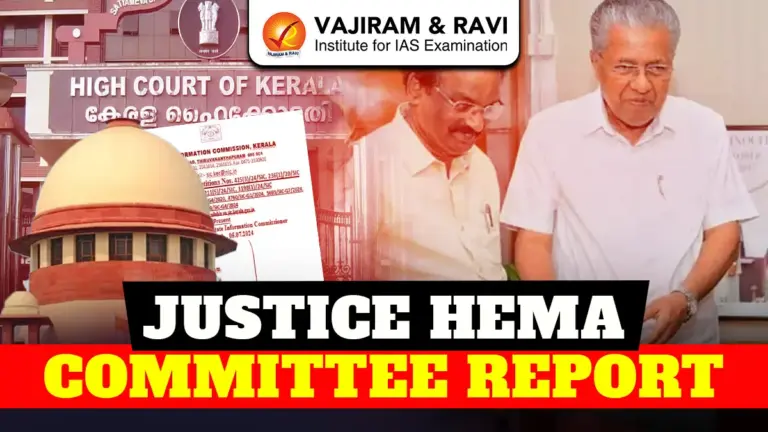
Hema Committee was an advisory committee formed by the Government of Kerala in July 2017, to investigate the issues related to sexual violence and gender inequality, in the Malayalam cinema industry.
It was a three-member committee chaired by former Kerala High Court judge Justice Hema. Film actress & politician Sarada and former IAS officer KB Vatsalakumari, were the other two members of the committee.
Justice Hema Committee Report Background
The committee was formed after a complaint to Chief Minister Pinarayi Vijayan by the Women in Cinema Collective (WCC), which had been formed after a young actress was assaulted in Kochi in 2017.
The committee after consulting multiple women professionals in the Malayalam film industry and recording detailed statistics on sexual harassment, earned wages and blacklisting from work submitted a 300-page report to Kerala chief minister Punarayi Vijayan. This report came to be known as the Hema Committee Report, however the report was not released to the public and no action was taken by the government till July 2024.
In July 2024, the Kerala State Information Commission passed an order directing the Kerala government to issue the committee report to RTI applicants before 22 July, after redacting information that could identify individuals mentioned in the report, as prohibited under the Right to Information Act.
On 19 August 2024, the report was made available to the RTI applicants. The Kerala government released only 233 pages of the report, excluding sections that could infringe on the privacy of the individuals mentioned
Issues Highlighted by Justice Hema Committee
- Sexual harassment : The report highlighted the issue of sexual harassment of women especially junior artists in form of unwanted physical touches, rape threats etc by influential individuals
- Casting Couch: The report highlights the prevalence of the casting couch, where women are often forced to exchange sexual favours for job opportunities.
- Culture of fear and silence: Victims hesitate to report abuse due to stigma around sexual harassment and fear of loss of work and informal blacklisting.
- Absence of effective grievance redressal mechanisms: Most production units lacked functional Internal Complaints Committees, despite legal mandates under the POSH Act.
- Informal employment: Lack of written contracts, job security and defined work conditions
- Inhumane working conditions: For example, work extending up to 19 hours a day
- Economic vulnerability: Irregular income, delayed payments and absence of minimum wage standards increased dependence on powerful intermediaries.
- Male-dominance: Decision-making roles were largely controlled by men, leading to gender bias and weak institutional accountability.
- Poor working conditions: Inadequate basic facilities such as toilets, changing rooms, safe accommodation and transport particularly affected women.
- Substance abuse on film sets: The presence of alcohol and drugs during work hours created unsafe environments and increased incidents of misconduct.
- Weak role of associations and unions: Industry bodies often prioritised reputation management over victim protection, failing to act impartially on complaints.





Justice Hema Committee Report Recommendations
- Internal Complaint Mechanism : Every film production unit, association and organisation should have a functional and independent complaints mechanism in line with the POSH Act, 2013 to address sexual harassment at the workplace.
- Independent Tribunal : An independent tribunal should be formed to handle complaints related to harassment, exploitation and abuse in the film industry.
- Compulsory written contracts : All artists and workers, especially junior and freelance workers, should be employed through written contracts clearly defining wages, working hours, roles and responsibilities to prevent arbitrary exploitation.
- Minimum wage and timely payment norms : Fixation of minimum remuneration and strict enforcement of timely payment to protect vulnerable workers from economic coercion.
- Better working conditions : Provision of basic facilities such as clean toilets, changing rooms, drinking water, food, rest areas, safe accommodation and transport, particularly for women and junior artistes.
- Gender sensitisation : Mandatory training programmes for producers, directors, actors and crew members to promote respectful behaviour, gender equality and professional ethics.
- Substance Abuse Controls : Strict prohibition of alcohol and drug use on shooting locations and during work hours to reduce unsafe environments and misconduct.
- Welfare Fund : Establish welfare schemes and funds for women workers to support them during maternity, illness, injury or periods of unemployment.
- Institutional accountability of associations : Film associations and unions should be made legally accountable for ensuring safe workplaces and for acting promptly on complaints, rather than shielding influential members.
Other Legal Safeguards for Women Safety at Workplaces
- Sexual Harassment of Women at Workplace (Prevention, Prohibition and Redressal) Act, 2013 (POSH Act) : This is the principal legislation dealing with workplace sexual harassment. It places a legal duty on employers to prevent harassment, establish complaint mechanisms and ensure time-bound redressal while protecting the dignity and confidentiality of women employees.
- Visakha guidelines 2017: Visakha guidelines were given by Supreme Court in 2017 imposing obligations on the employer for prevention, prohibition and redressal of sexual harassment at workplace.
- Bharatiya Nyaya Sanhita, 2023 (earlier referred to as the IPC) and the Bharatiya Nagarik Suraksha Sanhita (BNSS), 2023: The new criminal laws, have introduced certain provisions to adress sexual harassment at workplace
-
- Section 75 of the BNS deals with sexual harassment and the punishment for it (one year, or fine, or both), whereas Section 514 of BNSS provides for a limitation period of 3 years from the date of the incident.
- Section 69 of BNS has introduced a provision addressing sexual harassment under the guise of promise of employment, promotion and marriage which traditionally fell under cheating and fraud in earlier laws. It targets cases of sexual intercourse obtained through false promises, i.e. without any intention of fulfilling the same.

 Last updated on March, 2026
→ UPSC Final Result 2025 is now out.
→ UPSC has released UPSC Toppers List 2025 with the Civil Services final result on its official website.
→ Anuj Agnihotri secured AIR 1 in the UPSC Civil Services Examination 2025.
→ UPSC Marksheet 2025 is now out.
→ UPSC Notification 2026 & UPSC IFoS Notification 2026 is now out on the official website at upsconline.nic.in.
→ UPSC Calendar 2026 has been released.
→ Check out the latest UPSC Syllabus 2026 here.
→ UPSC Prelims 2026 will be conducted on 24th May, 2026 & UPSC Mains 2026 will be conducted on 21st August 2026.
→ The UPSC Selection Process is of 3 stages-Prelims, Mains and Interview.
→ Prepare effectively with Vajiram & Ravi’s UPSC Prelims Test Series 2026 featuring full-length mock tests, detailed solutions, and performance analysis.
→ Enroll in Vajiram & Ravi’s UPSC Mains Test Series 2026 for structured answer writing practice, expert evaluation, and exam-oriented feedback.
→ Join Vajiram & Ravi’s Best UPSC Mentorship Program for personalized guidance, strategy planning, and one-to-one support from experienced mentors.
→ Shakti Dubey secures AIR 1 in UPSC CSE Exam 2024.
→ Also check Best UPSC Coaching in India
Hema Committee Report FAQs
Q1. What is the Justice Hema Committee?+
Q2. Who headed the Justice Hema Committee?+
Q3. Who were the other members of the committee?+
Q4. What were the Vishaka Guidelines?+
Tags: justice hema committee report