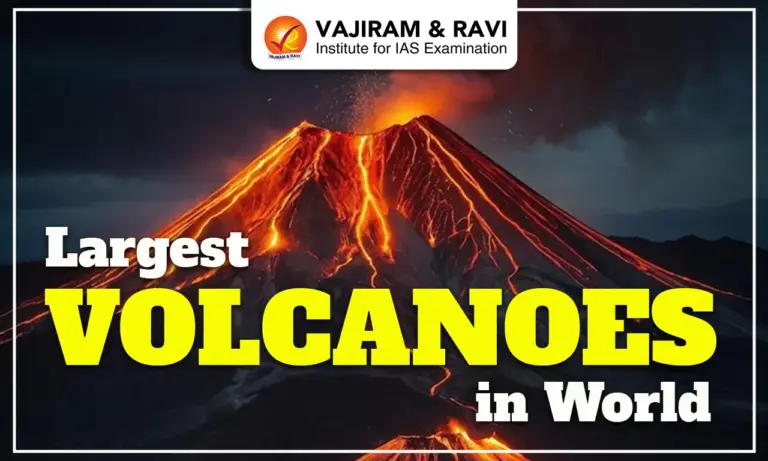
Volcanoes are natural geological structures formed when molten rock, gases, and ash escape from beneath the Earth’s crust and erupt onto the surface. They occur primarily along tectonic plate boundaries or at mantle hotspots, where immense pressure forces magma upward. Volcanoes play a dual role in shaping our planet while their eruptions can be destructive, causing loss of life, property, and environmental damage, they also create fertile soils, new landforms, and contribute to the recycling of Earth’s crust. In this article, we are going to cover the Largest Volcanoes in the World.
Largest Volcanoes in the World
Volcanoes are natural landforms created when molten rock, volcanic ash, and gases from the Earth’s mantle escape through cracks in the crust and reach the surface. They are commonly found along tectonic plate boundaries, where lithospheric plates collide, diverge, or slide past one another. Volcanic activity manifests in various ways, from violent explosions that release ash and pyroclastic material to slower outflows of lava that build new landmasses. Volcanoes differ greatly in their size, structural form, and eruptive behavior. The main types include:
- Shield Volcanoes: Characterized by wide, gently sloping profiles formed by the flow of fluid, low-viscosity basaltic lava. A classic example is Mauna Loa in Hawaii.
- Stratovolcanoes (Composite Volcanoes): Built from alternating layers of lava, ash, and rock debris, these steep-sloped giants are known for explosive eruptions. Mount St. Helens in the USA is a prominent example.
- Cinder Cone Volcanoes: Small, conical volcanoes that arise from the accumulation of volcanic fragments around a central vent.
- Calderas: Enormous depressions formed when the summit of a volcano collapses after a cataclysmic eruption.
- Submarine Volcanoes: Underwater volcanoes that play a vital role in shaping the seafloor, particularly along mid-ocean ridges.
The effects of volcanic eruptions differ in magnitude and consequences. They emit gases like water vapor, carbon dioxide, and sulfur dioxide, which can alter climate patterns and impact life. Despite their destructive power, volcanoes are essential to Earth’s geological evolution, contributing to fertile soils, mineral resources, and even the formation of new islands and landforms.
List of Largest Volcanoes in the World
Studying the Largest Volcanoes in the World and their formation not only strengthens understanding of physical geography but also offers insights into natural processes that have profoundly shaped Earth’s landscapes and human civilizations over millennia.
| Largest Volcanoes In the World | |||
| Feature & Location | Volcanoes in the World | Feet | Metres |
|
Hawaii, U.S.A |
Mauna Loa |
3085 |
9170 |
|
Canary Islands, Spain |
Teide |
24066 |
7500 |
|
Hawaii, U.S.A |
Haleakala |
30000 |
9144 |
|
Reunion, France |
Piton des Neiges |
23199 |
7071 |
|
Argentina/Chile – Highest active volcano on Earth |
Ojos del Salado |
22615 |
6893 |
|
Argentina/Chile – Second highest active volcano on Earth |
Llullaillaco |
22110 |
6739 |
|
Ecuador – Second highest in Ecuador |
Cotopaxi |
19347 |
5897 |
|
Ecuador – Farthest point from Earth’s centre |
Chimborazo |
20561 |
6267 |
|
Bolivia – The highest peak of Bolivia |
Nevado Sajama |
21463 |
6542 |
|
Tanzania – Highest volcano outside South America; the highest peak in Africa |
Kilimanjaro |
19341 |
5895 |
|
Russia – Highest volcano in Eurasia; the highest peak in Russia |
Mount Elbrus |
18510 |
5642 |
|
Ecuador – Third highest in Ecuador |
Cayambe |
18996 |
5790 |
|
Mexico – Highest volcano in North America; the highest peak in Mexico |
Pico de Orizaba |
18491 |
5636 |
|
Iran – Highest volcano within Asia; the highest peak in Iran |
Mount Damavand |
18406 |
5610 |
|
Kenya – Second highest volcano in Africa; the highest mountain in Kenya |
Mount Kenya |
17057 |
5199 |
|
Mexico – Second highest volcano in North America |
Popocatepetl |
17802 |
5426 |
|
Mexico – Third highest volcano in North America |
Iztaccihuatl |
17559 |
5230 |
|
Turkey/Armenia – The highest mountain in Turkey |
Mount Ararat |
16854 |
5137 |
|
Georgia – Highest volcano in Georgia |
Mount Kazbek |
16558 |
5047 |
|
Alaska – highest volcano in the United States |
Mount Bona |
16421 |
5047 |
|
The Kamchatka Peninsula, Russia – highest active in Eurasia; the highest mountain in Siberia |
Klyuchevskaya Sopka |
1584 |
4750 |
|
Rwanda/Democratic Republic of Congo – highest mountain in Rwanda |
Mount Karisimbi |
14787 |
4507 |
|
Guatemala – highest mountain in Central America |
Volcan Tajumulco |
13845 |
4220 |
|
Papua New Guinea – highest volcano in Australasia and Pacific islands |
Mount Giluwe |
14331 |
4368 |
|
Washington – highest volcano in the contiguous United States |
Mount Rainier |
14409 |
4392 |
|
Hawaii, United States – World’s tallest mountain from base to summit |
Mauna Kea |
13796 |
4205 |
|
Antarctica – Highest volcano in Antarctica |
Mount Sidley |
13717 |
4181 |
|
Armenia – highest mountain in Armenia |
Mount Aragats |
13435 |
4095 |
|
Cameroon – highest mountain in Cameroon |
Mount Cameroon |
13435 |
4095 |
|
Sumatra, Indonesia – Highest volcano in Indonesia; the highest mountain in Sumatra |
Mount Kerinci |
12484 |
3085 |
|
Chubu Region, Honshu – highest mountain in Japan |
Mount Fuji |
12388 |
3776 |
|
Lombok, Indonesia – Second-highest volcano in Indonesia |
Mount Rinjani |
1224 |
3726 |
|
Tenerife, Canary Islands – the highest peak in the Atlantic Islands and Spain |
Teide |
12198 |
3718 |
|
Java, Indonesia – highest mountain in Java |
Semeru |
12060 |
3676 |
|
Chad – the highest mountain in Chad & the Sahara |
Emi Koussi |
11204 |
3415 |
|
Sicily – active; highest volcano in Western Europe; the highest peak in Italy south of the Alps |
Mount Etna |
10922 |
3329 |
|
Maui, Hawaii – the highest peak of Maui |
Haleakala |
10023 |
3055 |
|
Bali, Indonesia – highest mountain in Bali |
Mount Agung |
9944 |
3031 |
|
Bioko, Equatorial Guinea – the highest mountain in Equatorial Guinea |
Pico Basile |
9879 |
3011 |
|
Mindanao – highest mountain in the Philippines |
Mount Apo |
9692 |
2954 |
|
Oromia Region – highest volcano in Ethiopia |
Mount Zuqualla |
9806 |
2989 |
|
Unimak Island, Alaska – highest mountain in the Aleutian Islands |
Mount Shishaldin (Sisquk) |
9373 |
2857 |
|
Heard Island – the highest mountain in Australia |
Mawson Peak |
9006 |
2745 |
|
Azores – highest mountain in Portugal |
Pico |
7713 |
2351 |
|
Jan Mayen, Norway – highest volcano in Norway |
Beerenberg |
7470 |
2277 |
|
Argentina–Chile border region |
Pali-Aike volcanic field |
591 |
180 |
|
Batangas, Philippines – – Smallest volcano on earth |
Taal Volcano |
1020 |
311 |





Volcanoes Distribution in the World
Volcanoes are not uniformly distributed across the planet; rather, they occur in specific zones influenced by tectonic plate interactions and mantle hotspot activity. Below is an overview of the global distribution of volcanoes:
- Ring of Fire: The Pacific Ring of Fire remains the most prominent volcanic belt, surrounding the Pacific Ocean. It is marked by a dense cluster of active volcanoes and intense seismicity. Nations such as Japan, Indonesia, the Philippines, along with the western margins of North and South America (United States, Canada, Mexico, Chile), and several Pacific islands lie within this region.
- Mid-Atlantic Ridge: This submarine volcanic chain extends along the Atlantic Ocean’s center. Here, the North American, Eurasian, South American, and African plates diverge, allowing magma to rise and solidify, giving birth to new oceanic crust.
- Iceland: Located directly atop the Mid-Atlantic Ridge, Iceland exhibits vigorous volcanic activity due to the rifting of the Eurasian and North American plates. The island frequently experiences eruptions and geothermal phenomena.
- East African Rift: Stretching from Ethiopia’s Afar Triangle to Mozambique, this rift represents a continental divergence zone. Volcanism is active here, with renowned peaks such as Mount Kilimanjaro and Mount Kenya.
- Andes Mountains: Extending along western South America, the Andes owe their origin to the subduction of the Nazca Plate beneath the South American Plate. This tectonic process has fueled numerous volcanoes across Chile, Peru, and Colombia.
- Mediterranean: Around southern Europe, particularly Italy and Greece, volcanic activity has historical significance. Famous examples include Mount Etna in Sicily and Mount Vesuvius near Naples.
- Indonesian Archipelago: Situated at the confluence of the Indian-Australian, Pacific, and Eurasian plates, Indonesia is one of the most volcanically active nations. Notorious eruptions like Krakatoa and Mount Merapi originate here.
- Alaska: The Aleutian volcanic arc in Alaska lies within the Pacific Ring of Fire, resulting from Pacific Plate subduction beneath the North American Plate, creating numerous active cones.
- Hawaii: The Hawaiian chain is formed by a persistent hotspot under the Pacific Plate. Its volcanoes, including Mauna Loa and Kilauea, highlight the island-building process as the plate shifts northwestward.
- East Asia: Countries such as Japan, Indonesia, and the Philippines showcase frequent eruptions, owing to tectonic convergence and subduction zones dominating the region.

 Last updated on March, 2026
→ UPSC Final Result 2025 is now out.
→ UPSC has released UPSC Toppers List 2025 with the Civil Services final result on its official website.
→ Anuj Agnihotri secured AIR 1 in the UPSC Civil Services Examination 2025.
→ UPSC Marksheet 2025 is now out.
→ UPSC Notification 2026 & UPSC IFoS Notification 2026 is now out on the official website at upsconline.nic.in.
→ UPSC Calendar 2026 has been released.
→ Check out the latest UPSC Syllabus 2026 here.
→ UPSC Prelims 2026 will be conducted on 24th May, 2026 & UPSC Mains 2026 will be conducted on 21st August 2026.
→ The UPSC Selection Process is of 3 stages-Prelims, Mains and Interview.
→ Prepare effectively with Vajiram & Ravi’s UPSC Prelims Test Series 2026 featuring full-length mock tests, detailed solutions, and performance analysis.
→ Enroll in Vajiram & Ravi’s UPSC Mains Test Series 2026 for structured answer writing practice, expert evaluation, and exam-oriented feedback.
→ Join Vajiram & Ravi’s Best UPSC Mentorship Program for personalized guidance, strategy planning, and one-to-one support from experienced mentors.
→ Shakti Dubey secures AIR 1 in UPSC CSE Exam 2024.
→ Also check Best UPSC Coaching in India
Largest Volcanoes in World FAQs
Q1. Which is the largest volcano in the world?+
Q2. What are the top 10 biggest volcanoes in the world?+
Q3. Where is the 2nd largest volcano in the world?+
Q4. Where are active volcanoes present?+
Q5. Are there any volcanoes present in India?+
Tags: largest volcanoes in world