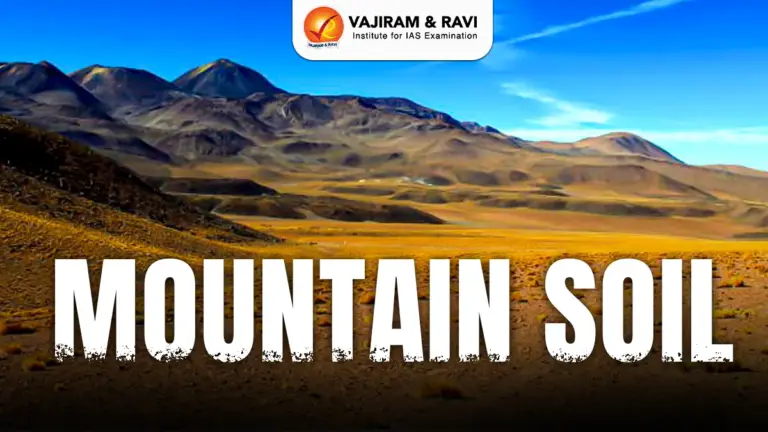
Mountain Soil refers to soils developed in highland and mountainous environments. In India, these soils occur mainly on the slopes and valleys of the Himalayan region and other hill systems. Their properties change significantly with altitude, vegetation cover and climatic conditions, which creates considerable variation in soil colour, texture and fertility within short distances.
Mountain Soil Characteristics
Mountain Soils show wide variation in physical and chemical properties depending on altitude, vegetation cover and slope conditions.
- Occurrence: commonly occur in valleys and hill slopes of the Himalayas at elevations between 2500 and 3000 metres.
- Soil Development: These soils are generally considered immature soils. Their formation is still ongoing because environmental factors such as slope movement, rainfall erosion and climatic variability continuously reshape the soil layers.
- Appearance: These soils generally appear dark brown in colour due to the presence of organic matter derived from forest vegetation.
- Nutrient Composition: Despite the presence of organic matter, these soils are generally deficient in important nutrients such as potash, phosphorus and lime. As a result, agricultural productivity often requires substantial fertilizer application.
- Drainage: Mountain Soils typically allow rapid drainage because of their loose structure and slope based position. While this ensures good aeration, it also increases vulnerability to soil erosion during heavy rainfall.
- Temperature Influence: Low temperatures at higher elevations slow down the decomposition of organic materials. As a result, organic matter remains partially decomposed in many alpine regions above the tree line.
Mountain Soil Crops
Mountain Soils support various agricultural and plantation crops depending on climatic conditions, altitude and regional vegetation.
- Tea Plantations: widely practiced particularly in humid hill regions.
- Coffee Cultivation: grown in the peninsular hill regions.
- Spice Production: Several spices are common in forested hill regions of peninsular India.
- Temperate Fruit Farming: In Himalayan mountain regions, temperate fruits are cultivated because cooler climates and well drained soils provide suitable conditions for fruit orchards.
- Cereal Crop Cultivation: Crops such as wheat, maize and barley are grown in several Himalayan valleys.
- Potato Farming: Potatoes are widely grown in mountain regions due to their adaptability to cool climates and well drained soils that reduce the risk of water stagnation.
Also Read: Soils of India





Mountain Soil Distribution in India
Mountain Soils are widely distributed in different hill regions across India where altitude and forest vegetation influence soil development.
- Coverage: Forest and Mountain Soils together cover approximately 2.85 lakh square kilometres, representing about 8.67% of India’s total geographical area.
- Himalayan Valleys: Mountain Soils are commonly found in valleys and relatively gentle slopes of the Himalayan region.
- North Facing Slopes: In the Himalayan mountains, north facing slopes support better soil formation because they experience relatively lower erosion and retain moisture more effectively.
- Lower Himalayan Ranges: Several districts such as Dehradun, Almora and Garhwal contain Mountain Soils formed under forest cover in lower and middle Himalayan ranges.
- Eastern Himalayan Region: Mountain Soils also occur in eastern Himalayan areas including regions of Assam and Darjeeling where heavy rainfall and dense vegetation support soil formation.
- Cold Desert Regions: Some Mountain Soils are present in high altitude cold regions such as Ladakh and Lahaul-Spiti where climatic conditions strongly influence soil properties.
- Western Himalayan Areas: Regions such as Kinnaur also contain Mountain Soils where forest vegetation and mountain terrain shape soil formation processes.
- Peninsular Hills: Apart from the Himalayas, Mountain Soils are found in the Western Ghats including the Nilgiri hills where forest ecosystems influence soil characteristics.
- Southern Hills: The Annamalai and Cardamom hills also contain Mountain Soils formed under forest vegetation and humid climatic conditions.
Mountain Soil Significance
Mountain Soils play an important role in the following ways:
- These soils provide a natural foundation for forest vegetation that plays a critical role in maintaining biodiversity and ecological stability in mountainous regions.
- Despite nutrient deficiencies, Mountain Soils support cultivation of cereals, fruits and plantation crops in several highland regions when proper soil management practices are applied.
- Mountain Soils support forestry and lumbering activities where timber production and forest resource management contribute significantly to regional economies.
- Their slope based structure ensures good air circulation and water drainage, which benefits crops requiring well drained soil conditions.
- Steep slopes make Mountain Soils highly susceptible to erosion, highlighting the importance of conservation measures such as afforestation and terrace farming.
- Forest vegetation growing on Mountain Soils helps control landslides and prevents rapid soil erosion in fragile mountain ecosystems.
- A research of March 2026 indicates that soil loss in the Aravalli mountain system increased by about 13.8% between 2017 and 2024 due to urban expansion and mining activities.
- Mountain Soils also support horticultural crops including various fruits grown in cooler mountain climates where soil aeration and drainage remain favourable.
- In some mountainous areas, shifting cultivation practices are observed where soil fertility declines after two to three years of cultivation due to continuous nutrient depletion.
- Due to limited agricultural possibilities on steep slopes, mountain regions often support silvi-pastoral systems combining forestry and grassland activities.

 Last updated on March, 2026
→ UPSC Final Result 2025 is now out.
→ UPSC has released UPSC Toppers List 2025 with the Civil Services final result on its official website.
→ Anuj Agnihotri secured AIR 1 in the UPSC Civil Services Examination 2025.
→ UPSC Marksheet 2025 is now out.
→ UPSC Notification 2026 & UPSC IFoS Notification 2026 is now out on the official website at upsconline.nic.in.
→ UPSC Calendar 2026 has been released.
→ Check out the latest UPSC Syllabus 2026 here.
→ UPSC Prelims 2026 will be conducted on 24th May, 2026 & UPSC Mains 2026 will be conducted on 21st August 2026.
→ The UPSC Selection Process is of 3 stages-Prelims, Mains and Interview.
→ Prepare effectively with Vajiram & Ravi’s UPSC Prelims Test Series 2026 featuring full-length mock tests, detailed solutions, and performance analysis.
→ Enroll in Vajiram & Ravi’s UPSC Mains Test Series 2026 for structured answer writing practice, expert evaluation, and exam-oriented feedback.
→ Join Vajiram & Ravi’s Best UPSC Mentorship Program for personalized guidance, strategy planning, and one-to-one support from experienced mentors.
→ Shakti Dubey secures AIR 1 in UPSC CSE Exam 2024.
→ Also check Best UPSC Coaching in India
Mountain Soil FAQs
Q1. What is Mountain Soil? +
Q2. What type of vegetation is commonly associated with Mountain Soils? +
Q3. What are the main characteristics of Mountain Soil? +
Q4. Which crops are grown in Mountain Soils? +
Q5. Where are Mountain Soils distributed in India? +
Tags: geography mountain soil