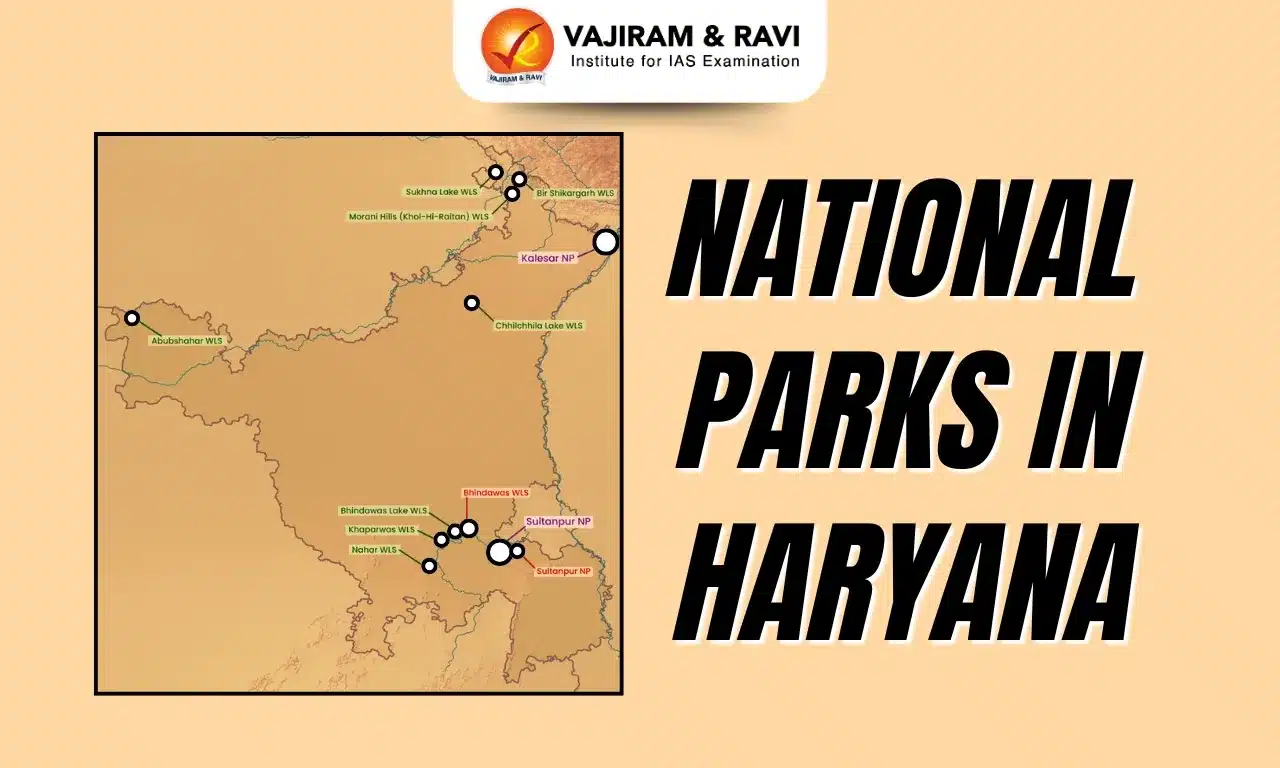
There are two National Parks in Haryana covering a combined area of 4,824.84 hectares. These parks represent wetland and Shivalik forest ecosystems and hold high ecological significance. Sultanpur National Park is a globally important wetland for migratory birds, while Kalesar National Park preserves dense Sal forests and Himalayan foothill biodiversity. These parks are legally notified under Section 35 of the Wildlife Protection Act, ensuring strict protection of habitats, wildlife species, and ecological processes.
Protected Areas in Haryana
Haryana has a structured network of protected areas conserving forests, wetlands, wildlife corridors, and biodiversity-rich ecosystems across diverse geographical zones.
- National Parks: Highest protection status conserving ecosystems with strict restrictions.
- Wildlife Sanctuaries: Areas protecting wildlife with regulated human activities.
- Conservation Reserves: Buffer zones linking protected forests and wildlife corridors.
- Community Reserves: Community-managed areas conserving local biodiversity.
- Wetlands: Critical water ecosystems supporting migratory birds and aquatic life.
- Breeding Centres: Specialized facilities for endangered species conservation.
National Parks in Haryana
National Parks in Haryana and other protected areas are legally notified regions created to conserve wildlife, forests, wetlands, and ecological systems. They restrict human activities like hunting, mining, and deforestation to protect biodiversity. In India, these areas are notified under the Wildlife Protection Act 1972. Protected areas include National Parks, Wildlife Sanctuaries, Conservation Reserves, and Community Reserves. They safeguard endangered species, regulate ecosystems, support climate balance, and preserve natural heritage for scientific research, education, and sustainable eco-tourism.
Sultanpur National Park
Sultanpur National Park, located in Gurugram district, is a globally significant wetland bird habitat spread over 142.52 hectares and declared a National Park in India in 1991.
- Location: Situated 15 kilometers from Gurugram on Gurugram-Farukhnagar road.
- Legal Status: Declared National Park on 5 July 1991 under Wildlife Act.
- Bird Diversity: Records around 250 bird species annually.
- Migratory Birds: Hosts birds from Europe, Siberia, and Central Asia.
- Wetland Area: Expanded to 1.42 square kilometers from original sanctuary.
- Global Recognition: Identified by IUCN in 1969 for wetland importance.
- Ramsar Status: Recognized as Ramsar wetland in August 2021.
Kalesar National Park
Kalesar National Park lies in Yamunanagar district within Shivalik foothills, covering 4,682.32 hectares and declared a National Park on 8 December 2003.
- Geographic Location: Situated between Yamuna River and Shivalik ranges.
- Forest Type: Dominated by Sal, Khair, and mixed deciduous forests.
- Faunal Diversity: Supports leopard, sambar, chital, goral, python, and king cobra.
- Connectivity: Shares ecological corridor with Rajaji National Park.
- Ecological Role: Prevents soil erosion and flash floods in plains.
- Mammal Records: Hosts around 20 to 22 leopards.
- Visitor Facility: Jeep safari permitted under forest department regulation.


Wildlife Sanctuaries in Haryana
Wildlife Sanctuaries in Haryana form the backbone of the state’s biodiversity conservation framework. Spread across plains, wetlands, Shivalik foothills, and semi-arid regions, these sanctuaries protect birds, mammals, reptiles, and plant species. Haryana has officially notified wildlife sanctuaries covering a total area of 23,441.17 hectares. These sanctuaries support migratory birds, grassland species, wetland fauna, and forest-dwelling animals while maintaining ecological balance and providing habitats critical for endangered species survival.
Wildlife Sanctuaries in Haryana List
Haryana has multiple wildlife sanctuaries protecting wetlands, forests, grasslands, and wildlife corridors critical for biodiversity conservation and ecological stability.
- Kalesar Wildlife Sanctuary: Located in Yamunanagar, covering 5,435.72 hectares, protecting Shivalik forests, medicinal plants, leopards, sambar, chital, goral, and serving as buffer for Kalesar National Park.
- Bir Shikargah Wildlife Sanctuary: Spread across 767.30 hectares in Panchkula, supporting wild boar, nilgai, langur, peafowl, and acting as an important forest refuge near urban areas.
- Chhilchhila Wildlife Sanctuary: A 28.92-hectare wetland near Kurukshetra, supporting waterbirds, peafowl, and migratory species, crucial for regional bird diversity and wetland conservation.
- Nahar Wildlife Sanctuary: Located in Rewari district with 211.35 hectares, protecting grassland fauna like nilgai, jackal, langur, and providing habitat connectivity in southern Haryana.
- Abubshahar Wildlife Sanctuary: Haryana’s largest sanctuary at 11,530.56 hectares in Sirsa, preserving semi-arid forests, desert wildlife, and acting as an ecological shield near Rajasthan border.
- Bhindawas Wildlife Sanctuary: Spread over 411.55 hectares in Jhajjar, Haryana’s largest wetland, supporting over 250 bird species and multiple globally threatened avian species.
- Khaparwas Wildlife Sanctuary: A 82.70-hectare wetland near Jhajjar, functioning as an important bird habitat and hydrological support system for surrounding agricultural areas.
- Khol Hi-Raitan Wildlife Sanctuary: Located in Panchkula with over 2,226 hectares, conserving Shivalik forests, wildlife corridors, and diverse avifauna near Morni hills.
Ramsar Site in Haryana
Haryana has two internationally recognized Ramsar wetlands supporting migratory birds, biodiversity conservation, and sustainable wetland ecosystems. Both sites were added under Ramsar Convention signed in 1971. They maintain water regulation, flood control, and bird migration routes.
- Sultanpur National Park: Ramsar-listed in 2021, supporting over 220 bird species, including globally endangered migratory waterfowl during winter migration cycles.
- Bhindawas Wildlife Sanctuary: Ramsar-listed in 2021, Haryana’s largest wetland, hosting more than 250 bird species and over 10 globally threatened birds.

 Last updated on Oct, 2026
→ UPSC 2027 Notification will be released on 13 January 2027 at upsconline.nic.in.
→ Asian Games 2026 are being held in Aichi-Nagoya, Japan, from 19 September to 4 October.
→ Check Nobel Prize 2026 Winners List here.
→ Download PIB PRiSM Monthly Magazine 2026 here.
→ Check UPSC Monthly Current Affairs Magazine The Recitals here.
→ Check out the latest UPSC Syllabus here.
→ Download UPSC Model Answers for Mains 2026
→ UPSC Mains Question Paper 2026 is out now for Essay & GS Paper 1, 2, 3 & 4.
→ UPSC Calendar 2027 has been released.
→ Enroll in Vajiram & Ravi’s UPSC Mains Test Series 2027 for structured answer writing practice, expert evaluation, and exam-oriented feedback.
→ Join Vajiram & Ravi’s UPSC Mentorship Program 2027 for personalized guidance, strategy planning, and one-to-one support from experienced mentors.
→ Go through the UPSC Mains Previous Year Papers to enhance your preparation.
→ UPSC has released UPSC Toppers List 2025 with the Civil Services final result on its official website.
→ Also check Best UPSC Coaching in India
National Parks in Haryana FAQs
Q1. How many National Parks are there in Haryana?+
Q2. Which is the largest National Park in Haryana?+
Q3. Which National Park in Haryana is famous for migratory birds?+
Q4. How many Ramsar sites are there in Haryana?+
Q5. Under which law are National Parks in Haryana protected?+
Tags: national parks in haryana