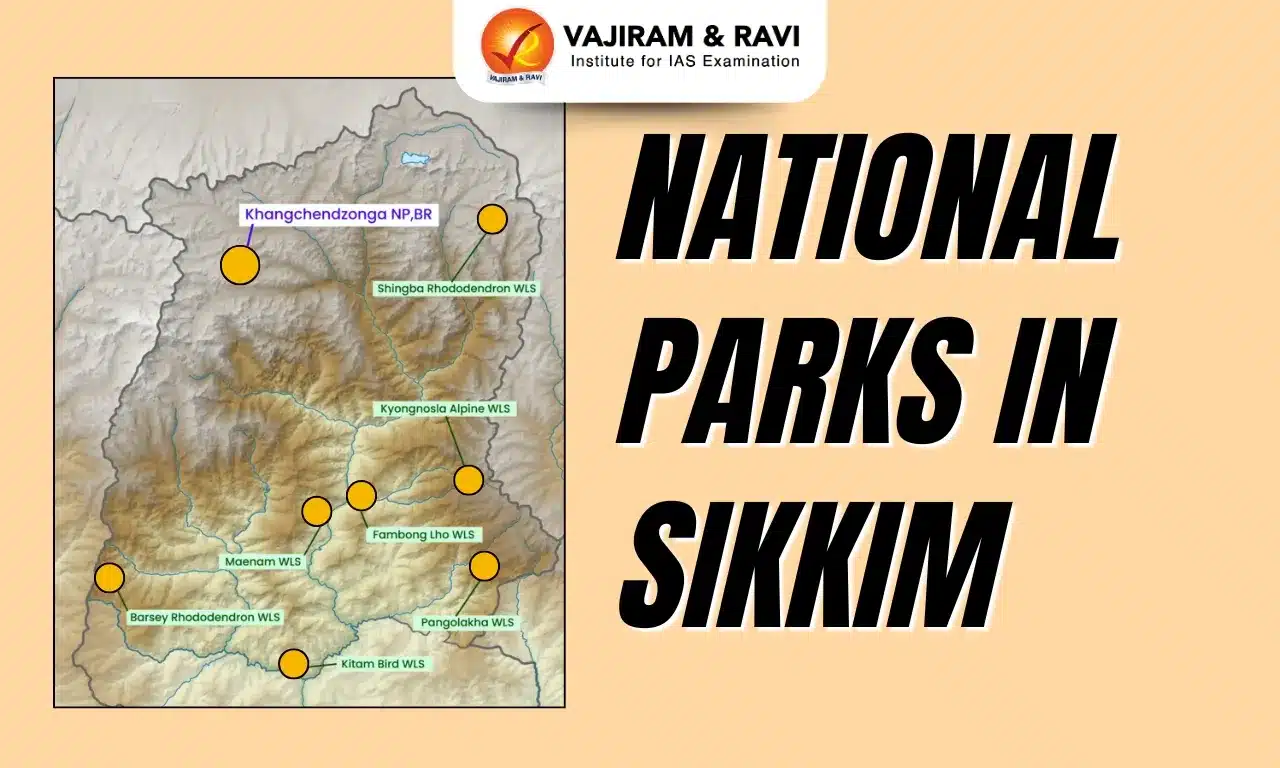
National Parks in Sikkim are legally notified regions established to conserve ecologically important landscapes, wildlife populations, plant diversity, and natural geological features. Under the Wildlife Protection Act 1972, State Governments can declare areas of significant ecological, faunal, floral, geomorphological, natural, or zoological value as protected zones. National Parks in India offer the highest protection, prohibiting human activities except those permitted for conservation purposes, while Wildlife Sanctuaries allow limited regulated activities. As of 2025, India currently has 107 National Parks covering 44,402.95 square kilometres and 574 Wildlife Sanctuaries spanning 127,241.24 square kilometres, ensuring long-term biodiversity security.
Protected Areas in Sikkim
Sikkim has a dense protected area network covering ecologically sensitive Himalayan landscapes with strict legal protection.
- Protected Area Network: Nine protected areas collectively cover 30.77% of Sikkim’s total geographical area.
- National Park Coverage: One National Park alone protects 1,784 square kilometres of alpine ecosystems.
- Wildlife Sanctuaries: Seven sanctuaries safeguard forests, wetlands, alpine meadows, and bird habitats.
- Conservation Reserve: One orchid-focused conservation reserve protects rare endemic plant species.
- Biosphere Integration: Protected areas integrate with Khangchendzonga Biosphere Reserve for landscape level conservation.
National Parks in Sikkim
There is only one National Park in Sikkim, but it is among India’s most ecologically significant and globally recognised conservation landscapes. Khangchendzonga National Park spans 1,784 square kilometres across North and West Sikkim and protects altitudes ranging from 1,400 metres to 8,585 metres, including Mount Kangchenjunga, the world’s third-highest peak. Declared a UNESCO World Heritage Site in 2016, it is India’s first “Mixed Heritage Site,” recognised for both natural and cultural values. The park forms the core of the Khangchendzonga Biosphere Reserve and plays a critical role in Himalayan biodiversity conservation.
Khangchendzonga National Park
Khangchendzonga National Park is Sikkim’s largest protected ecosystem, preserving pristine Himalayan wilderness. The key features of the Khangchendzonga National Park has been highlighted below:
- Geographical Extent: Covers 1,784 square kilometres across North and West Sikkim districts.
- Altitude Range: Elevation varies from 1,400 metres to 8,585 metres at Kangchenjunga peak.
- Global Recognition: Declared UNESCO World Heritage Site on 17 July 2016.
- Heritage Status: India’s first Mixed Heritage Site recognising natural and cultural values.
- Biosphere Core: Forms the core zone of Khangchendzonga Biosphere Reserve.
- Vegetation Zones: Supports temperate broadleaf, mixed forests, subalpine and alpine vegetation.
- Key Mammals: Home to snow leopard, red panda, Himalayan black bear, and musk deer.
- High-Altitude Fauna: Supports Himalayan blue sheep, takin, serow, goral, and Tibetan wild ass.
- Natural Boundaries: Bounded by Zemu Glacier, Lamaongden ridge, Mount Pandim, and Nepal Peak.
- Ecological Integrity: Remains largely untouched due to formidable natural geographical barriers.
Wildlife Sanctuaries in Sikkim
Sikkim’s seven Wildlife Sanctuaries protect diverse Himalayan ecosystems ranging from lowland forests to alpine zones. These sanctuaries collectively cover 399.10 square kilometres and support rare rhododendron species, migratory birds, alpine fauna, and critical wildlife corridors connecting protected landscapes across India, Nepal, and West Bengal. Declared under the Wildlife Protection Act 1972, these sanctuaries allow limited human activities while ensuring habitat protection, species conservation, and ecological stability across varying altitudinal gradients.


List of Wildlife Sanctuaries in Sikkim
The list of seven officially recognised Wildlife Sanctuaries in Sikkim has been given below:
- Barsey Rhododendron Sanctuary: Located in Singalila Range, protects vast rhododendron forests bordering Nepal and West Bengal.
- Fambong Lho Wildlife Sanctuary: Situated near Gangtok, conserves subtropical forests contiguous with Khangchendzonga National Park.
- Kyongnosla Alpine Sanctuary: East Sikkim sanctuary protecting alpine meadows between 3,292 and 4,116 metres altitude.
- Maenam Wildlife Sanctuary: South Sikkim sanctuary preserving temperate forests and critical wildlife corridors.
- Pangolakha Wildlife Sanctuary: Eastern Sikkim sanctuary connected to Neora Valley National Park of West Bengal.
- Shingba Rhododendron Sanctuary: North Sikkim sanctuary famous for high-altitude rhododendron species diversity.
- Kitam Bird Sanctuary: South Sikkim’s low-altitude bird sanctuary supporting migratory and resident avifauna.
Ramsar Site in Sikkim (Khachoedpalri Wetland)
Khachoedpalri Wetland is Sikkim’s first Ramsar Site, recognised for high-altitude wetland conservation. The key features of this site are given below:
- Ramsar Recognition: Declared Ramsar Site in 2024.
- Wetland Area: Covers 1.72 square kilometres of high-altitude Himalayan wetland ecosystem.
- Ecological Importance: Supports peatlands, temperate forests, and over 680 plant species.
- Key Wildlife: Habitat for endangered red panda and vulnerable Himalayan black bear.
- Cultural Significance: Sacred pilgrimage site with major ecological and tourism value in Sikkim.

 Last updated on Oct, 2026
→ UPSC 2027 Notification will be released on 13 January 2027 at upsconline.nic.in.
→ Asian Games 2026 are being held in Aichi-Nagoya, Japan, from 19 September to 4 October.
→ Check Nobel Prize 2026 Winners List here.
→ Download PIB PRiSM Monthly Magazine 2026 here.
→ Check UPSC Monthly Current Affairs Magazine The Recitals here.
→ Check out the latest UPSC Syllabus here.
→ Download UPSC Model Answers for Mains 2026
→ UPSC Mains Question Paper 2026 is out now for Essay & GS Paper 1, 2, 3 & 4.
→ UPSC Calendar 2027 has been released.
→ Enroll in Vajiram & Ravi’s UPSC Mains Test Series 2027 for structured answer writing practice, expert evaluation, and exam-oriented feedback.
→ Join Vajiram & Ravi’s UPSC Mentorship Program 2027 for personalized guidance, strategy planning, and one-to-one support from experienced mentors.
→ Go through the UPSC Mains Previous Year Papers to enhance your preparation.
→ UPSC has released UPSC Toppers List 2025 with the Civil Services final result on its official website.
→ Also check Best UPSC Coaching in India
National Parks in Sikkim FAQs
Q1. How many National Parks are there in Sikkim?+
Q2. Why is Khangchendzonga National Park globally important?+
Q3. How much of the area in Sikkim is under protected areas?+
Q4. How many Wildlife Sanctuaries exist in Sikkim?+
Q5. How many Ramsar Sites are there in Sikkim?+
Tags: national parks in sikkim