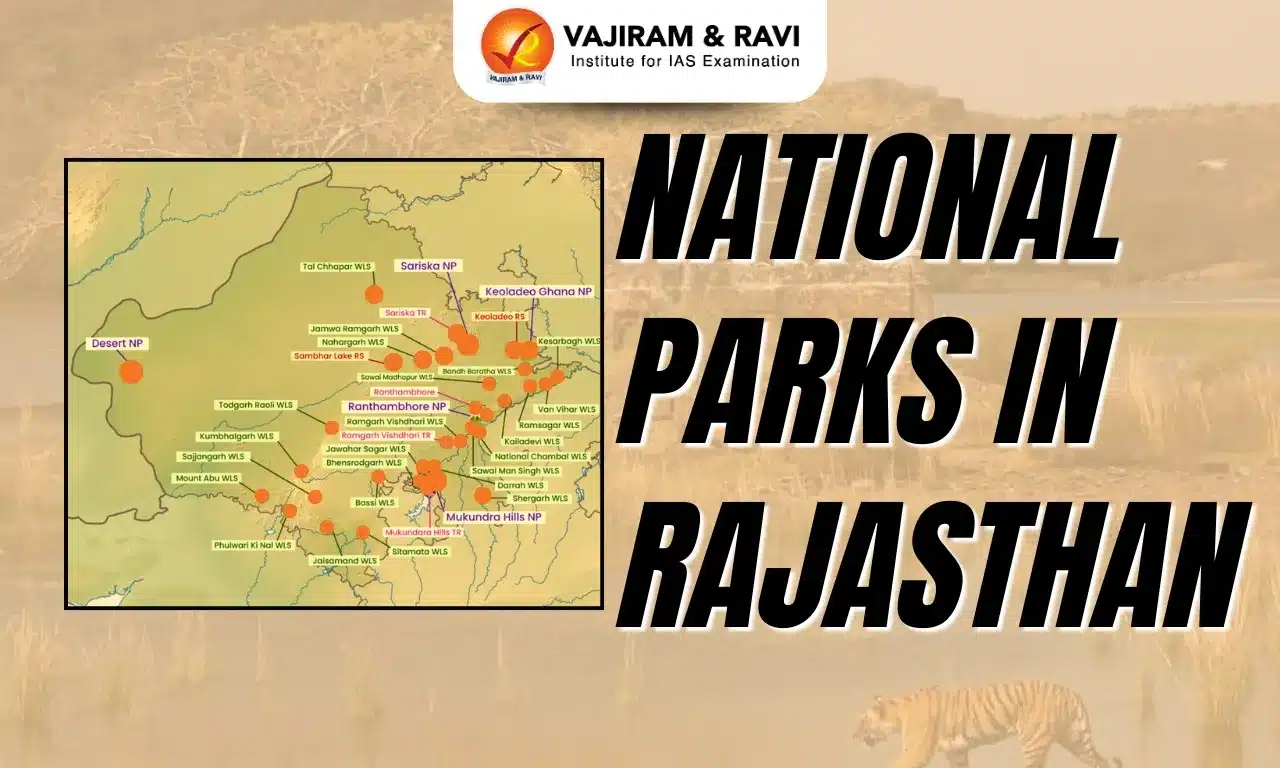
National Parks in Rajasthan are legally defined regions created to conserve ecosystems, wildlife species, and natural processes over the long term. According to the IUCN, protected areas are managed geographical spaces dedicated to biodiversity conservation with associated ecosystem services and cultural values. National Parks in India specifically focus on preserving large-scale ecological processes, native flora and fauna, and natural landscapes while supporting education, research, recreation, and eco-tourism in an environmentally responsible manner.
Protected Areas in Rajasthan
Rajasthan has an extensive protected area network conserving desert, Aravalli, wetland, and plateau ecosystems. These areas include: National Parks, Wildlife Sanctuaries, Tiger Reserves, Ramsar Sites, etc.
- Forest Area Coverage: Rajasthan has 32,639 sq km forest area, about 9.54% of its geography.
- Protected Area Network: Includes tiger reserves, national parks, wildlife sanctuaries, and Ramsar wetlands.
- Ecological Importance: Protects desert fauna, Aravalli biodiversity, wetlands, and riverine ecosystems.
- Conservation Challenge: Low per capita forest cover of only 0.02 hectares highlights ecological stress.
National Parks in Rajasthan
Rajasthan has three officially notified National Parks covering about 510.31 sq km. These parks conserve diverse ecosystems ranging from wetlands and dry deciduous forests to rocky plateaus. They play a crucial role in protecting flagship species like Bengal tiger, migratory birds, and grassland fauna. Despite low overall forest cover in the state, these National Parks act as biodiversity hotspots, support eco-tourism, and contribute significantly to wildlife research, habitat restoration, and long-term ecological stability in arid and semi-arid landscapes.
Keoladeo Ghana National Park
Keoladeo Ghana National Park in Bharatpur is a globally significant wetland ecosystem and UNESCO World Heritage Site.
- Location and Area: Situated in Bharatpur district, spread over 28.73 sq km.
- Wetland Nature: Artificial freshwater marshes flooded during monsoon support aquatic biodiversity.
- Bird Diversity: Hosts thousands of migratory birds including Siberian crane and sarus crane.
- Vegetation Type: Tropical dry deciduous forest, grasslands, and marsh vegetation.
- Conservation Status: Declared Ramsar Site and placed on Montreux Record due to ecological stress.
Mukundra Hills National Park
Mukundra Hills National Park is a critical dry deciduous forest and grassland ecosystem in southeastern Rajasthan.
- Location and Area: Located in Kota and Chittorgarh districts covering 199.55 sq km.
- Earlier Status: Formerly part of Darrah Wildlife Sanctuary complex.
- Habitat Type: Dry deciduous forests and open grasslands of Kathiawar-Gir ecoregion.
- Major Fauna: Bengal tiger, leopard, sloth bear, chital, sambar, and Indian wolf.
- Ecological Role: Important corridor linking tiger landscapes of southeastern Rajasthan.
Desert National Park
Desert National Park represents one of the finest examples of Thar Desert ecology in India.
- Location and Area: Spread across Jaisalmer and Barmer districts, covering 3,162 sq km.
- Landscape Type: Sand dunes, rocky terrain, thorn scrub, and grassland patches.
- Flora Composition: Dominated by sewan grass and hardy desert shrubs like aak.
- Flagship Species: Critically endangered Great Indian Bustard and desert fox.
- Conservation Value: One of the largest arid zone protected areas in the country.
Ranthambhore National Park
Ranthambhore National Park is among India’s most renowned tiger habitats located in eastern Rajasthan.
- Location and Area: Situated in Sawai Madhopur district, covering 282.03 sq km.
- River Boundaries: Bounded by Banas River in north and Chambal River in south.
- Vegetation Type: Dry deciduous forest interspersed with grasslands and lakes.
- Major Fauna: Bengal tiger, leopard, nilgai, sambar, and mugger crocodile.
- Conservation Issues: Faces challenges of overcrowding, habitat fragmentation, and human conflict.
Sariska National Park
Sariska National Park lies in the Aravalli hills and forms a critical tiger landscape in Rajasthan.
- Location and Area: Located in Alwar district with forested hills and valleys.
- Ecoregion: Part of Kathiawar-Gir dry deciduous forest zone.
- Vegetation: Arid forest, scrub-thorn woodland, and grassland ecosystems.
- Wildlife Diversity: Bengal tiger, leopard, jackal, chital, sambar, and rhesus macaque.
- Conservation History: Tiger population revived after reintroduction program in 2008.


Tiger Reserves in Rajasthan
Rajasthan has five notified tiger reserves covering about 5,980.88 sq km, strengthening landscape-level conservation.
- Ranthambore Tiger Reserve: Oldest reserve with high tiger density and tourism pressure.
- Sariska Tiger Reserve: Aravalli based reserve revived through tiger relocation program.
- Mukundara Hills Tiger Reserve: Newly established reserve supporting tiger dispersal corridors.
- Ramgarh Vishdhari Tiger Reserve: Acts as buffer and corridor between Ranthambore and Mukundara.
- Dholpur-Karauli Tiger Reserve: Riverine Chambal landscape enhancing eastern Rajasthan connectivity.
Wildlife Sanctuaries in Rajasthan
Rajasthan has a vast number of wildlife sanctuaries covering about 9,145.13 sq km, conserving diverse habitats. The major Wildlife Sanctuaries in Rajasthan has been listed here:
- Sariska Sanctuary: Aravalli forests supporting large mammals and avifauna.
- Darrah Sanctuary: Rocky plateau and forest habitat near Kota.
- Van Vihar Sanctuary: Small forest patch in Dholpur district.
- Jaisamand Sanctuary: Surrounds Dhebar Lake, one of India’s largest artificial lakes.
- Mount Abu Sanctuary: Highest biodiversity zone of Aravallis with altitude variation.
- Kumbhalgarh Sanctuary: Extensive Aravalli forest supporting wolves and leopards.
- Tal Chhapar Sanctuary: Grassland sanctuary famous for blackbuck conservation.
- Sitamata Sanctuary: Southern Rajasthan forest once considered for Asiatic lion.
- National Chambal Sanctuary: Riverine habitat protecting gharial and dolphins.
- Nahargarh Sanctuary: Forest near Jaipur city acting as urban green buffer.
- Jamwa Ramgarh Sanctuary: Man-made lake ecosystem near Jaipur.
- Jawahar Sagar Sanctuary: Chambal river dam ecosystem with crocodilian fauna.
- Desert National Park Sanctuary: Arid grassland protecting desert species.
- Ramgarh Vishdhari Sanctuary: Recently upgraded and linked with tiger corridors.
- Bhensrodgarh Sanctuary: Chambal riverine forest near Rana Pratap Sagar Dam.
- Kailadevi Sanctuary: Extension of Ranthambore forest landscape.
- Shergarh Sanctuary: Eastern Rajasthan forest adjoining Mukundara Hills.
- Todgarh Raoli Sanctuary: Aravalli forest stretch across multiple districts.
- Phulwari Ki Nal Sanctuary: Southern Aravalli hills near Gujarat border.
- Sawai Madhopur Sanctuary: Peripheral forest of Ranthambore Tiger Reserve.
- Sawai Man Singh Sanctuary: Buffer zone supporting Ranthambore wildlife movement.
- Band Baretha Sanctuary: Surrounds Baretha Dam supporting wetland biodiversity.
- Sajjangarh Sanctuary: Small hill sanctuary near Udaipur city.
- Bassi Sanctuary: Forest west of Mukundara Tiger Reserve.
- Ramsagar Sanctuary: Wetland ecosystem in Dholpur district.
- Kesarbagh Sanctuary: Small protected forest patch in Dholpur region.
Ramsar Site in Rajasthan
Rajasthan has four Ramsar-designated wetlands of international importance supporting migratory birds.
- Khichan Wetland: Famous wintering site for thousands of Demoiselle cranes.
- Menar Wetland: Community-conserved bird village near Udaipur.
- Keoladeo Wetland: Artificial marsh complex supporting global waterbird populations.
- Sambhar Lake: India’s largest inland saltwater lake and flamingo habitat.

 Last updated on Oct, 2026
→ UPSC 2027 Notification will be released on 13 January 2027 at upsconline.nic.in.
→ Check Nobel Prize 2026 Winners List here.
→ Download PIB PRiSM Monthly Magazine 2026 here.
→ Check UPSC Monthly Current Affairs Magazine The Recitals here.
→ Check out the latest UPSC Syllabus here.
→ Download UPSC Model Answers for Mains 2026
→ UPSC Mains Question Paper 2026 is out now for Essay & GS Paper 1, 2, 3 & 4.
→ UPSC Calendar 2027 has been released.
→ Enroll in Vajiram & Ravi’s UPSC Mains Test Series 2027 for structured answer writing practice, expert evaluation, and exam-oriented feedback.
→ Join Vajiram & Ravi’s UPSC Mentorship Program 2027 for personalized guidance, strategy planning, and one-to-one support from experienced mentors.
→ Go through the UPSC Mains Previous Year Papers to enhance your preparation.
→ UPSC has released UPSC Toppers List 2025 with the Civil Services final result on its official website.
→ Also check Best UPSC Coaching in India
National Parks in Rajasthan FAQs
Q1. How many National Parks are there in Rajasthan?+
Q2. Which National Park in Rajasthan is a UNESCO World Heritage Site?+
Q3. Which National Park is famous for tigers in Rajasthan?+
Q4. Which National Park represents the desert ecosystem in Rajasthan?+
Q5. How many Tiger Reserves are there in Rajasthan?+
Tags: national parks in rajasthan