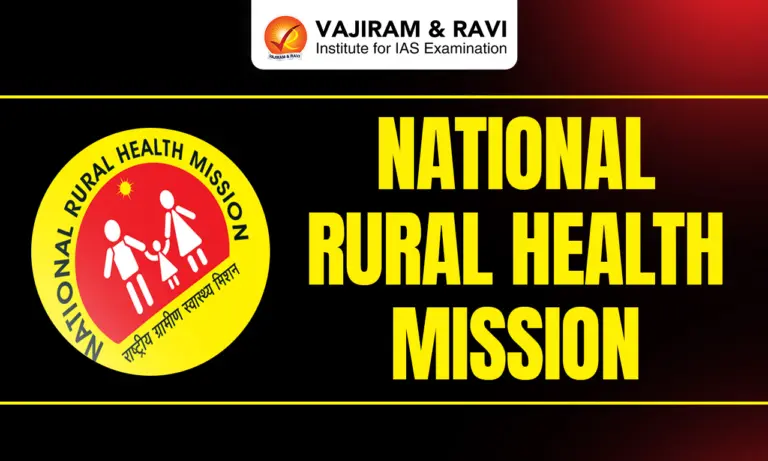
The National Rural Health Mission is a government programme launched to improve healthcare services in rural areas of India. It focuses on providing affordable and accessible medical care to people living in villages, especially the poor and vulnerable. The mission aims to strengthen rural health facilities, increase awareness about health and hygiene, and ensure better care for mothers and children. Overall, it works to improve the quality of life by making basic healthcare services available to everyone in rural communities.
About National Rural Health Mission
- The National Rural Health Mission (NRHM) was launched on 12th April 2005 by the Prime Minister to provide affordable, accessible, and quality healthcare to people living in rural areas, especially the poor and vulnerable sections of society.
- Later, on 1st May 2013, the government introduced the National Urban Health Mission as a sub-mission under the National Health Mission, where NRHM became the rural component of this larger mission.
- The main aim of NRHM is to ensure that people in villages get equal and quality healthcare services without facing financial burden, and special attention is given to Empowered Action Group (EAG) states, North-Eastern states, Jammu & Kashmir, and Himachal Pradesh, where health services are weaker.
- The mission focuses on building a strong, community-based and decentralized healthcare system, where local communities take part in managing health services, and different sectors like water, sanitation, education, nutrition, and gender equality work together to improve overall health.
- It also aims to improve the performance of healthcare facilities by following Indian Public Health Standards (IPHS) and ensuring better outcomes.
National Rural Health Mission Key Achievements
- More than 12 lakh additional healthcare workers were engaged between FY 2021-24 to strengthen health services.
- Around 220 crore COVID-19 vaccine doses were successfully administered across the country.
- Maternal Mortality Ratio (MMR) declined by 83% since 1990, which is higher than the global decline of 45%.
- Under-5 Mortality Rate reduced by 75%, better than the global reduction of 60%.
- Tuberculosis (TB) cases reduced from 237 per 1 lakh (2015) to 195 (2023), and the death rate declined from 28 to 22.
- Over 1.56 lakh Ni-kshay Mitra volunteers are helping around 9.4 lakh TB patients under the Pradhan Mantri TB Mukt Bharat Abhiyan.
- Around 1.72 lakh Ayushman Arogya Mandir Centres are functional by FY 2023-24.
- The National Sickle Cell Anemia Elimination Mission screened more than 2.61 crore people.
- India achieved 97.98% coverage in the Measles-Rubella vaccination campaign.
- Significant progress has been made in malaria control and Kala-azar elimination.
- The U-WIN digital platform was launched to track vaccination.
- The Pradhan Mantri National Dialysis Programme benefited over 4.53 lakh patients in FY 2023-24.


National Rural Health Mission Objectives
- To reduce Infant Mortality Rate (IMR) and Maternal Mortality Ratio (MMR) in rural areas.
- To achieve population stabilization and improve reproductive health.
- To prevent and control both communicable and non-communicable diseases.
- To promote traditional systems like AYUSH (Ayurveda, Yoga, Unani, Siddha, and Homeopathy) for a healthy lifestyle.
National Rural Health Mission Key Initiatives and Components
- ASHA (Accredited Social Health Activists): More than 8.84 lakh ASHA workers act as a bridge between rural communities and the healthcare system. They are often the first contact point, especially for women and children, helping people access medical services and increasing the use of public health facilities.
- Rogi Kalyan Samiti (Hospital Management Society): These are registered groups that manage hospital activities and ensure better patient care and financial management at the local level through a common fund.s
- Untied Grants to Sub-Centres: These grants help ANMs (Auxiliary Nurse Midwives) by providing essential equipment like BP machines, stethoscopes, and weighing machines, enabling better maternal and primary healthcare services.
- Village Health Sanitation and Nutrition Committee (VHSNC): Works at the grassroots level to improve health awareness, sanitation, and nutrition in villages and empowers local communities.
- Healthcare Service Delivery Strengthening: NRHM has addressed the shortage of health staff by providing around 1.7 lakh human resources, including doctors, specialists, nurses, and ANMs on a contractual basis.
- Mobile Medical Units (MMUs): Around 2024 mobile units are working in 459 districts, bringing healthcare services to remote and unserved areas.
- Emergency Transport Services: Free ambulance services are available across rural areas through a toll-free number, ensuring quick medical help within about 30 minutes, supported by over 12,000 vehicles.
- Janani Shishu Suraksha Karyakram (JSSK): This scheme provides completely free services for pregnant women and sick newborns in government hospitals, including transport, medicines, diagnostics, blood, and diet, promoting safe deliveries and child health.
National Rural Health Mission Significance
- Improves access to healthcare in rural areas by providing essential services closer to villages, especially in remote and underserved regions.
- Reduces financial burden on poor families by offering free or low-cost treatment and medicines through public health facilities.
- Strengthens rural healthcare infrastructure by upgrading health centres and increasing availability of doctors, nurses, and medical staff.
- Helps reduce Infant Mortality Rate (IMR) and Maternal Mortality Ratio (MMR) by improving maternal and child healthcare services.
- Promotes community participation through ASHA workers and local committees, making healthcare more effective and people-focused.
- Controls diseases and spreads awareness about hygiene, nutrition, and healthy lifestyles, improving overall rural health conditions.

 Last updated on Oct, 2026
→ UPSC 2027 Notification will be released on 13 January 2027 at upsconline.nic.in.
→ Check Nobel Prize 2026 Winners List here.
→ Download PIB PRiSM Monthly Magazine 2026 here.
→ Check UPSC Monthly Current Affairs Magazine The Recitals here.
→ Check out the latest UPSC Syllabus here.
→ Download UPSC Model Answers for Mains 2026
→ UPSC Mains Question Paper 2026 is out now for Essay & GS Paper 1, 2, 3 & 4.
→ UPSC Calendar 2027 has been released.
→ Enroll in Vajiram & Ravi’s UPSC Mains Test Series 2027 for structured answer writing practice, expert evaluation, and exam-oriented feedback.
→ Join Vajiram & Ravi’s UPSC Mentorship Program 2027 for personalized guidance, strategy planning, and one-to-one support from experienced mentors.
→ Go through the UPSC Mains Previous Year Papers to enhance your preparation.
→ UPSC has released UPSC Toppers List 2025 with the Civil Services final result on its official website.
→ Also check Best UPSC Coaching in India
National Rural Health Mission FAQs
Q1. What is the National Rural Health Mission?+
Q2. When was National Rural Health Mission launched?+
Q3. What are the main objectives of National Rural Health Mission?+
Q4. Who are the beneficiaries of National Rural Health Mission?+
Q5. What are the key initiatives under National Rural Health Mission?+
Tags: indian society indian society notes national rural health mission