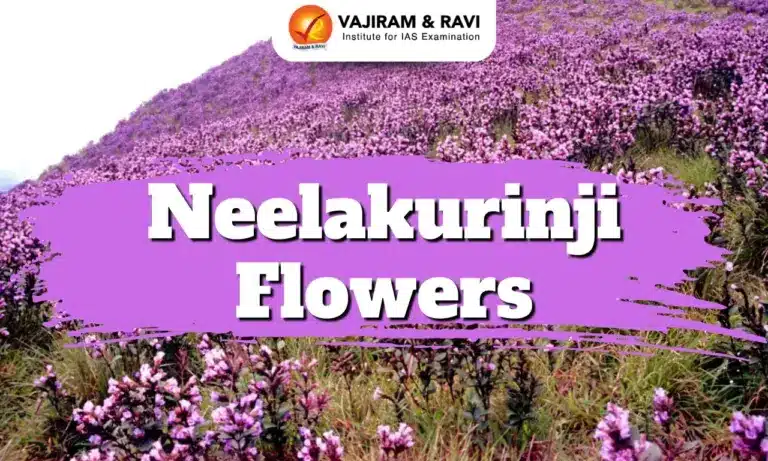
Neelakurinji Flowers are one of the rarest natural flowering phenomena in the world, known for their mass blooming once every twelve years across select high altitude regions of southwest India. Scientifically named Strobilanthes kunthiana, these flowers transform mountain grasslands into vast blue-purple landscapes. Endemic to India’s Shola Grassland ecosystems, Neelakurinji Flowers are ecologically significant and globally recognised for their unique life cycle, restricted distribution and increasing conservation concerns.
Neelakurinji Flowers
Neelakurinji Flowers refer to the mass flowering of Strobilanthes kunthiana, a semelparous shrub endemic to southwest India’s high altitude mountain landscapes. Strobilanthes kunthiana belongs to the Acanthaceae family and was first scientifically described in the nineteenth century by Nees von Esenbeck. Neelakurinji Flowers occur only in India, confined to five mountain landscapes of the Western and Eastern Ghats. The species flowers once every twelve years, reproduces only once in its lifetime, sets seeds and then dies. It recently bloomed in 2018.
Neelakurinji Flowers Features
Neelakurinji Flowers possess unique biological and ecological features that distinguish them from most flowering plants globally.
- Growth Form: The shrub generally grows 30-60 cm tall but can reach up to three metres under favourable ecological conditions.
- Habitat Range: Found at elevations between 1340 and 2600 metres within shola grassland ecosystems.
- Appearance: Produces dense clusters of purplish-blue flowers, giving the Nilgiri Mountains their name, meaning “Blue Mountains”.
- Population Distribution: Consists of 34 subpopulations across 14 ecoregions, with 33 in the Western Ghats and one in the Eastern Ghats.





Neelakurinji Flowers Significance
Neelakurinji Flowers hold ecological, conservation, cultural and scientific importance at regional and global levels.
- Ecological Indicator: Acts as a key indicator of ecosystem health in high altitude grasslands of the Western Ghats biodiversity hotspot.
- Biodiversity Support: Mass flowering attracts pollinators and supports wildlife, including the endangered Nilgiri Tahr.
- Conservation Status: Listed as Vulnerable under IUCN Red List Criteria A2c due to approximately 40% habitat loss.
- Major Threats: Habitat fragmentation from tea plantations, urban expansion, invasive species, tourism pressure and climate change.
- Cultural Relevance: The Paliyan tribal community uses the twelve year flowering cycle to calculate age and track generations.
- Protected Areas: Kurinjimala Sanctuary in Kerala protects nearly 32 square kilometres of core Neelakurinji habitat.

 Last updated on March, 2026
→ UPSC Final Result 2025 is now out.
→ UPSC has released UPSC Toppers List 2025 with the Civil Services final result on its official website.
→ Anuj Agnihotri secured AIR 1 in the UPSC Civil Services Examination 2025.
→ UPSC Marksheet 2025 is now out.
→ UPSC Notification 2026 & UPSC IFoS Notification 2026 is now out on the official website at upsconline.nic.in.
→ UPSC Calendar 2026 has been released.
→ Check out the latest UPSC Syllabus 2026 here.
→ UPSC Prelims 2026 will be conducted on 24th May, 2026 & UPSC Mains 2026 will be conducted on 21st August 2026.
→ The UPSC Selection Process is of 3 stages-Prelims, Mains and Interview.
→ Prepare effectively with Vajiram & Ravi’s UPSC Prelims Test Series 2026 featuring full-length mock tests, detailed solutions, and performance analysis.
→ Enroll in Vajiram & Ravi’s UPSC Mains Test Series 2026 for structured answer writing practice, expert evaluation, and exam-oriented feedback.
→ Join Vajiram & Ravi’s Best UPSC Mentorship Program for personalized guidance, strategy planning, and one-to-one support from experienced mentors.
→ Shakti Dubey secures AIR 1 in UPSC CSE Exam 2024.
→ Also check Best UPSC Coaching in India
Neelakurinji Flowers FAQs
Q1. What are Neelakurinji Flowers?+
Q2. Where are Neelakurinji Flowers found?+
Q3. Why do Neelakurinji Flowers bloom once in 12 years?+
Q4. What is the conservation status of Neelakurinji Flowers?+
Q5. Why are Neelakurinji Flowers important?+
Tags: neelakurinji flowers