What’s in today’s article?
- Why in News?
- WHO’s revised air quality guidelines 2021
- India’s National Ambient Air Quality Standards (NAAQS)
- Key highlights of the study
Why in News?
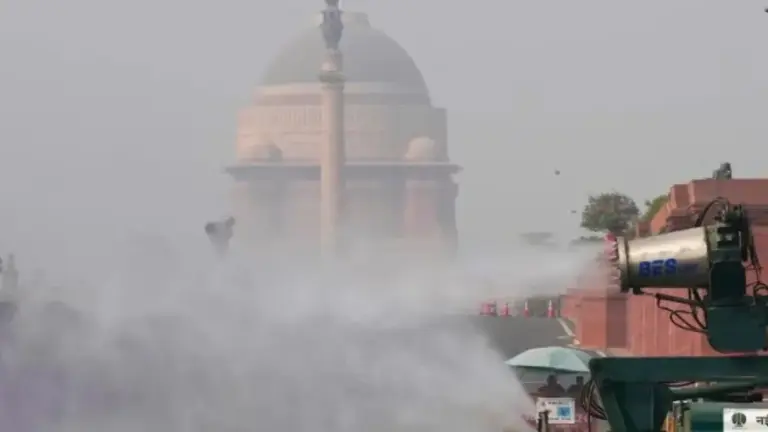
According to a study recently published in Lancet Planet Health, no one in India lives in areas where the yearly average pollution levels are below the levels recommended by the World Health Organization (WHO).







WHO’s revised air quality guidelines 2021

- About
- In September 2021, the World Health Organization (WHO) updated its air quality guidelines (AQGs) to reflect the serious health impacts of air pollution:
- PM2.5: The annual mean concentration should not exceed 5 µg/m3. This is half of the 2005 guideline of 10 µg/m3.
- NO2: The annual mean concentration should not exceed 10 µg/m3.
- Ozone: The peak season mean 8-hour concentration should not exceed 60 µg/m3.
- PM10: The annual mean concentration should not exceed 15 µg/m3, and the 24-hour mean should not exceed 45 µg/m3.
- SO2: The 24-hour mean concentration should not exceed 40 µg/m3.
- CO: The 24-hour mean concentration should not exceed 7 µg/m3.
- In September 2021, the World Health Organization (WHO) updated its air quality guidelines (AQGs) to reflect the serious health impacts of air pollution:
- Non-binding in nature
- The WHO AQGs are not legally binding, but they are often used by countries and legislative bodies to set air quality policies.
- The guidelines are based on scientific evidence from multiple countries and are intended to help reduce the health impacts of air pollution.
India’s National Ambient Air Quality Standards (NAAQS)
- Ambient air quality refers to the condition or quality of air surrounding us in the outdoors.
- Under the authority of the Air (Prevention and Control of Pollution) Act of 1981, India’s Central Pollution Control Board sets national ambient air quality standards.
- The current Standards include following 12 pollutants:

Key highlights of the study
- Widespread Air Pollution in India
- No area in India meets the WHO’s recommended PM2.5 pollution level of 5 µg/m³.
- 81.9% of the population lives in areas exceeding India’s National Ambient Air Quality Standards (NAAQS) of 40 µg/m³.
- Health Impact of Air Pollution
- High levels of PM2.5 are linked to 1.5 million deaths annually in India.
- Long-term exposure to air pollution increases risks of respiratory diseases, heart attacks, strokes, high blood pressure, and developmental delays in children.
- Every 10 µg/m³ increase in PM2.5 levels raises the risk of death by 8.6%.
- Regional Pollution Levels
- Pollution levels ranged from 11.2 µg/m³ in Arunachal Pradesh’s Lower Subansiri district (2019) to 119 µg/m³ in Ghaziabad and Delhi (2016).
- Potential for Improvement
- Meeting NAAQS could prevent 0.3 million deaths annually; achieving WHO levels would save even more lives.
- Identifying and addressing pollution sources, such as construction, vehicular emissions, and crop burning, is critical.
Q.1. How does air pollution affect health in India?
High PM2.5 levels cause respiratory issues, heart attacks, strokes, and developmental delays. Every 10 µg/m³ increase in PM2.5 raises mortality risk by 8.6%.
Q.2. What measures can reduce air pollution deaths in India?
Meeting NAAQS standards can prevent 0.3 million deaths annually. Reducing emissions from vehicles, construction, and crop burning is crucial for improvement.
News: Zero safe zones: No Indian city meets WHO air quality standards, says Lancet study | IS Global | Live Mint

 Last updated on April, 2026
→ UPSC Final Result 2025 is now out.
→ UPSC has released UPSC Toppers List 2025 with the Civil Services final result on its official website.
→ Anuj Agnihotri secured AIR 1 in the UPSC Civil Services Examination 2025.
→ UPSC Marksheet 2025 is now out.
→ UPSC Notification 2026 & UPSC IFoS Notification 2026 is now out on the official website at upsconline.nic.in.
→ UPSC Calendar 2026 has been released.
→ Check out the latest UPSC Syllabus 2026 here.
→ UPSC Prelims 2026 will be conducted on 24th May, 2026 & UPSC Mains 2026 will be conducted on 21st August 2026.
→ The UPSC Selection Process is of 3 stages-Prelims, Mains and Interview.
→ Prepare effectively with Vajiram & Ravi’s UPSC Prelims Test Series 2026 featuring full-length mock tests, detailed solutions, and performance analysis.
→ Enroll in Vajiram & Ravi’s UPSC Mains Test Series 2026 for structured answer writing practice, expert evaluation, and exam-oriented feedback.
→ Join Vajiram & Ravi’s Best UPSC Mentorship Program for personalized guidance, strategy planning, and one-to-one support from experienced mentors.
→ Shakti Dubey secures AIR 1 in UPSC CSE Exam 2024.
→ Also check Best UPSC Coaching in India