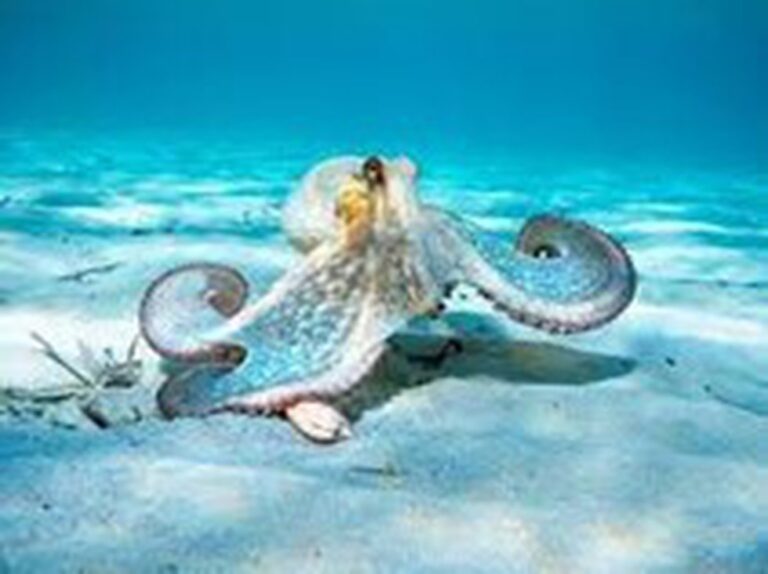
About Octopus nursery:
- The newly found nursery is almost two miles below the surface of the Pacific Ocean.
- This nursery belongs to the genus of Muusoctopus, and don’t have ink sacs – an organ found in most cephalopods.
Key facts about Octopus
- It is a marine mollusk and a member of the class Cephalopoda, more commonly called cephalopods.
- Cephalopoda means “head foot” in Greek, and in this class of organisms the head and feet are merged.
- A ring of eight equally-long arms surround the head. They use their arms to “walk” on seafloor.
- The undersides of the arms are covered with suction cups that are very sensitive to touch and taste.
- The sack-like body is perched atop the head, which has two complex and sensitive eyes, while the mouth is on the underside.
- They have three functioning hearts.
- Two of the hearts work exclusively to move blood to the gills, while the third pumps blood through the rest of the body.
- Their blood is copper-based which is more efficient at transporting oxygen at low temperatures and makes their blood blue in color.
- They are solitary creatures excellent at camouflaging and concealing themselves.
- They are about 90 percent muscle, and because they lack bones, they can fit through very small spaces.
- Their skin contains cells called chromatophores that allow the octopus to change color and pattern.
- They are found in every ocean of the world.
Q1) What are Cephalopods?
Cephalopods are a group of marine animals that belong to the class Cephalopoda. They are characterized by having a distinct head (cephalo-) and foot (-pod), which is often modified into arms or tentacles. Cephalopods include familiar creatures such as squids, octopuses, cuttlefish, and nautiluses.
Source: Third active Octopus nursery found beneath waves of Costa Rica. Watch






 Last updated on March, 2026
→ UPSC Final Result 2025 is now out.
→ UPSC has released UPSC Toppers List 2025 with the Civil Services final result on its official website.
→ Anuj Agnihotri secured AIR 1 in the UPSC Civil Services Examination 2025.
→ UPSC Marksheet 2025 is now out.
→ UPSC Notification 2026 & UPSC IFoS Notification 2026 is now out on the official website at upsconline.nic.in.
→ UPSC Calendar 2026 has been released.
→ Check out the latest UPSC Syllabus 2026 here.
→ UPSC Prelims 2026 will be conducted on 24th May, 2026 & UPSC Mains 2026 will be conducted on 21st August 2026.
→ The UPSC Selection Process is of 3 stages-Prelims, Mains and Interview.
→ Prepare effectively with Vajiram & Ravi’s UPSC Prelims Test Series 2026 featuring full-length mock tests, detailed solutions, and performance analysis.
→ Enroll in Vajiram & Ravi’s UPSC Mains Test Series 2026 for structured answer writing practice, expert evaluation, and exam-oriented feedback.
→ Join Vajiram & Ravi’s Best UPSC Mentorship Program for personalized guidance, strategy planning, and one-to-one support from experienced mentors.
→ Shakti Dubey secures AIR 1 in UPSC CSE Exam 2024.
→ Also check Best UPSC Coaching in India