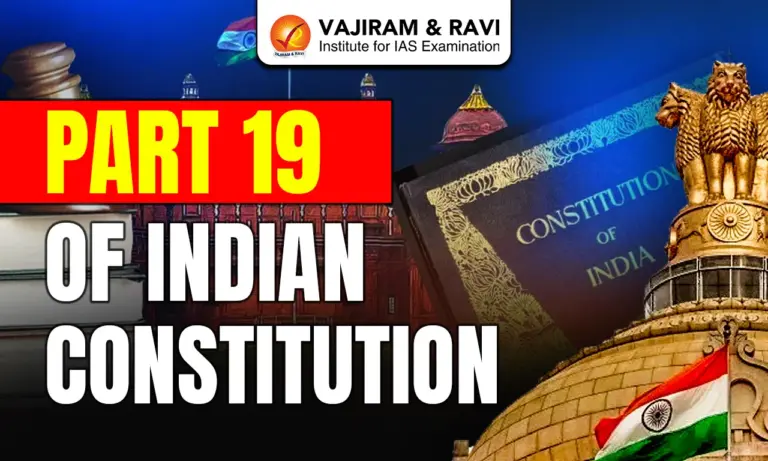
Part 19 of Indian Constitution contains miscellaneous provisions that grant immunities to high constitutional authorities and provide interpretative and transitional provisions to ensure smooth constitutional functioning.
Part 19 of Indian Constitution Related Articles
- Article 361 deals with protection of the President and Governors.
- Article 361A provides protection for publication of parliamentary proceedings.
- Article 361B disqualifies defectors from holding remunerative political posts.
- Article 362 (repealed) earlier dealt with rights and privileges of rulers of Indian States.
- Article 363 bars courts from interfering in disputes related to pre-Constitution treaties and agreements.
- Article 363A abolishes recognition of rulers and privy purses.
- Article 364 relates to special provisions regarding major ports and aerodromes.
- Article 365 provides consequences of failure to comply with Union directions.
- Article 366 contains definitions of constitutional terms.
- Article 367 provides rules for interpretation of the Constitution.
Article 361 Protection of the President and Governors
- Article 361 grants constitutional immunity to the President of India and the Governors of States in respect of their official acts.
- They are not answerable to any court for the exercise and performance of their powers and duties.
- No criminal proceedings can be initiated against them during their term of office.
- However, civil proceedings relating to personal acts may be instituted after giving two months’ prior notice.
This protection is intended to ensure that these constitutional authorities can perform their duties independently and without fear of litigation.
Article 361A Protection of Publication of Parliamentary Proceedings
- Article 361A provides legal protection to persons publishing a substantially true report of proceedings of Parliament or State Legislatures.
- This protection does not apply to secret sittings.
Article 361B Disqualification for Remunerative Political Post
- Article 361B states that a member disqualified under the Tenth Schedule (anti-defection law) is also disqualified from being appointed to any remunerative political post.
- This provision was introduced to prevent defectors from being rewarded with office and to strengthen the anti-defection framework.
Article 362 (Repealed)
Article 362 originally required the State to respect the rights and privileges of former rulers of Indian States. However, it was repealed by the 26th Constitutional Amendment Act, 1971, which abolished privy purses and ended official recognition of princely rulers.
Article 363 Bar to Interference by Courts
Article 363 bars courts from adjudicating disputes arising out of treaties, agreements, or covenants entered into before the commencement of the Constitution between the Government of India and rulers of Indian States. These matters were treated as political rather than judicial issues.
Article 363A Abolition of Privy Purses
Article 363A abolished the recognition of rulers of Indian States and discontinued privy purses and privileges granted to them after independence. This marked the completion of political integration and reinforced the principle of equality in a democratic republic.
Article 364 Special Provisions Regarding Major Ports and Aerodromes
Article 364 empowers the President to issue directions concerning the administration of major ports and aerodromes in certain circumstances.
Article 365 Effect of Failure to Comply with Union Directions
Article 365 provides that if a State fails to comply with or give effect to directions given by the Union, the President may consider that a situation has arisen in which the government of the State cannot be carried on in accordance with the Constitution. This provision is closely connected with the imposition of President’s Rule under Article 356.
Article 366 Definitions
Article 366 provides definitions of various constitutional terms such as “Scheduled Castes,” “Scheduled Tribes,” and other expressions used throughout the Constitution. These definitions ensure clarity and uniform interpretation.
Article 367 Interpretation
Article 367 lays down rules for interpreting the Constitution and refers to the General Clauses Act, 1897 for guidance in understanding terms and expressions. It helps avoid ambiguity in constitutional interpretation.
Part 19 of Indian Constitution Related Constitutional Amendments
Here we have discussed all the constitutional amendments related to Part 19 of Indian Constitution.
26th Constitutional Amendment Act, 1971
- This amendment repealed Article 362 and inserted Article 363A.
- It abolished the recognition of rulers of Indian States and discontinued privy purses and privileges.
44th Constitutional Amendment Act, 1978
- This amendment inserted Article 361A.
- It provided constitutional protection for the publication of substantially true reports of parliamentary and state legislature proceedings.
91st Constitutional Amendment Act, 2003
- This amendment inserted Article 361B.
- It disqualified members who are disqualified under the Tenth Schedule (anti-defection law) from being appointed to any remunerative political post, thereby strengthening the anti-defection framework.





Part 19 of Indian Constitution Related Case Laws
- Rameshwar Prasad v. Union of India (2006): The Supreme Court held that although the Governor enjoys immunity under Article 361, his actions and reports can be judicially reviewed, and constitutional immunity does not place his decisions beyond scrutiny.
- S.R. Bommai v. Union of India (1994): While primarily related to Article 356, the Court clarified that Article 365 does not give absolute power to the Union, and the President’s satisfaction regarding failure of constitutional machinery is subject to judicial review.
- Madhav Rao Scindia v. Union of India (1971): The Supreme Court struck down the Presidential order abolishing privy purses, leading to the 26th Constitutional Amendment and insertion of Article 363A abolishing recognition of rulers and privy purses.
- Kehar Singh v. Union of India (1989): The Court held that although the President enjoys immunity under Article 361, the exercise of his powers (such as pardon under Article 72) can be subject to limited judicial review.
- P.V. Narasimha Rao v. State (1998): The Supreme Court interpreted constitutional immunities relating to legislative functioning and clarified the scope of protection for actions connected with parliamentary proceedings, relevant to Article 361A.
- Raja Ram Pal v. Hon’ble Speaker, Lok Sabha (2007): The Court held that even though parliamentary proceedings enjoy protection, they are not completely immune from judicial review if there is a substantive constitutional violation, reinforcing constitutional supremacy.

 Last updated on March, 2026
→ UPSC Final Result 2025 is now out.
→ UPSC has released UPSC Toppers List 2025 with the Civil Services final result on its official website.
→ Anuj Agnihotri secured AIR 1 in the UPSC Civil Services Examination 2025.
→ UPSC Marksheet 2025 is now out.
→ UPSC Notification 2026 & UPSC IFoS Notification 2026 is now out on the official website at upsconline.nic.in.
→ UPSC Calendar 2026 has been released.
→ Check out the latest UPSC Syllabus 2026 here.
→ UPSC Prelims 2026 will be conducted on 24th May, 2026 & UPSC Mains 2026 will be conducted on 21st August 2026.
→ The UPSC Selection Process is of 3 stages-Prelims, Mains and Interview.
→ Prepare effectively with Vajiram & Ravi’s UPSC Prelims Test Series 2026 featuring full-length mock tests, detailed solutions, and performance analysis.
→ Enroll in Vajiram & Ravi’s UPSC Mains Test Series 2026 for structured answer writing practice, expert evaluation, and exam-oriented feedback.
→ Join Vajiram & Ravi’s Best UPSC Mentorship Program for personalized guidance, strategy planning, and one-to-one support from experienced mentors.
→ Shakti Dubey secures AIR 1 in UPSC CSE Exam 2024.
→ Also check Best UPSC Coaching in India
Part 19 of the Indian Constitution FAQs
Q1. What does Part 19 of the Indian Constitution deal with?+
Q2. Does the President enjoy immunity from legal proceedings?+
Q3. What happened to Article 362?+
Q4. What does Article 363 provide?+
Q5. What is the purpose of Article 365?+
Tags: part 19 of indian constitution parts of indian constitution