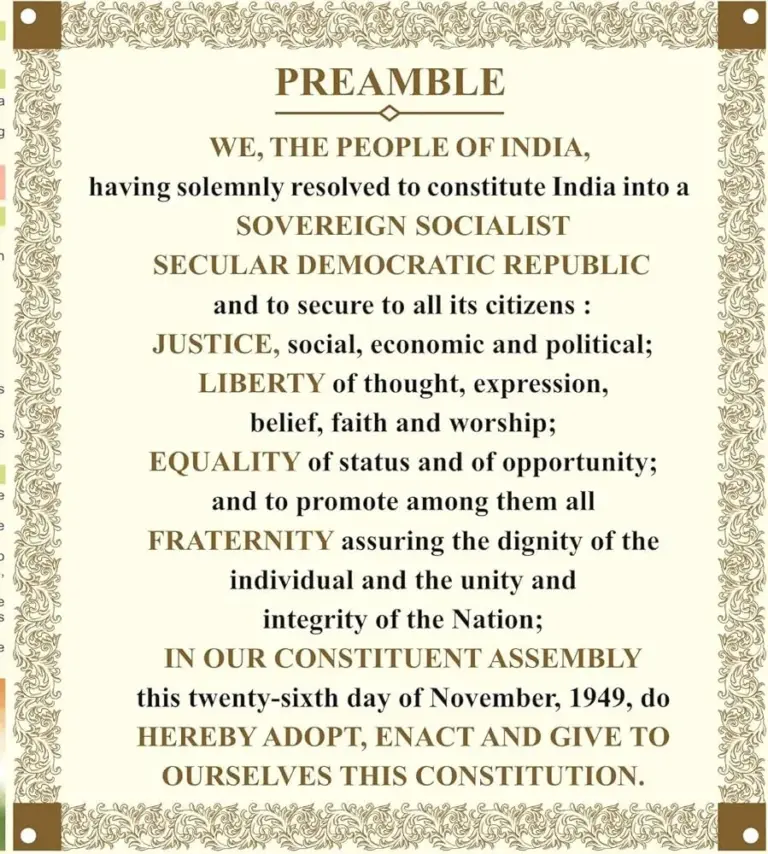
About Preamble of the Indian Constitution
- The preamble of the Indian Constitution serves as a brief introductory statement of the Constitution that sets out the guiding purpose, principles, and philosophy of the Indian Constitution.
- The Preamble is based on the Objectives Resolution’, drafted and moved by Jawaharlal Nehru and adopted by the Constituent Assembly on January 22, 1947.
- The Preamble reveals four ingredients or components:
- Source of authority of the Constitution: It is indicated by the Preamble that the source of authority of the Constitution lies with the people of India.
- Nature of the Indian State: It declares India to be a sovereign, socialist, secular, and democratic republic.
- Objectives of the Constitution: The objectives stated by the Preamble are to secure justice, liberty, and equality to all citizens and promote fraternity to maintain unity and integrity of the nation.
- Date of adoption of the Constitution: It stipulates November 26, 1949, as the date.
- Amendments: By the 42nd Amendment of 1976, the words “Socialist” and “Secular” were inserted; the Preamble now reads “Sovereign Socialist Secular Democratic Republic”.
- Interpretation by the Supreme Court:
- Berubari Union case: In this case, it was held by the Supreme Court that the Preamble is part of the Constitution. However, it recognised that the Preamble could be used as a guiding principle if a term in any article of the Constitution is ambiguous or has more than one meaning.
- Keshvananda Bharti v. State of Kerala: In this case, the Supreme Court overturned its earlier decision and held that the Preamble is a part of the Constitution and can be amended under Article 368 of the Constitution.
- Again, in the LIC of India case, the Supreme Court held that the Preamble is a part of the Constitution.
Q1) What is the Constituent Assembly of India?
The Indian Constitution was made by the Constituent Assembly, which came into existence as per the provisions of the Cabinet Mission of May 1946. Its task was to formulate a Constitution for facilitating the appropriate transfer of sovereign power from British authorities to Indian hands. It comprised members who were partly elected and partly nominated. The elected members were indirectly elected by members of the provincial legislative Assembly, who were elected on the limited franchise.
Source: Could Preamble have been amended without altering Constitution’s adoption date, SC asks






 Last updated on March, 2026
→ UPSC Final Result 2025 is now out.
→ UPSC has released UPSC Toppers List 2025 with the Civil Services final result on its official website.
→ Anuj Agnihotri secured AIR 1 in the UPSC Civil Services Examination 2025.
→ UPSC Marksheet 2025 is now out.
→ UPSC Notification 2026 & UPSC IFoS Notification 2026 is now out on the official website at upsconline.nic.in.
→ UPSC Calendar 2026 has been released.
→ Check out the latest UPSC Syllabus 2026 here.
→ UPSC Prelims 2026 will be conducted on 24th May, 2026 & UPSC Mains 2026 will be conducted on 21st August 2026.
→ The UPSC Selection Process is of 3 stages-Prelims, Mains and Interview.
→ Prepare effectively with Vajiram & Ravi’s UPSC Prelims Test Series 2026 featuring full-length mock tests, detailed solutions, and performance analysis.
→ Enroll in Vajiram & Ravi’s UPSC Mains Test Series 2026 for structured answer writing practice, expert evaluation, and exam-oriented feedback.
→ Join Vajiram & Ravi’s Best UPSC Mentorship Program for personalized guidance, strategy planning, and one-to-one support from experienced mentors.
→ Shakti Dubey secures AIR 1 in UPSC CSE Exam 2024.
→ Also check Best UPSC Coaching in India