Critical Minerals Latest News
- The Quad nations—India, Australia, Japan, and the US—have launched a joint initiative to secure critical mineral supply chains amid growing concerns over China’s dominance and potential disruptions.
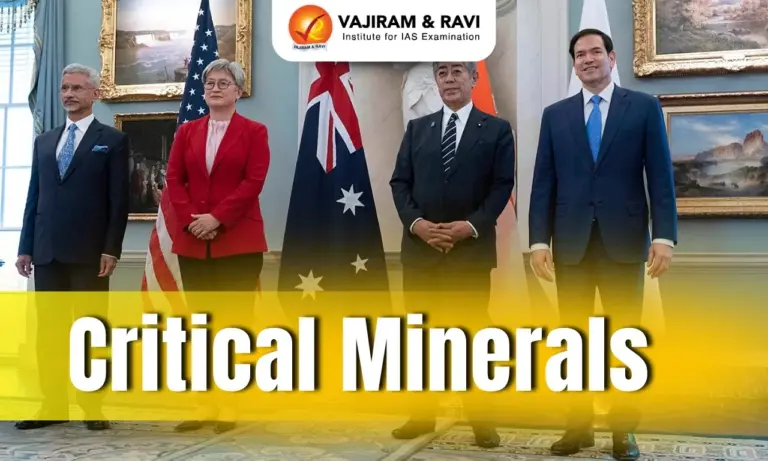
Quad Foreign Ministers Meet in Washington, DC
- The second Quad foreign ministers’ meeting took place in Washington, DC.
- During the meeting, members reaffirmed its commitment to four key areas: maritime and transnational security, economic prosperity and security, critical and emerging technologies, and humanitarian assistance.
- The ministers strongly condemned the Pahalgam terror attack, urging that the perpetrators, organisers, and financiers be brought to justice promptly.
Launch of Quad Critical Minerals Initiative
- The ministers launched the Quad Critical Minerals Initiative to secure supply chains and reduce dependency on China for essential resources.
Focus on Maritime and Logistics Cooperation
- The participating ministers also announced:
- The first Quad Indo-Pacific Logistics Network field training exercise to be held this year.
- The launch of the Quad Ports of the Future Partnership in Mumbai later this year.





Quad Critical Minerals Initiative
- India, Australia, Japan, and the United States have jointly launched the Quad Critical Minerals Initiative to build resilient and diversified supply chains for critical minerals vital to modern technologies.
- The initiative will enhance cooperation on securing and diversifying supply chains, recovering critical minerals from e-waste, and boosting private sector investment to strengthen supply chain resilience.
- Quad members expressed serious concerns about the growing dependency on China for processing and refining critical minerals, warning of risks like economic coercion, price manipulation, and supply disruptions.
China’s Dominance in Critical Minerals
- Critical minerals, including rare earth elements (REEs), are essential for advanced technologies like semiconductors, EVs, and jet fighters.
- China dominates the production of neodymium-iron-boron (NdFeB) magnets, which are vital for EV motors, power steering, braking, and more.
- Though rare earth metals are globally available, China leads in efficient processing—a position once held by the US and Japan.
- Japan has revived part of its mineral processing industry through policy measures, while the US and India remain largely dependent on Chinese exports.
Supply Chain Barriers Amid Geopolitical Tensions
- In response to US tariffs under President Trump, China imposed bureaucratic barriers and later restricted exports of key critical minerals.
- China has also restricted the export of several heavy rare earth elements and high-tech materials with potential military uses, intensifying supply chain concerns globally.
India’s EV Industry Hit by Chinese Export Curbs
- India’s emerging electric vehicle sector is facing production setbacks due to China’s restrictions on exporting rare earth magnets crucial for EV motors.
- Despite multiple requests, China has not approved any applications from Indian carmakers to source critical minerals, raising serious supply concerns.
- China mandates end-user licences and local government endorsements ensuring minerals won’t be used for military purposes—a major hurdle for Indian firms.
- Beijing is now urging foreign carmakers to purchase entire electric motor assemblies from Chinese suppliers, rather than just magnets.
- China has granted export permits to magnet producers serving companies like Volkswagen, reportedly after intense lobbying—something Indian firms have struggled to match.
G7 Action Plan Laid the Groundwork for Quad Critical Minerals Push
- The Quad Critical Minerals Initiative builds on the G7 Critical Minerals Action Plan announced in Canada, which India also endorsed.
- The G7 plan commits to partnering with emerging markets and developing countries to diversify supply chains and promote local value addition.
- G7 finance ministers pledged support for the World Bank-led Resilient and Inclusive Supply Chain Enhancement (RISE) initiative.
India’s National Critical Mineral Mission
- India’s Mines Ministry proposed external funding via RISE for its ₹16,300 crore National Critical Mineral Mission, which aims to strengthen exploration, overseas acquisition, R&D, and recycling.
- India joined the US-led Minerals Security Partnership (MSP) in June 2023.
- The MSP was formed in June 2022 with all G7 countries and a few others like Australia, South Korea, Finland, and Sweden.
- During PM Modi’s visit to Washington in February 2025, India and the U.S. signed the Transforming Relationship Utilizing Strategic Technology (TRUST) initiative to collaborate on mineral extraction and processing technologies.
- The TRUST agreement targets key minerals like lithium and rare earth elements, aiming to co-develop extraction and processing capabilities.

 Last updated on April, 2026
→ UPSC Final Result 2025 is now out.
→ UPSC has released UPSC Toppers List 2025 with the Civil Services final result on its official website.
→ Anuj Agnihotri secured AIR 1 in the UPSC Civil Services Examination 2025.
→ UPSC Marksheet 2025 is now out.
→ UPSC Notification 2026 & UPSC IFoS Notification 2026 is now out on the official website at upsconline.nic.in.
→ UPSC Calendar 2026 has been released.
→ Check out the latest UPSC Syllabus 2026 here.
→ UPSC Prelims 2026 will be conducted on 24th May, 2026 & UPSC Mains 2026 will be conducted on 21st August 2026.
→ The UPSC Selection Process is of 3 stages-Prelims, Mains and Interview.
→ Prepare effectively with Vajiram & Ravi’s UPSC Prelims Test Series 2026 featuring full-length mock tests, detailed solutions, and performance analysis.
→ Enroll in Vajiram & Ravi’s UPSC Mains Test Series 2026 for structured answer writing practice, expert evaluation, and exam-oriented feedback.
→ Join Vajiram & Ravi’s Best UPSC Mentorship Program for personalized guidance, strategy planning, and one-to-one support from experienced mentors.
→ Shakti Dubey secures AIR 1 in UPSC CSE Exam 2024.
→ Also check Best UPSC Coaching in India
Critical Minerals FAQs
Q1. What is the Quad Critical Minerals Initiative? +
Q2. Why is China’s dominance a concern? +
Q3. How does the initiative help India’s EV sector? +
Q4. What role does the G7 plan play? +
Q5. Which technologies depend on critical minerals? +
Tags: critical minerals mains articles upsc current affairs upsc mains current affairs