The Saddler University Commission(1917-19) was a turning point in the evolution of higher education in India. The commission examined the entire educational spectrum, recognising that meaningful reforms in universities were only possible if secondary education was simultaneously strengthened. Its recommendations focused on teaching universities, academic autonomy, specialisation and professional education, laying the groundwork for the modern university system in India. In this article, we are going to cover the Saddler University Commission, its historical background, objectives and recommendations.
Saddler Commission
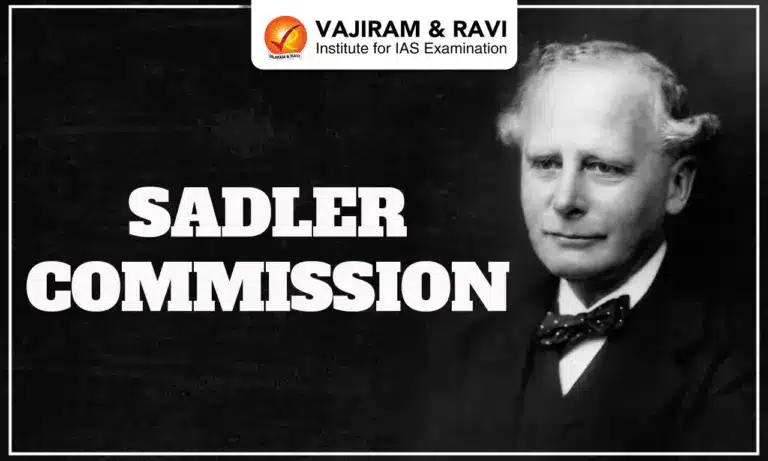
The Saddler University Commission was known as the Calcutta University Commission appointed in 1917 under the chairmanship of Dr. Michael E. Sadler, the Vice-Chancellor of the University of Leeds. The Commission got its name from him and became a landmark inquiry into the problems and prospects of higher education in India, with a focus on Calcutta University. The Commission didn’t restrict itself to immediate issues of university education alone. Instead it examined the complete educational structure from school to university level to make sure that reforms at the higher levels are not supported by a strong foundation at the secondary stage. The philosophy of the commission was that improving higher education was impossible without strengthening secondary education first. The reforms inspired by the commission not only reshaped Calcutta University but also left a lasting impact on the entire higher education landscape of India.
Saddler University Commission Background
- The Saddler University Commission was appointed in 1917 to study the state of Calcutta University, one of the best institutes of higher learning in India during that time.
- The Commission was headed by Dr. Michael E. Sadler, a well-known educationist, who assisted both British and Indian members. Important Indian members included Dr. Ziauddin Ahmad and Sir Ashutosh Mukherjee.
- The Commissions before the Saddler Commission, like the Hunter Commission (1882) focused mainly on secondary education, while the Indian Universities Commission (1902) looked narrowly at university affairs. The Saddler Commission adopted a much broader perspective.
- The Saddler Commission said that reforms introduced after the 1904 Universities Act had not laid the groundwork for a coherent university system. There remained gaps in the coordination between schools, colleges, and universities, as well as in teacher training and curriculum design.
- Although its findings were centered on Calcutta University, the recommendations were framed in a manner that could guide reforms across Indian universities.





Saddler University Commission Objectives
The Saddler University Commission was established to fulfil the following objectives:
- Assessing the current and future condition of Calcutta University.
- Relieving universities of the burden of supervising secondary education, thereby allowing them to focus exclusively on higher learning and research.
- Creating a framework for universities that promoted academic freedom, reduced government control, and improved overall quality of education.
Saddler University Commission Recommendations
The Saddler Commission made many recommendations that influenced the trajectory of Indian higher education:
- Teaching Universities
- Calcutta University should be reorganized as a full-fledged teaching and residential university, rather than functioning just as an affiliating and examining body.
- Expansion of Universities
- A separate teaching and residential university should be established at Dacca (now Dhaka).
- More universities should be opened in India, and existing ones should gradually evolve into residential and teaching universities.
- Autonomy and Academic Governance
- Universities should be granted freedom from excessive official control and interference by the government.
- New academic councils should be set up to deliberate on academic matters.
- The traditional governing bodies like the Senate and Syndicate were to be replaced with more effective structures such as the Court and Council.
- Administrative Reforms
- Appointment of a full-time salaried Vice-Chancellor as the chief executive officer of the university.
- Better organization of departments, faculties, boards of studies, and statutory academic bodies.
- Curriculum and Courses
- Introduction of Honours courses to promote specialization.
- Incorporation of tutorial and practical work alongside lectures.
- Provision for teaching in professional fields like engineering, medicine, law, agriculture, and technology.
- Inter-University Cooperation
- Establishment of an Inter-University Board to coordinate activities and standardize academic practices among Indian universities.
Saddler University Commission Impact
The Saddler Commission had long-lasting effects on the Indian education system. Its recommendations shaped policies and institutional structures in the years that followed. The impacts included:
- New Universities Established: Between 1916 and 1921, seven new universities were established. These universities were set up in Mysore, Patna, Banaras, Aligarh, Dacca, Lucknow, and Osmania.
- Strengthening Academic Activities: Introduction of Honours courses encouraged specialization and research. New departments were set up, and the position of professor was institutionalized.
- Improved University Administration: The establishment of Academic Councils improved curriculum design, examination reforms, and research oversight.
- Professional Education: Greater emphasis was put on fields like engineering, medicine, law, and agriculture, broadening the scope of university education.
- Vice-Chancellor’s Role: The concept of a full-time salaried Vice-Chancellor became an integral part of university governance.

 Last updated on March, 2026
→ UPSC Final Result 2025 is now out.
→ UPSC has released UPSC Toppers List 2025 with the Civil Services final result on its official website.
→ Anuj Agnihotri secured AIR 1 in the UPSC Civil Services Examination 2025.
→ UPSC Marksheet 2025 is now out.
→ UPSC Notification 2026 & UPSC IFoS Notification 2026 is now out on the official website at upsconline.nic.in.
→ UPSC Calendar 2026 has been released.
→ Check out the latest UPSC Syllabus 2026 here.
→ UPSC Prelims 2026 will be conducted on 24th May, 2026 & UPSC Mains 2026 will be conducted on 21st August 2026.
→ The UPSC Selection Process is of 3 stages-Prelims, Mains and Interview.
→ Prepare effectively with Vajiram & Ravi’s UPSC Prelims Test Series 2026 featuring full-length mock tests, detailed solutions, and performance analysis.
→ Enroll in Vajiram & Ravi’s UPSC Mains Test Series 2026 for structured answer writing practice, expert evaluation, and exam-oriented feedback.
→ Join Vajiram & Ravi’s Best UPSC Mentorship Program for personalized guidance, strategy planning, and one-to-one support from experienced mentors.
→ Shakti Dubey secures AIR 1 in UPSC CSE Exam 2024.
→ Also check Best UPSC Coaching in India
Sadler Commission FAQs
Q1. What is the purpose of the Sadler Commission?+
Q2. Who was the Chairman of the Sadler Commission?+
Q3. Who are the members of Sadler Committee?+
Q4. What was the gist of the Sadler Commission report of 1917?+
Q5. What was a result of the Sadler Report?+
Tags: sadler commission