Samudragupta was a powerful Gupta ruler who expanded the empire and strengthened Indian political unity. He ruled from about 330 to 380 CE and is seen as an ideal king of ancient India. He combined military strength with cultural excellence and laid the foundation of a prosperous imperial system. His achievements in warfare, administration and culture made the Samudragupta era a defining phase of early Indian history.
Samudragupta
Samudragupta was born into the Gupta dynasty to Chandragupta I. He was the second emperor of the dynasty and became one of the greatest emperors of ancient India.
- Parentage: Samudragupta was the son of Chandragupta I and the Licchavi princess Kumaradevi, which strengthened his political legitimacy through both Gupta and Licchavi lineages.
- Accession: He was chosen as successor by his father due to his qualities like courage, intelligence and leadership, even though other princes may have contested the throne.
- Early Struggles: After ascending the throne, Samudragupta faced revolts and opposition which he successfully suppressed, consolidating his authority in the initial phase of his reign.
- Personality: He was described as a warrior with numerous battle scars, symbolizing his participation in many wars and his personal bravery on the battlefield.
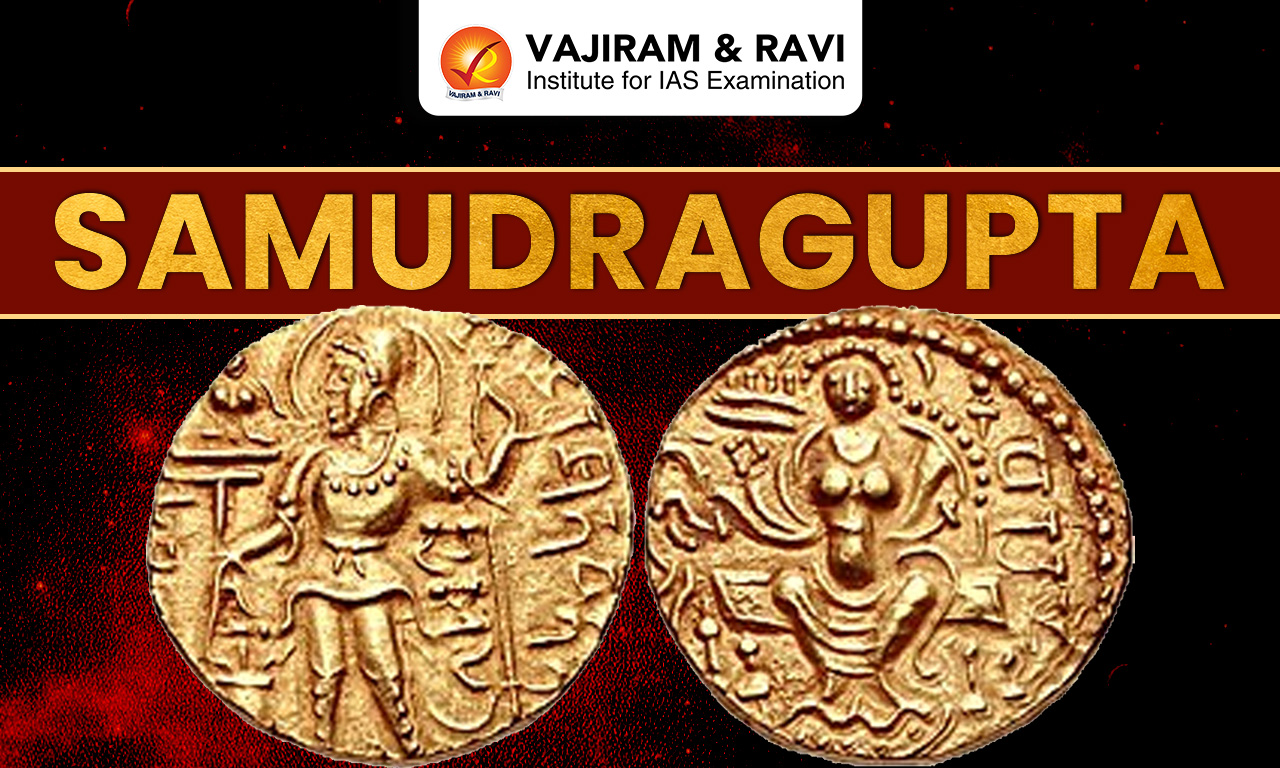
- Talents: Samudragupta was not only a conqueror but also a poet and musician, earning the title “Kaviraja” and being depicted playing the Veena on coins.
- Religious Inclination: He was a devout follower of Hinduism, especially devoted to Vishnu, yet showed tolerance towards other religions including Buddhism.
- Family: His son Chandragupta II succeeded him and continued his expansionist policies, further strengthening the empire.
- Title “Napoleon of India”: Historian V. A. Smith gave Samudragupta this title due to his extensive military campaigns, rapid conquests and unmatched ability to defeat numerous kings across northern and southern India.
Samudragupta Empire
Samudragupta built a vast empire through continuous conquests and political strategies, making his rule a turning point in Indian history.
- Time Period: He ruled approximately from 335/336 CE to 375/380 CE, marking a significant phase in the rise of the Gupta Empire.
- Extent of Empire: Samudragupta’s empire extended from the Brahmaputra River in the east to the Yamuna and Chambal in the west and from the Himalayan foothills to the Narmada River, covering fertile and densely populated regions.
- Core Regions: The central territories included the Ganga valley, which formed the economic and political heartland of Samudragupta’s rule, ensuring stability and strong administrative control over major cities and trade routes.
- Tributary States: Frontier regions like Assam, Nepal, eastern Bengal and parts of Punjab accepted his authority and paid tribute, maintaining local autonomy while acknowledging Samudragupta’s supremacy.
- Southern Policy: After defeating southern kings like Vishnugopa of Kanchipuram, Samudragupta restored them to power as tributaries, showing a flexible approach toward distant territories.
- Northern Annexations: Several northern rulers were defeated and their territories directly annexed into the empire, strengthening centralized authority and expanding territorial boundaries.


Administration under Samudragupta
Samudragupta maintained an efficient administrative system that ensured peace and prosperity across his vast empire.
- Central Authority: The king held supreme authority and supervised all administrative functions, ensuring effective governance and control over distant regions through trusted officials.
- Provincial Administration: Provinces enjoyed limited autonomy but remained under central supervision, helping maintain local efficiency while ensuring loyalty to the emperor.
- Officials and Governance: Administrative officers were appointed to manage revenue, law and order, ensuring smooth functioning of the state machinery across the empire.
- Military Control: A strong military system supported governance, preventing rebellions and maintaining internal security throughout Samudragupta’s reign.
Economy under Samudragupta
The economy during Samudragupta’s reign was prosperous, supported by agriculture, trade and advanced coinage systems.
- Agricultural Base: Fertile regions of the Ganga valley ensured high agricultural output, forming the backbone of the empire’s economy and supporting a large population.
- Trade and Commerce: Internal and external trade flourished due to political stability and control over key trade routes connecting different parts of the subcontinent.
- Gold Coinage: Samudragupta issued high quality gold coins with excellent craftsmanship, reflecting economic strength and advanced metallurgical knowledge.
- Types of Coins: Coins included Garuda type, Ashvamedha type and Veena playing type, each representing political achievements, religious rituals and cultural interests.
- Influence of Kushans: The coinage system adopted features from Kushan models, including weight standards and designs, showing continuity and adaptation in economic practices.
Art and Architecture under Samudragupta
Art and cultural expression flourished under Samudragupta, reflecting the intellectual richness of his reign.
- Patron of Literature: Samudragupta was known as Kaviraj due to his skills in Sanskrit poetry, showing his deep interest in literature and intellectual pursuits.
- Court Scholars: His court included notable scholars like Harisena, who composed the Prayag Prashasti, providing valuable historical information about his reign.
- Musical Talent: Coins depict Samudragupta playing the Veena, highlighting his abilities as a musician and his patronage of performing arts.
- Religious Architecture: He allowed construction of a Buddhist monastery at Bodh Gaya for the king of Ceylon, showing support for religious institutions.
- Cultural Growth: His reign saw a blend of art, literature and philosophy, contributing to the cultural richness of the Gupta period.
Society and Culture under Samudragupta
Society during Samudragupta’s time was structured yet culturally vibrant, influenced by religious and social developments.
- Brahmanical Influence: The period saw the strengthening of Brahmanism as a social and religious system, influencing social practices and hierarchy.
- Caste System: The Gupta rulers supported caste distinctions, which became more organized and influential in shaping social structure.
- Religious Tolerance: Despite being devoted to Vishnu, Samudragupta showed tolerance toward other religions, including Buddhism.
- Ashvamedha Yajna: He performed the Ashvamedha sacrifice to assert imperial authority and revive Vedic traditions, enhancing his political legitimacy.
- Cultural Integration: Interaction between regions through conquests and diplomacy promoted cultural exchange and unity across the empire.
Campaigns of Samudragupta
Samudragupta conducted extensive military campaigns that established his reputation as a great conqueror.
- Aryavarta Campaign: He defeated several northern kings and annexed their territories, strengthening the core region of his empire.
- Dakshinapatha Campaign: In the south, he defeated 12 rulers including those of Kosala, Kanchi and Vengi, but restored them as tributaries.
- Atavika States: Forest kingdoms were subdued and brought under control, ensuring security and expansion into central India.
- Frontier States: Regions like Assam, Nepal and Rajasthan accepted his authority and paid tribute, extending his influence beyond direct control.
- Military Achievements: He fought numerous battles, defeated 9 northern kings, subjugated 12 southern rulers and earned the title of an undefeated conqueror.

 Last updated on Oct, 2026
→ UPSC 2027 Notification will be released on 13 January 2027 at upsconline.nic.in.
→ Check Nobel Prize 2026 Winners List here.
→ Download PIB PRiSM Monthly Magazine 2026 here.
→ Check UPSC Monthly Current Affairs Magazine The Recitals here.
→ Check out the latest UPSC Syllabus here.
→ Download UPSC Model Answers for Mains 2026
→ UPSC Mains Question Paper 2026 is out now for Essay & GS Paper 1, 2, 3 & 4.
→ UPSC Calendar 2027 has been released.
→ Enroll in Vajiram & Ravi’s UPSC Mains Test Series 2027 for structured answer writing practice, expert evaluation, and exam-oriented feedback.
→ Join Vajiram & Ravi’s UPSC Mentorship Program 2027 for personalized guidance, strategy planning, and one-to-one support from experienced mentors.
→ Go through the UPSC Mains Previous Year Papers to enhance your preparation.
→ UPSC has released UPSC Toppers List 2025 with the Civil Services final result on its official website.
→ Also check Best UPSC Coaching in India
Samudragupta FAQs
Q1. Who was Samudragupta?+
Q2. Why is Samudragupta called the Napoleon of India?+
Q3. What is the Prayag Prashasti?+
Q4. What were the main achievements of Samudragupta?+
Q5. Who succeeded Samudragupta?+
Tags: ancient indian history samudragupta