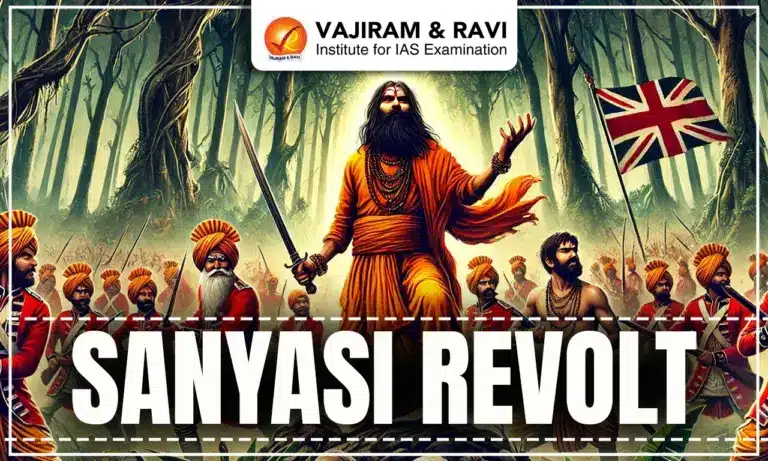
The Sanyasi Revolt was one of the earliest uprisings against British colonial rule in Bengal, occurring between 1770 and 1820. It was led primarily by Hindu ascetics, known as sanyasis, along with some Muslim fakirs, who resisted the oppressive taxation and economic exploitation imposed by the British East India Company following the Battle of Plassey (1757) and the Bengal Famine of 1770. This revolt marked one of the first organized movements of resistance against British authority in India.
Sanyasi Revolt
The Sanyasi Revolt was one of the earliest uprisings against British rule in India, taking place in Bengal during the late 18th century. It was led by Hindu monks known as Sanyasis, along with Muslim fakirs and local peasants, who protested against oppressive taxes and harsh policies imposed by the British. While it was not a highly organized political movement like the Revolt of 1857, it marked an early expression of Indian resistance.
The term “Sanyasi” refers to ascetics or monks who renounce worldly life. Many of these Sanyasis, primarily from northern India, traveled across Bengal collecting alms. When British authorities imposed strict controls and heavy taxation, the Sanyasis struggled to survive, prompting their resistance, which soon escalated into a widespread revolt.
Sanyasi Rebellion History
The Sanyasi Rebellion began around 1763 and continued into the early 1800s, primarily in Bengal and parts of North Bihar. The revolt gained momentum after the Battle of Buxar in 1764, when the British East India Company secured full control over Bengal. Following this, the British intensified revenue collection through local zamindars and imposed strict regulations on the population.
Before British rule, Sanyasis visited temples and collected religious offerings from landlords and farmers. However, under British policies, the heavy taxation and restrictions compounded the suffering caused by the Bengal famine of 1770, which claimed millions of lives. When the British barred Sanyasis from collecting alms and imprisoned many, the ascetics decided to resist, escalating their protests into a full-fledged revolt.
The Sanyasi Revolt is often described as both semi-religious and semi-political. While the rebels were not fighting for national independence, their opposition to economic exploitation laid the groundwork for future uprisings against colonial rule in India.





Sanyasi Revolt Causes
Several factors triggered the Sanyasi Revolt, primarily economic, religious, and political. The main causes include:
- Economic Exploitation: The British imposed heavy taxes on farmers and zamindars. Many peasants could not meet these demands and lost their lands. Even religious groups like the Sanyasis were forced to pay taxes or were prohibited from collecting donations.
- Famine of 1770: This catastrophic famine, one of the deadliest in Indian history, claimed nearly 10 million lives. Despite the widespread suffering, the British did not reduce taxes, which fueled resentment among the population.
- Religious Restrictions: The British viewed Sanyasis with suspicion, fearing that large gatherings of monks could threaten their authority. Consequently, they restricted the movement of Sanyasis and arrested many.
- Loss of Livelihood: Sanyasis relied on traveling and collecting alms for survival. British interference disrupted their traditional way of life, leaving them without a source of sustenance.
- Local Support: Many peasants, small landlords, and displaced individuals joined the Sanyasis. This local backing strengthened the revolt and enabled it to spread across various districts.
Sanyasi Revolt Major Events
The Sanyasi Revolt was not a single event but a prolonged series of uprisings across Bengal and parts of Bihar, spanning nearly four decades. Key events include:
- Early Clashes (1763-1770): The first signs of rebellion appeared in 1763 when Sanyasis clashed with Company officials. After the Battle of Buxar in 1764, their activities intensified, including looting treasuries and government offices.
- Attacks in Rangpur and Dinajpur (1770s): These districts saw some of the most significant Sanyasi attacks, targeting British establishments, tax collectors, and collaborators.
- Battle of 1771: In a major confrontation, the British army killed over 150 Sanyasis. This incident turned many locals against the Company and inspired additional Sanyasis to join the movement.
- Skirmishes until the 1800s: The revolt lacked a central leader or organized army. Sanyasis operated in small groups, employing guerrilla tactics, striking suddenly and retreating into forests.
Sanyasi Revolt Leaders
The Sanyasi Revolt did not have a single central leader, but numerous local figures guided the uprising across different regions. Some prominent names recorded in British documents and local legends include:
- Pandit Bhabani Charan Pathak: Also spelled Bhawani Sharan Pathak or Bhavanicharan Pathak, he was a Bhumihar from Jaso village in Buxar and is often regarded as the principal hero of the rebellion.
- Manju Shah Fakir: A Muslim fakir (Sufi saint) who collaborated with Hindu Sanyasis, demonstrating that the revolt transcended religious boundaries.
- Debi Chaudhurani: A legendary woman leader whose involvement highlights the role of women in early resistance against British rule.
- Musa Shah and Chirag Ali: Other notable participants who played significant roles in the revolt.
Sanyasi Revolt Impact
The Sanyasi Revolt, though it did not succeed in overthrowing British rule, had a lasting impact on Indian society and future resistance movements.
- Raised Consciousness: The revolt demonstrated that ordinary people including monks and farmers could rise against colonial exploitation.
- Unity Among Communities: Hindu and Muslim ascetics joined forces, showing that solidarity across religion and caste was possible.
- Inspiration for Literature: The rebellion influenced notable works such as Anandamath by Bankim Chandra Chatterjee, which introduced the iconic song Vande Mataram.
- Early Sign of Resistance: It made clear that British authority was not fully accepted, paving the way for larger uprisings like the Revolt of 1857.
- Changed British Policy: The colonial administration recognised that religious groups could pose political threats, leading to tighter controls over religious movements in Bengal and North India.
Sanyasi Revolt Outcomes
The Sanyasi Revolt was ultimately suppressed by the British, but its legacy endured.
- Suppression by British Army: By 1800, the revolt was crushed through military action, arrests, and legal measures.
- Inspired Later Revolts: The rebellion served as an inspiration for subsequent uprisings, including the Fakir Rebellion and various tribal revolts in eastern India.
Symbol of Resistance: Although it did not achieve victory, the revolt became a lasting symbol of protest against injustice and colonial exploitation.

 Last updated on March, 2026
→ UPSC Final Result 2025 is now out.
→ UPSC has released UPSC Toppers List 2025 with the Civil Services final result on its official website.
→ Anuj Agnihotri secured AIR 1 in the UPSC Civil Services Examination 2025.
→ UPSC Marksheet 2025 is now out.
→ UPSC Notification 2026 & UPSC IFoS Notification 2026 is now out on the official website at upsconline.nic.in.
→ UPSC Calendar 2026 has been released.
→ Check out the latest UPSC Syllabus 2026 here.
→ UPSC Prelims 2026 will be conducted on 24th May, 2026 & UPSC Mains 2026 will be conducted on 21st August 2026.
→ The UPSC Selection Process is of 3 stages-Prelims, Mains and Interview.
→ Prepare effectively with Vajiram & Ravi’s UPSC Prelims Test Series 2026 featuring full-length mock tests, detailed solutions, and performance analysis.
→ Enroll in Vajiram & Ravi’s UPSC Mains Test Series 2026 for structured answer writing practice, expert evaluation, and exam-oriented feedback.
→ Join Vajiram & Ravi’s Best UPSC Mentorship Program for personalized guidance, strategy planning, and one-to-one support from experienced mentors.
→ Shakti Dubey secures AIR 1 in UPSC CSE Exam 2024.
→ Also check Best UPSC Coaching in India
Sanyasi Revolt FAQs
Q1. Who started the Sanyasi revolt?+
Q2. What was the Sanyasi rebellion of 1763?+
Q3. Where was the chief centre of the Sanyasi revolt started in 1770?+
Q4. Who suppressed the Sanyasi revolt?+
Q5. Was the Sanyasi Revolt successful?+
Tags: sanyasi revolt