Sapinda Marriage
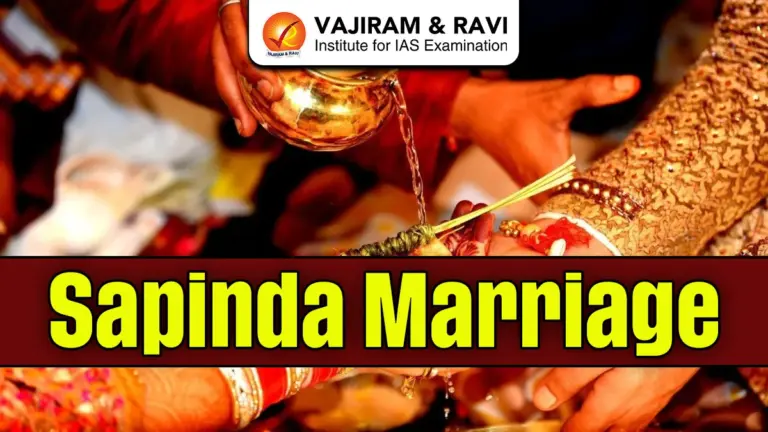
A sapinda marriage is a marriage between closely related individuals. For example, a man marrying his father’s brother’s daughter (i.e., his first cousin) is a sapinda marriage.
As per section 3 of Hindu Marriage Act (HMA), “Two persons are said to be sapindas of each other if one is a lineal ascendant (it means son, grandson) of the other, or if they have a common lineal ascendant who is within the limits of sapinda relationship.”
Constitutional Validity of Sapinda Marriages
Sapinda marriages are void by the Section 5(v) of the Hindu Marriage Act. Marriage is forbidden within three generations on Mother’s side. For Example, marriage between siblings, their parents, their grandparents. On Father’s Side, it extends to five generations.





Exceptions
Under Hindu Marriage Act, Sapinda Marriage is valid if the custom of each individual permits sapinda marriages.
The definition of the word “custom” is provided in Section 3(a) of the Hindu Marriage Act. As per the law, a custom must be continuously and uniformly observed for a long period to gain legitimacy among Hindu.
As per the Supreme Court in Thakur Gokal Chand v. Parvin Kumari (1952) customs should not be unreasonable or opposed to public policy. In the case of a rule that is applicable only to a certain family, the rule should not have been “discontinued by that family”.
Recent Supreme Court Judgements
Recently in Neetu Grover v. Union of India & Ors, 2024 case Supreme Court rejected a challenge to the constitutionality of Section 5(v) of the Hindu Marriage Act, 1955 (HMA), which prohibits marriage between two Hindus if they are “Sapindas” of each other.
Status of Sapinda Marriages in other Countries
In many countries, marriages within close blood relations – comparable to sapinda marriages under Hindu law – are regulated differently based on social, religious, and medical considerations.
In most Western countries such as the United States, the United Kingdom, Canada, and much of Europe, marriages between lineal relatives and siblings are strictly prohibited, while first-cousin marriages are either allowed or regulated at the state level, reflecting a more liberal approach.
In contrast, several West Asian and North African countries, including Saudi Arabia, Iran, and Egypt, legally permit consanguineous marriages, particularly first-cousin marriages, as they are socially and culturally accepted. Similarly, in Japan and South Korea, marriages between certain cousins are legally permissible.

 Last updated on March, 2026
→ UPSC Final Result 2025 is now out.
→ UPSC has released UPSC Toppers List 2025 with the Civil Services final result on its official website.
→ Anuj Agnihotri secured AIR 1 in the UPSC Civil Services Examination 2025.
→ UPSC Marksheet 2025 is now out.
→ UPSC Notification 2026 & UPSC IFoS Notification 2026 is now out on the official website at upsconline.nic.in.
→ UPSC Calendar 2026 has been released.
→ Check out the latest UPSC Syllabus 2026 here.
→ UPSC Prelims 2026 will be conducted on 24th May, 2026 & UPSC Mains 2026 will be conducted on 21st August 2026.
→ The UPSC Selection Process is of 3 stages-Prelims, Mains and Interview.
→ Prepare effectively with Vajiram & Ravi’s UPSC Prelims Test Series 2026 featuring full-length mock tests, detailed solutions, and performance analysis.
→ Enroll in Vajiram & Ravi’s UPSC Mains Test Series 2026 for structured answer writing practice, expert evaluation, and exam-oriented feedback.
→ Join Vajiram & Ravi’s Best UPSC Mentorship Program for personalized guidance, strategy planning, and one-to-one support from experienced mentors.
→ Shakti Dubey secures AIR 1 in UPSC CSE Exam 2024.
→ Also check Best UPSC Coaching in India
Sapinda Marriage FAQs
Q1. What is Sapinda Marriage?+
Q2. Is sapinda marriage legally valid in India?+
Q3. What are the exceptions to Sapinda Marriages?+
Q4. What happens if a sapinda marriage is performed without a valid custom?+
Q5. Has the constitutionality of the sapinda prohibition been challenged?+
Tags: sapinda marriage